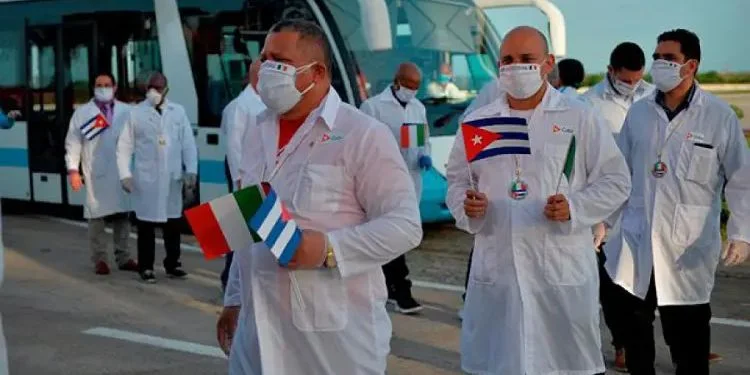
While the Cuban doctors retire, Antigua and Barbuda is already preparing to replace them with professionals from Ghana.
LIMA, Peru – After 25 years of “health cooperation” with the Castro regime, Antigua and Barbuda ended the agreement that allowed the hiring of Cuban doctors in the Caribbean country.
Suddenly, the Antiguans bid farewell to the Island’s doctors with a message of gratitude for the service provided and without offering further details about the event.
“The United Progressive Party (UPP) extends its deep gratitude, admiration and respect to the hundreds of medical professionals who have served the Nation of Antigua and Barbuda,” he wrote in a statement the organization.
The UPP described as “regrettable” the end of the “mutually beneficial” partnership that the two countries had forged, blaming the current Administration of Antigua and Barbuda for the “abrupt” measure.
The cancellation transcends after the inclusion of Antiguan nationals in the last travel ban issued by The White House in Washington, which restricted entry to the US to some 15 countries for reasons of national security.
But while the Cubans withdraw, Antigua and Barbuda is already preparing to replace them with professionals from Ghana, a process that the country’s authorities hope will be a “fluid, orderly and responsible transition,” according to media coverage. Antigua Observer.
Antiguan Health Minister Sir Molwyn Joseph said the Government has completed the recruitment of approximately 120 medical professionals to strengthen the delivery of public services.
“This new contingent of health workers, which is mainly made up of nurses and also a number of doctors, is being recruited in Ghana. The medical staff is expected to be fully deployed across the two-island country before the end of this year,” he said.
Other officials of the Council of Ministers assured that the transition between professionals from Cuba and Ghana is being managed with great care to guarantee continuity of care and avoid any interruption in essential health services for the population.
On the Cuban side, control is tight over doctors
In conversation with CubaNet, The director of the Cubalex Legal Information Center, Laritza Diversent, maintained that what Cuban doctors face on international missions fully fits the definition of modern slavery according to the conventions of the International Labor Organization (ILO) and international law.
“Forced labor and modern slavery are defined, among other things, by extreme vulnerability of the person,” Diversent explained. “And every person who lives in Cuba today is in a vulnerable situation, even if they have graduated from university.”
The jurist emphasizes: “When you threaten someone with their salary, with returning them to a place where they have worse conditions, then you are already abusing and using your power.” And he adds: “You implement an entire system where the threat is to return it to a place where there is a 72-hour blackout, where people do not have food, where they do not have money to access food or medicine… that is taking advantage of you.”
Diversent, who has interviewed numerous doctors who have participated in missions in different regions of the world, points out that the control over workers is systematic: “After 6:00 in the afternoon, [en algunos de los países donde cumplen misión] They have a kind of curfew. That curfew is not written, but from the operations center of the medical mission they call the houses where they are staying and do a roll call.”
The sanctions, he states, include everything from “a public reprimand in front of his colleagues” to a 10% deduction from his salary. In addition, doctors must report their movements and, in some cases, are forced to denounce colleagues who have defected. “If that is not control and lack of freedom“I don’t know what it will be,” said the lawyer.
For Diversent, it is particularly serious that doctors are forced to carry out activities outside their profession, such as “speaking well about the work carried out by the medical mission” or participating in propaganda acts. This, he warns, has a political impact: “Medical missions influence the electorate (…). If they are taking them to rural regions where other doctors do not want to go, that already influences the vote. Therefore, it is a political benefit for whoever is in power.”
Diversent concludes: “They do not share their salary voluntarily, they do it because they are in a condition of poverty. That is the basis of slavery. It is a form of modern slavery. You have to read the ILO conventions on forced labor to understand that what the Cuban doctor experiences in these missions is not cooperation, it is exploitation.”
“They [los médicos cubanos] “They are the last link in the chain,” says the lawyer. “The only solution is for them to come out and talk themselves.” [denuncien]. Unfortunately, they are under threat of being returned to Cuba and being prosecuted – their reality is cross-border repression – but the only thing they can do is continue talking to the independent press.”