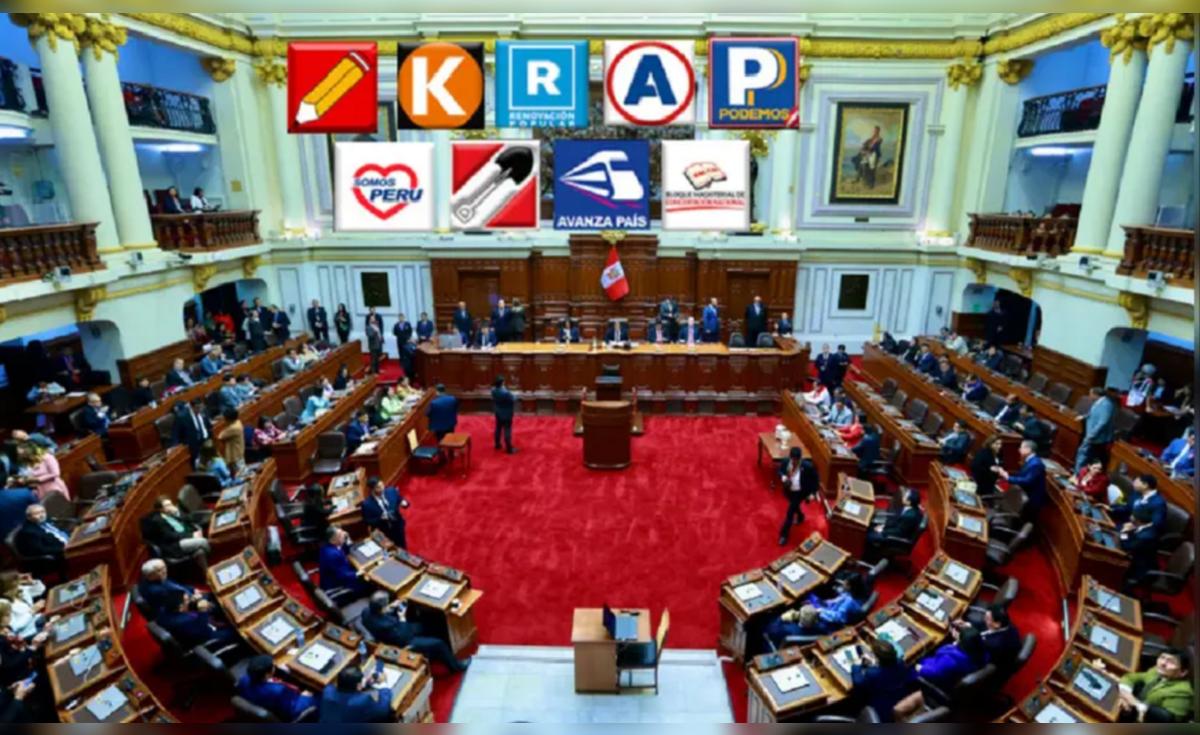
Although they had 10 years to comply with the requirement, the Plenary Session of Congress decided to benefit more than 3,000 professors from universities who do not have a master’s degree or a doctorate, as required by the University Law. They will be able to continue teaching on university campuses, without having those academic degrees, as long as the Executive publishes the law’s signature.
listen to the newsText converted to audio
Artificial intelligence
The story began in July 2014 when the University Law was promulgated, article 82 of which mandates that professors must possess a master’s degree for the undergraduate level and a doctorate for the postgraduate level.
WE RECOMMEND YOU
BYE LAVA JATO AND WHITE NECKS + ELECTIONS | WITHOUT SCRIPT WITH ROSA MARÍA PALACIOS
Thus, so that the teachers of the old University Law can comply with this new requirement, a period of five years was established that, at the beginning, had to start in July 2014. However, and after a ruling by the Constitutional Court (TC), this was only counted since November 2015.
In this way, November 2020 arrived and, since that date, Congress extended the deadline on several occasions because there were still 20% of professors who did not comply in public universities.
The last extension expired this month. However, a few days ago, they went further. On December 3, the Plenary approved an opinion, which groups five bills, to incorporate an exceptional provision in the University Law, with the aim of now making the requirement of a master’s degree and doctorate optional for teachers who taught before the current University Law. This will not apply to those who were appointed or hired after July 2014, as was already happening.
In addition to this, the Plenary – with the votes of all the parties – exonerated the teachers of the old University Law of having these academic degrees for entry and promotion in the public career. These changes will benefit the more than 3,000 professors who did not obtain a master’s degree or a doctorate, unlike the almost 13,000 who did achieve it at state universities.
Questions
“This is a mockery for the teachers who did comply with the requirement; especially for those from private universities,” said the director of Cappes, Jorge Mori, who is knowledgeable about the subject because he was a Minedu official.
Mori explained that the problem is that the most emblematic public universities, such as San Marcos, Villarreal, UNI and Gonzaga de Ica, They have a high number of non-compliance. “In practice, Congress is eliminating the obligation to have master’s degrees and doctorates for this group of professors and that is the responsibility of the unions and federations of teachers who are not committed to university quality,” he said.
The specialist added that Public universities are not experiencing a budget crisis but a management crisis, so they are losing students due to the quality of their offer. “They migrate to private universities because they do not have good teachers, laboratories or equipment.”
They did not ask Sunedu for an opinion.
Congressmen version
Legislator Guido Bellido, author of one of the bills, responded that some of the teachers – who began their careers with different rules before the current University Law – are already close to retirement, so imposing new requirements on them represents ignorance of their labor rights.
His colleague Segundo Montalvo, also a proponent and president of the Education Commission, pointed out that many of the professors do not have those required degrees, but they do have a recognized academic career.
However, the former Minister of Education, Idel Vexler, regretted that this requirement for teachers from the old University Law was eliminated. “There cannot be a differentiation. There cannot be a majority group of professors who do have master’s degrees and doctorates and another small group who do not. The appropriate thing should have been to extend it for a while longer,” he said.
Vexler also considered it unlikely that President José Jerí will observe the law’s signature because it is a bag of votes in the context of an electoral campaign.