That humanity has been under the spell of gold for thousands of years is something impossible to deny. Since the times of ancient Egypt 5,000 years ago, This yellow, malleable mineral has been the object of fascination and legend.
(See: Will gold maintain its bullish trend in the market? What the projections say).
Among the Greeks, The story of King Midas of Phrygia, who received the power to turn everything he touched into the precious metal, was repeated from generation to generation. And over the centuries, the obsession with hoarding it has been the determining factor in numerous wars and betrayals.
It is enough to remember that in the conquest of America this was the determining factor. The myth of El Dorado inspired multiple failed expeditions and all kinds of abuses against the indigenous people, by those who were in search of a city that contained a wealth never seen before. Centuries later, the gold rush in California would end up being essential for Mexico to lose a good part of its territory.
For the economy, the gold standard was the dominant monetary system for decades in dozens of countries, including Colombia, where until almost 100 years ago each peso was equivalent to 1.67 grams. When the United States ended the convertibility of the dollar in 1971, it evolved into a scheme based on trust, which is still in force.
Despite this, metal has not lost relevance. In addition to the fact that its use for jewelry continues to increase in a world where displaying it is associated with status and power, it is a fundamental reserve asset, stored in armored vaults on all five continents.
Gold.
AFP
When in doubt…
It is also a refuge in times of uncertainty. Because of this, the fact that the value of an ounce of gold (which is equivalent to 31.1 grams) exceeded $4,000 last week ended up being a kind of warning bell that was heard throughout the planet.
The reason is that, so far in 2025, the increase in its value exceeds 50%. And if the lens is expanded to the last two years, the jump has been double. In comparison, The S&P 500 index, which reflects the price of shares on the New York Stock Exchange, has registered an increase of 13% in the past 12 months.
(See: ANM will present the terms package for copper, gold and polymetallic mining round).
Every time metal surpasses a symbolic ceiling there is an episode that explains it. In 2011, when the global financial crisis knocked on Europe’s doors, an ounce reached $1,000; In 2020, due to the pandemic, it reached 2,000; and last March, shortly before Donald Trump made his campaign promise to raise the tariffs paid on imports entering the United States, it stood at $3,000.
Now the specific reason is related to the dispute in Washington over budget allocations that led to the partial shutdown of the federal government. After reaching an all-time high of $4,040 per ounce due to the impasse, prices fell a little until on Friday the threat from the White House to once again turn batteries against China unleashed another wave of increases.
What is evident, however, is that there are more powerful currents beneath the surface. As explained last week by the director of the International Monetary Fund, Kristalina Georgieva, The central banks of dozens of countries have been buying significant quantities of the metal, which is now equivalent to more than a fifth of the assets they own. Just three years ago, in mid-2022, that proportion was less than 14%.
Behind such a recomposition, appears the strategy of reducing the component denominated in dollars. Although the greenback still monopolizes the majority of preferences, the implicit message is one of diversification that consists of not putting all one’s eggs in the same basket.
Along with this more vigorous institutional demand, there is that of investors who do not see the outlook clearly. Although on paper the world economy is moving at an acceptable pace and the impact of the measures taken by Washington seems manageable, nervousness is the order of the day.
There are more and more voices speaking about the risk of a collapse in the markets. While the main stock markets reach new records, warnings are sounded regarding the possibility of bursting a bubble of high prices based more on irrational optimism than on realities.
(See: The town of Colombia that seems asleep, but produces tons of gold every year).
For example, regarding Wall Street there are those who claim that the current situation is similar to the so-called dot-com bubble at the end of the last century. When the massification of the Internet came, an explosion of ventures took place that reached million-dollar valuations on account of business plans that, in most cases, did not become a reality.
Something of that style could be happening now, due to the overwhelming enthusiasm for artificial intelligence. On the one hand, there are enormous investments destined to the construction of server farms, necessary to process the enormous need for information that the new tool demands.
No one knows for sure if that large amount of additional computing is going to be required and, above all, who is going to pay for it. Because the other factor is that the sale of services associated with this technology remains in modest numbers, so obtaining significant profits would be impossible.

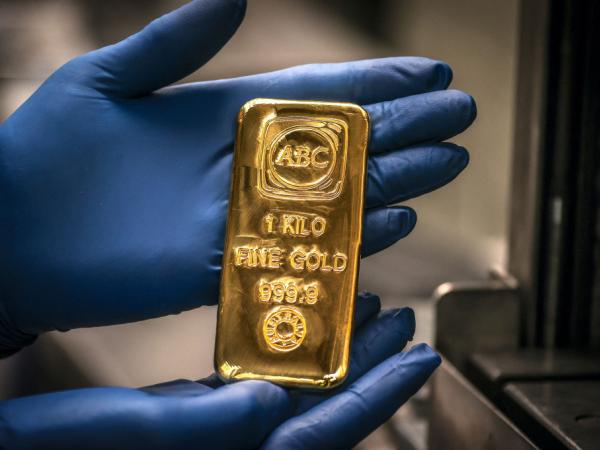
Gold.
AFP
Thus, the majority of people who access artificial intelligence tools do so for free from any terminal. Some suggest that the same thing could happen that happened with cell phones, which went from voice services to high-speed data transmission without the user paying more for these advances.
Faced with such a possibility, the bets of the technology giants that have committed to Hundreds of billions of dollars in expansion projects could be impossible to recover. And since the enthusiasm in this sector explains the good moment of the stocks, a sudden turnaround would give rise to a debacle of enormous proportions, with ramifications on the assets of millions of households, the health of the big banks, the economic growth and the finances of the richest nations.
To the above we must add a geopolitical situation of great complexity. It is no mystery to anyone that the sources of tension at a global level are more numerous now and range from the war in Ukraine to how the situation in Gaza evolves, including the outcome of the crisis in Venezuela. On the list of concerns appears a possible Chinese invasion of Taiwan, the hostile attitude of North Korea, political instability in Europe and the growing polarization in the United States that affects the functioning of its democracy.
(See: Researchers develop method to extract gold from electronic waste).
As if that were not enough, the debts of individuals and governments are at an all-time high, without it being clear what may happen to inflation and interest rates. YesAdd to that the impact of global warming or the aging of the world’s population, there is no doubt that there are underlying reasons to frown when looking at the future.
That is why there is nothing to suggest that, in the midst of so many doubts about the future, the current gold fever will find a remedy soon. In fact, there is a kind of contagion in the search for more refuges, which has been transmitted to other metals such as silver and influences crypto assets, such as bitcoin.

Gold pieces.
AFP
Local effect
All of the above serves to analyze what this situation means for Colombia, which is one of the 15 largest gold producers in the world and the fourth in Latin America. In terms of exports, this item today occupies fourth place, below oil, coffee and coal, with 2,742 million dollars sold between January and August 2025.
As William Buiter recalled in a text written for the Financial Times newspaper, stocks of the yellow metal in the world amounted to 216,265 tons at the end of last year. Of this amount, 45% corresponds to jewelry, while the rest is found in coins and ingots held by individuals, as well as in the vaults of central banks. An additional part corresponds to devices, since due to its conductivity properties the element is used especially in the field of technology.
Such an inventory is the result of centuries of accumulation. The annual production of gold is close to 5,000 tons, of which 75% comes from mines and the rest is recycled. At the level of the fifty countries that extract a relevant amount on the planet, China heads the list, followed by Russia and Australia, while in Latin America the leadership is held by Mexico, Peru and Brazil.
What happened with prices has caused a real bonanza in those nations that have important deposits. For example, The mountains of Central Asia have the most important reserves on that continent, which has benefited countries such as Kazakhstan, Uzbekistan and Kyrgyzstan, former republics of the Soviet bloc.
But behind the boom are dark stories, including the uncontrolled plundering of natural resources, the displacement of native populations and the violence associated with the control of a particularly lucrative activity. We must not forget that a gram of gold can be sold today for almost $125, while the cost of extracting it from the earth is a fraction of that figure, something that depends on the type of operation used and the use of environmentally responsible techniques.
(See: You won’t believe it: these are the four Latin countries with the largest gold reserves).
Unfortunately for Colombia, the outlook is not encouraging. According to data from the World Gold Council, national production was about 66 tons in 2024, an amount that doubles that of Chile.
However, unlike that country, in our case about two thirds of the sum comes from informal or illegal exploitations. In the latter, irreparable damage has occurred in the basins of dozens of rivers and in the contamination of waters with mercury. The destruction caused by dredgers and yellow machinery is visible from the window of a plane flying over parts of Antioquia, Córdoba or southern Bolívar on a clear day.
Many of these ‘entables’ have the protection of armed groups that charge a portion of what is taken or operate directly in various points of the geography. Although the authorities carry out controls that include the destruction of facilities, the truth is that the country continues to lose the battle in this matter. In addition, companies that comply with the regulations are under siege by violent parties, including harassment and attacks resulting in loss of life.
Thus, instead of the current situation serving to sow progress in the producing areas, the specter of greater instability appears. It is ironic that, in the midst of global tribulations, Colombia is exposed to being left with the sin of being hit by the tail due to uncertainty and without the support that would accompany being a major exporter of the yellow metal.
Hence, it is still pending to amend the plan and start doing things right. Protecting the rights of populations that make a living from mining is not in conflict with combating criminals who profit from its exploitation, much less with promoting the formalization and use of best practices in operations of all sizes. That would be the only way to avoid having to repeat ad nauseam that in Colombia gold does not shine.
RICARDO ÁVILA PINTO
Special for EL TIEMPO
In X: @ravilapinto