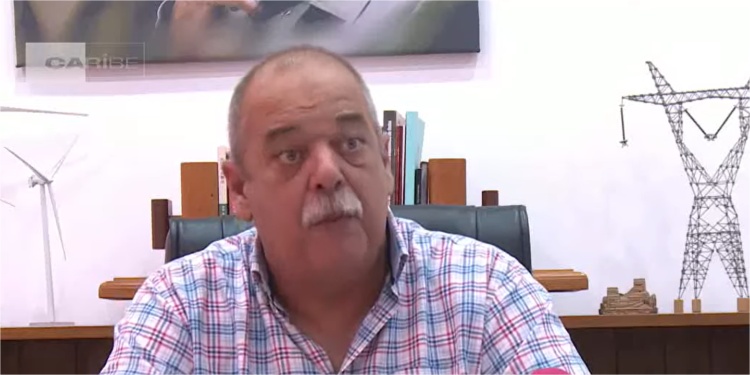
“An exceptional failure that had never happened to us,” said Minister of Energy and Mines, Vicente de la O Levy after three floors.
Lima, Peru – “An exceptional failure that had never happened to us,” described the Minister of Energy and Mines, Vicente de la O Levy, the simultaneous output of three electric generation plants during the eve.
“He took more than 270 megawatts (MW) instantly, already having a low availability,” said the headline during a recent appearance on the state of the National Electroenergetic System (SEN).
For its part, The electric union (UNE) later said that the national electrical system will maintain a serious situation this Saturday, with blackouts in about 58% of the territory due to the strong generation deficit.
In its daily note, the state company acknowledged that the service was interrupted during the 24 hours on Friday, October 3 and that the effects were extended throughout the morning of this Saturday. The maximum disconnection of the previous day occurred at 7:20 p.m., with a deficit of 1,842 MW.
Among the main incidents of this October 4, 10 thermoelectric units out of service stand out. Facts were reported in Unit 2 of CTE Felton, Unit 5 and 8 of Mariel, Unit 5 of CTE Nuevitas and Unit 3, 5 and 6 of the CTE I rent.
Likewise, Unit 1 and 2 of the Santa Cruz CTE and Unit 4 of the CTE Carlos Manuel de Céspedes in Cienfuegos are extinguished.
The situation will get worse during the highest consumption schedule. According to the state electric, in the night peak the demand will reach 3,300 MW, while the available generation will be only 1,470 MW. This will generate a deficit of 1,830 MW, with an estimated affectation of 1,900 MW, equivalent to 57.6% of the national territory.
Electricity cuts exceed 20 and 30 hours a day in the provinces of the East, while in Havana the blackouts reach up to 10 hours a day.
The Energy crisiswhich crawls since mid -2024, obeys breakdowns in obsolete thermal plants, programmed maintenance, lack of fuel and lubricants, in addition to the stoppage of tens of distributed generation engines and bad government management.