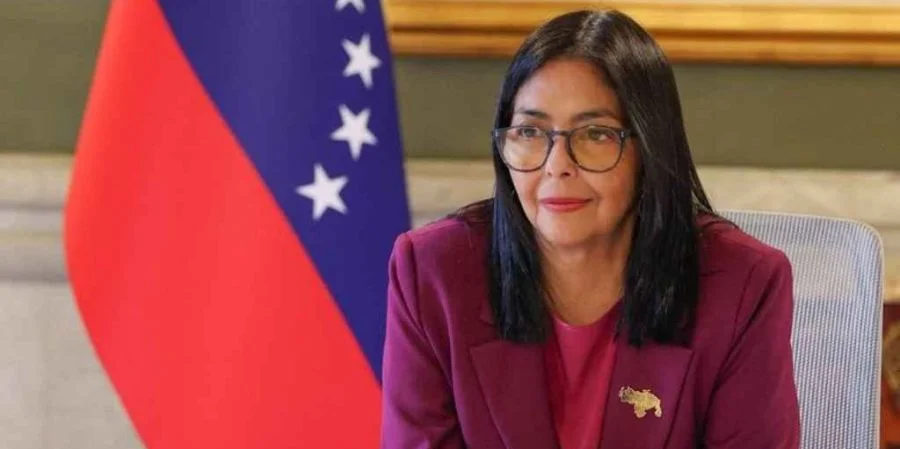
HAVANA.- This Thursday, the National Assembly of Venezuela – controlled by Chavismo, but with the presence of opposition sectors – unanimously approved the Amnesty Law for Democratic Coexistence. The important legal body came into force immediately after its promulgation by the “president in charge”, Delcy Rodríguez.
The president spoke of the beginning of “a new stage” for the homeland of the Liberator and assured that the law “opens an extraordinary door for Venezuela to reunite, learn to live together in a democratic and peaceful manner, and get rid of hatred and intolerance, allowing human rights, love, understanding and recognition to prevail.”
Rodríguez went even further by asking the Special Commission appointed by the National Assembly to supervise the application of the amnesty to review the cases of detainees not covered by the law, in order to make recommendations that deepen coexistence and national stability.
Of course, when dealing with representatives of traditional Chavismo-Madurismo – although today they appear “recycled” due to circumstances – the possibility of manipulation must always be taken into account.
Various specialists and defenders of political prisoners agree that the amnesty law, although long demanded, presents significant gaps. They point out that it leaves numerous detainees for political reasons without protection and that its application remains in the hands of a judicial system whose independence and credibility have been widely questioned. Even among those who support the initiative there is consensus that it is an incomplete and limited standard.
The rule only benefits people detained in relation to certain protests, leaving out other cases. Human rights organizations warn that those facing charges considered serious—such as alleged violent or armed acts—would be excluded, despite the fact that this type of accusation, they maintain, has been applied in a discretionary manner and frequently supported by fabricated evidence.
In the last few hours, democratic media have picked up on these objections. Infobae, for example, titled: “The opposition Juan Pablo Guanipa regained his freedom and questioned the amnesty lawIn PanAm Post, columnist José Gregorio Martínez went further by describing it as a “false Amnesty Law.”
However, beyond the criticism from certain sectors of the opposition, there is an undeniable fact: the new provision has opened the doors for numerous Venezuelans imprisoned for political reasons to regain their freedom.
As a Cuban, I do not limit myself to celebrating this measure that benefits an appreciable number of Venezuelan democrats. I believe that its reach can and should be extended symbolically to the island where we were born. The question is inevitable: why not aspire for a similar standard to be approved and applied in our own country?
It is no secret the close coincidence between the countries of the so-called “socialism of the 21st century”, particularly between Cuba and Venezuela. If this affinity has served for years for policies marked by sectarianism and confrontation, with much more reason should it be applied now to a measure oriented—beyond its possible manipulations—to national reconciliation.
In that context, I refer to the article I published in CubaNet on the 4th, where I pointed out that the “mayimbes” of Havana would do well to closely observe the events in Caracas, including Delcy Rodríguez’s proposal to grant an amnesty to political prisoners in Venezuela.
He then concluded that a similar decision would be highly positive for the current Cuban rulers. What justification can there be for peaceful and dignified citizens like Felix Navarro or Luis Manuel Otero continue to be imprisoned? This is yet another arbitrariness of the regime, whose only reasonable solution is the release of those affected, who number more than a thousand.
It is appropriate, however, to offer a clarification to readers. I have no illusions about the good intentions of Castroism. For more than six decades it has devastated the country and sustained its power through systematic repression against all dissent.
Even so, the situation of political prisoners and prisoners of conscience—those who suffer most directly from the brutality of the regime—deserves all of our attention. Even ignoring the inevitable manipulations, any action that contributes to their liberation will be insufficient in the face of the magnitude of the injustice they face.