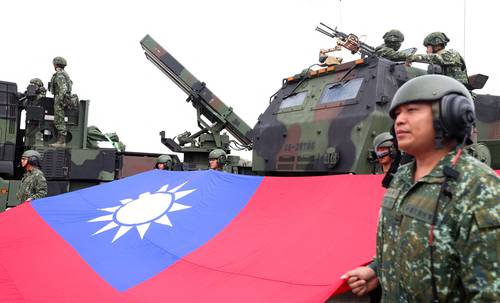
▲ Military exercises yesterday in Taichung province, Taiwan.Photo Afp
d
After the White House publications (National Security Strategy, bit.ly/3YXb3y4) and the Pentagon (National Defense Strategy, bit.ly/4riYdpY), the quoted think tank RAND, much consulted by Russia and China, mysteriously withdrew its document of last October 14, arguing that it required “further revision (bit.ly/4t2pqyP)”, by being disconnected from the new regional “strategic stability” policy with China in the Indo-Pacific region.
The document in question that we managed to preserve addresses the “geostrategic balance”, whose objective is the discovery of “possible (sic) elements of a stable balance” in the rivalry in the next five to seven years (sic)”, which “can serve the interests of both countries”, contemplates “new agreements in cyber competition and mutually agreed upon “strategic nuclear deterrence”, and enshrines four items on: 1. Taiwan, where the United States operates its ominous acts acrobatics to “balance its commitments” to the island and “leverage its influence to ensure that actions” by Taipei “do not aggravate tensions with China”; It proposes exploring “real collaboration” in areas that do not pose a threat (to the United States)”, and 4. Interpretation and interference: the same old empty talk (bit.ly/3Z3rUze).
Thirteen days later Global Times analyzed under the pen of Anthony Moretti, professor at Robert Morris University, “What is behind the somersault on China-U.S. ties? (bit.ly/3M819Xq)”.
Moretti comments on the “six somehow connected principles that should guide future talks” between the two top geoeconomic superpowers: 1. “The United States should accept the legitimacy of the Chinese Communist Party”; 2. “Reestablish reliable lines of communication between senior officials of both parties”; 3. “Improve crisis management practices”; 4. “Create new specific agreements to limit friction on cyber-related issues”; 5. “Promote nuclear deterrence,” and 6. “Seek modest cooperative initiatives in interests that overlap or are related to humanitarian issues (sic).”
Moretti criticizes that the United States “often talks about supporting the “one China” principle, but at the same time takes actions that give Taiwan confidence that Washington will continue to be a critical provider of military and other aid needed to combat China.”
The United States “insists on believing in fire prevention, while providing fire equipment to others. If Washington focused more on prevention and less on provocation, tensions would be reduced.”
Moretti lambasts suggestions to “keep the prospect of a war as dangerous and uncertain as possible for China,” which “reflects a chronically negative mentality on the part of the United States, according to which a military conflict could be the only way to resolve the issue of Taiwan’s future reunification with mainland China.”
Moretti highlights an editorial from the magazine time which states that “Taiwan constitutes a fundamental interest for China and the military balance is tilting more and more against Taiwan every day,” and recalls that “just a couple of years ago the main military leaders questioned the US ability to sustain and win a war against China.”
In my opinion, everything seems to indicate, according to the chronological sequence of the United States’ position on the renegade island, which is not even mentioned in the recent National Defense Strategy of the War Department, that Trump would be willing to sacrifice Taiwan during his next visit to China in April. In exchange for what?
Facebook: AlfredoJalife
Telegram: https://t.me/AJalife
YouTube: @AlfredoJalifeR
Tiktok: ZM8KnkKQn/
Instagram: @alfredojalifer