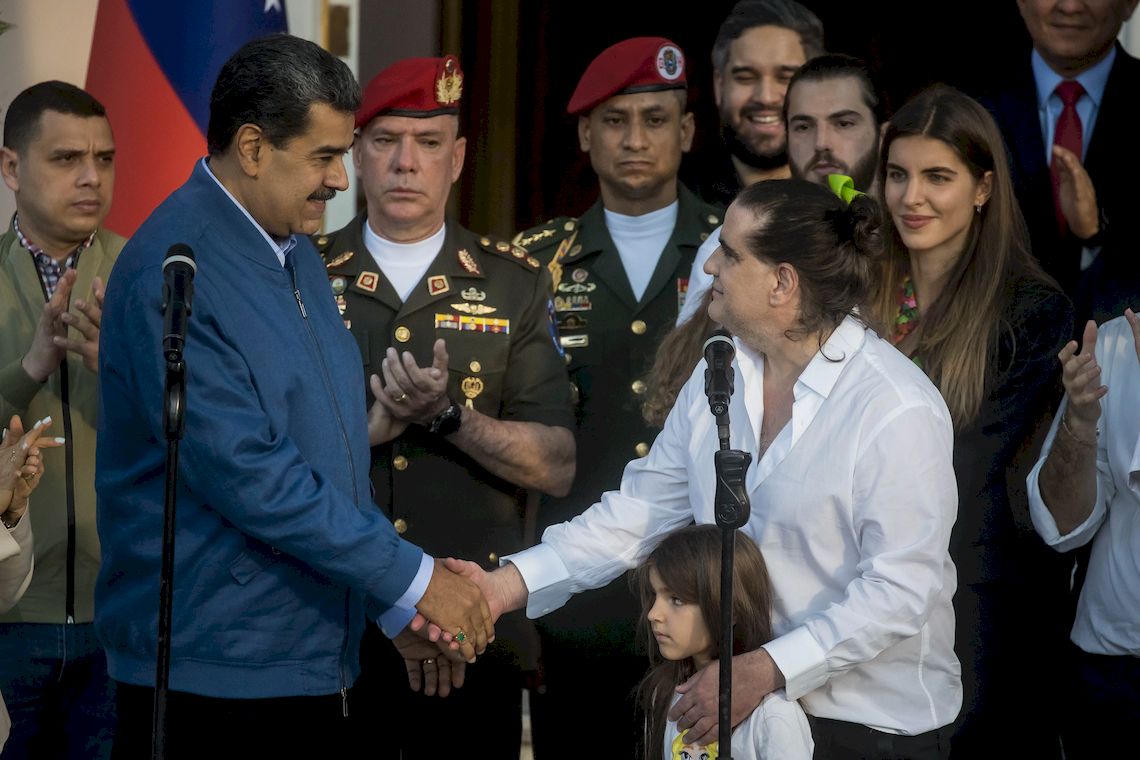
The Colombian-Venezuelan businessman Alex Saab, considered for years one of the closest financial operators to former President Nicolás Maduro and declared by him as a “national hero,” was arrested in Venezuelaaccording to press reports.
Saab’s arrest would have been the result of a joint operation between the Bolivarian Intelligence Service (Sebin) and the US FBI, according to media such as Colombian stations Caracol Radio and Blu Radio.
According to these reports, the capture occurred in the early hours of this Wednesday in the Cerro Verde urbanization, southeast of the Venezuelan capital, where businessman Raúl Gorrín, owner of Globovisión and sanctioned by the United States Department of the Treasury, was also detained.
Although there is still no official confirmation of his arrest by the Venezuelan Government, anonymous sources cited by the agency Reuters They assured that Saab could be extradited in the coming days to the United States, where he faces charges of money laundering and corruption.
The agency EFEfor its part, affirms that sources close to Saab have denied the arrest, while the prosecutor’s office and the president of the Venezuelan Parliament, the Chavista Jorge Rodríguez, said they had no confirmation in this regard. The FBI, meanwhile, did not deny the information and limited itself to responding “no comment.”
The news has generated a strong political impact, since Saab had returned to Venezuela at the end of 2023 after an exchange of prisoners with Washington, after having already been detained in the United States and was received with honors by Maduro, who appointed him Minister of Industry and National Production.
From national hero to eventual extradition to the US
In 2020, Saab (Barranquilla, 1971) was arrested in Cape Verde during an air stopover to Iran, accused by the US of participating in a bribery and money laundering scheme. After a long judicial process, he was extradited to Miami, where he faced federal charges.
However, at the end of 2023, within the framework of the Barbados Accords, he was released as part of a prisoner exchange between Caracas and Washington, which allowed him to return to Venezuela, becoming a symbol of resistance against US sanctions.
Maduro publicly honored him, declared him a “national hero” and incorporated him into the economic cabinet. Saab first assumed the coordination of imports and exports, and was later appointed Minister of Industry and National Production.
His management, however, lasted only until the fall of Maduro. Last January he was dismissed by the acting president Delcy Rodríguez as part of the reorganization of the Chavista Government after the US attack on January 3 and the capture of the then president and his wife. Since then, Saab’s political future was uncertain.
The US releases Alex Saab, a new step in the “thaw” with the Maduro Government
Counterweights from Chavismo
While the news of Saab’s arrest shook the country, the ruling party sought to unite its bases with symbolic acts.
The current leader of the ruling United Socialist Party of Venezuela (PSUV) and Minister of the Interior, Diosdado Cabello, led a tribute to former President Hugo Chávez at the Cuartel de la Montaña, on the 34th anniversary of the civil-military rebellion of February 4, 1992.
Accompanied by officers who participated in that revolt, Cabello placed a white rose on the tomb of the Bolivarian leader and highlighted that “Chávez’s teachings are a historical and main reference for what we experience in Venezuela.”
Cabello insisted that civil-military unity is essential to guarantee the survival of the Bolivarian Revolution in times of crisis.
“Internal strength is necessary, as long as they see us united they will think so, but when they see us separated they will eat us one by one,” he stated in a speech broadcast by official media.
The tribute sought to reinforce the narrative of historical continuity of Chavismo, at a time when important former government officials, such as former vice president Elías Jaua, affirm that the current government of Venezuela must operate under the guidelines of an “occupying power.”
“Although it may sound harsh, we are a militarily occupied country, the government that remains has to work under the guidelines of the occupying power,” said the former foreign minister in a video posted on the left-wing Venezuelan portal Pound.
In parallel, the Minister of Defense, Vladimir Padrino López, announced the beginning of an investigation into “all the events” that occurred during the US attack on January 3. Padrino pointed out that the objective is to evaluate and adjust the transformation plan dictated by Maduro before his fall, which includes strategic goals in security and territorial integrity.
The military chief assured that the Bolivarian National Armed Force remains “united and cohesive” and that Venezuela continues “standing and erect” despite external aggression.
Capriles and a wing of the opposition dialogue with the Government
The political crisis has also opened spaces for negotiation. The opposition leader Henrique Capriles, along with other minority parties, accepted the invitation of the interim president Delcy Rodríguez to begin a dialogue process.
In a statement released by deputy Stalin González, the opposition pointed out that “participating in this space is not just any gesture, much less comfortable, but we have reached this moment with a deeply wounded Venezuela,” press reports point out.
The parties Unión y Cambio, Hagamos Fuerza, MAS, Puente, Lápiz, Cambio y Paz and Un Nuevo Tiempo agreed that democratic coexistence requires respect, plurality and the end of political persecution.
They proposed as a first step an amnesty law that would allow progress towards national reconciliation. Rodríguez, for his part, has insisted that the dialogue must be “Venezuelan” and not imposed from Washington, Bogotá or Madrid.
His brother Jorge Rodríguez, current president of the National Assembly, said that the meeting held this Wednesday was “a first discussion” of “big proposals”, in which a work agenda was agreed that will be prepared “quickly” to hold a new meeting next Monday. refers EFE.
The Chavista leader indicated that with dialogue they seek to resolve specific problems, achieve “early victories” and seek “meeting mechanisms” between the different political sectors, although he noted that there are opposition leaders “abroad” who “exclude themselves”, although without directly mentioning the leader of the majority opposition, María Corina Machado.
Return of migrants from the United States continues
In the midst of the political upheaval, the Government of Venezuela continues with the Vuelta a la Patria program, focused on the return of Venezuelan migrants from other countries.
This Tuesday, 273 migrants deported from the United States arrived at the Simón Bolívar International Airport in Maiquetía, on a flight from Phoenix, Arizona. According to the Ministry of Interior Relations, Justice and Peace, the returnees received comprehensive medical care and free medications upon arrival in the country.
Since February 2025, more than 20,200 Venezuelans have returned through this route, joining the more than 1.6 million who have returned from various parts of the world since the creation of the program.
The arrival of the migrants was presented by the ruling party as a sign of the State’s ability to protect its citizens in times of crisis.