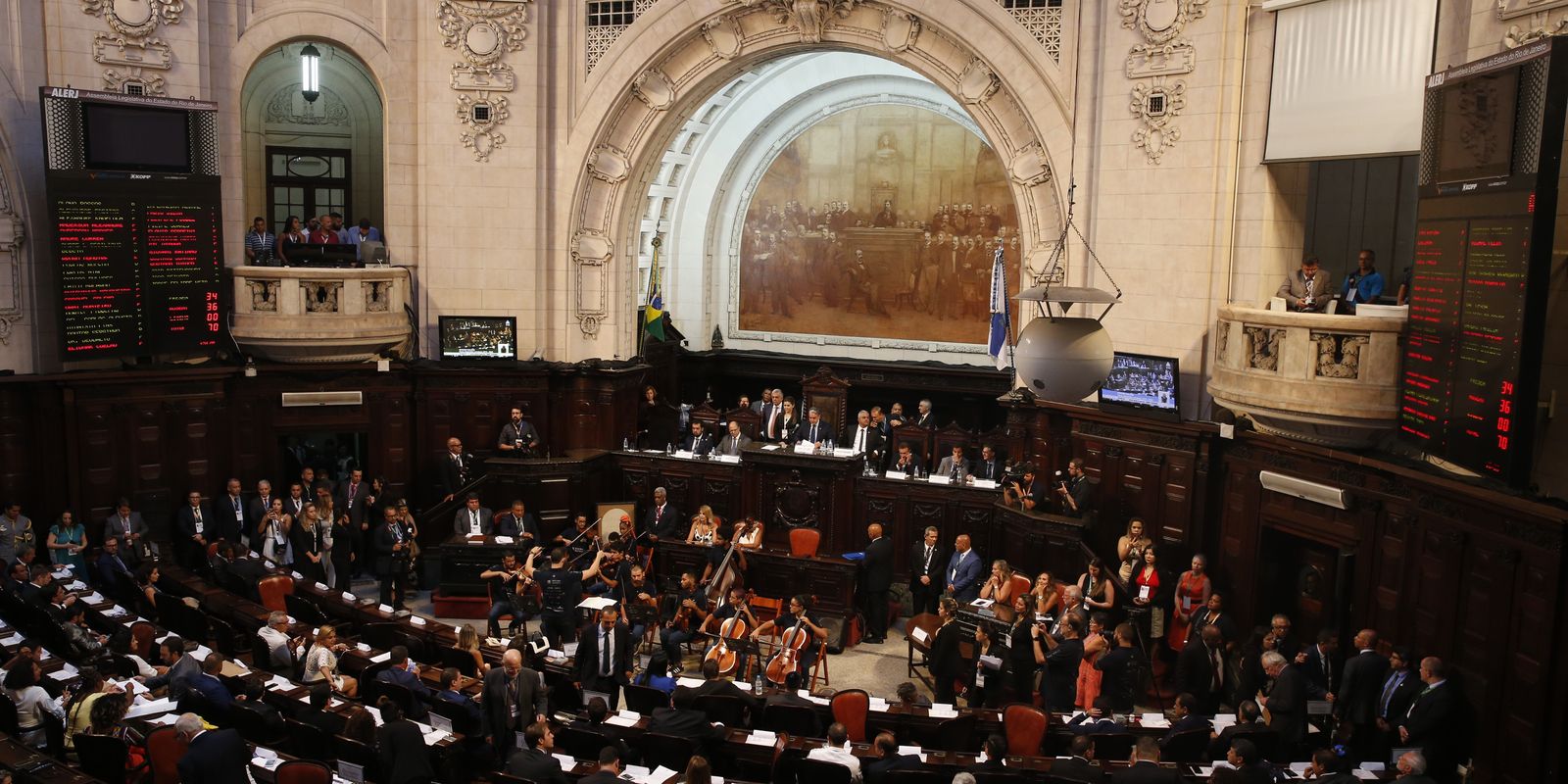
The decision on maintaining or revoking the arrest of the president of the Legislative Assembly of Rio de Janeiro (Alerj), Rodrigo Bacellar (União Brasil), must be taken by the House itself in the coming days. The forecast is that the Rio de Janeiro Legislature will be notified by the Court about the case within 24 hours. 
The deputy was arrested preventively this Wednesday morning (3) during a Federal Police operation to investigate the leak of confidential information.
The procedure at Alerj has been the standard in recent years, after a decision by the Federal Supreme Court (STF) in 2019. At the time, the Court defined that the legislative assemblies of the states have the power to revoke the arrest of state deputies, expanding to them the immunities provided for federal parliamentarians in article 53 of the Constitution.
Assemblies were also allowed to suspend criminal actions opened against state deputies. Article 27 of the Constitution provides that the state deputy has the right to the constitutional rules on the electoral system, inviolability and immunities provided for in the Charter.
Based on this article, state constitutions reproduced the rule, provided for in Article 53, which guarantees deputies and senators arrest only for a non-bailable crime and endorsed by their legislative house.
In 2017, Jorge Picciani was released by the House alongside parliamentarians Paulo Melo and Edson Albertassi. In 2019, Alerj released five deputies arrested in Operation Furna da Onça.
Arrest history
Bacellar is not the first president of Alerj to be arrested since the 1988 Constitution. In 2017, Jorge Picciani (MDB) was also arrested when he held the highest position in the Rio de Janeiro legislature.
At the time, he was arrested along with deputies from the same party, Paulo Melo and Edson Albertassi, as part of Operation Cadeia Velha. The three were accused of receiving bribes to favor bus companies.
In 2019, Picciani was sentenced by the Federal Regional Court of the 2nd region to 21 years in prison. He died in 2021, due to bladder cancer.
In addition to Bacellar and Picciani, other former presidents of Alerj were arrested, but when they no longer occupied the leadership position of the legislative house. This is the case of Paulo Melo himself, arrested together with Picciani, who held the position between 2011 and 2013, and again between 2013 and 2015.
Sérgio Cabral (MDB) presided over Alerj between 1997 and 1999 and then between 1999 and 2001. He was arrested in Operation Lava-Jato in 2016. Cabral was accused of leading a criminal organization that rigged tenders and charged bribes.
He was also governor of Rio de Janeiro between 2007 and 2014. There were several convictions in the context of Lava Jato, with combined sentences exceeding 390 years. In 2024, the Court overturned three convictions, causing the shares to be redistributed.
José Nader (PTB) commanded Alerj between 1991 and 1992, and then between 1993 and 1994. In 2005, he was arrested in Tocantins accused of predatory fishing and illegal possession of weapons. In 2008, he was one of the targets of the Federal Police’s Operation Passárgada. He was indicted for passive corruption, conspiracy, embezzlement and administrative law. He died in 2015, after suffering a stroke.