Havana/Questions accumulate around the relationship between Havana and Caracas after the capture of Nicolas Maduro by United States troops. To the doubts about the continuity of Cuban medical missions, the future of Venezuelan oil and the true dimension of the island’s military presence in the South American country, another less visible, but equally strategic unknown is now added: what will happen to the submarine fiber optic cable that directly connects Cuba and Venezuela, a key infrastructure not only for communications, but also for the control of information.
For years, the Alba-1 cable has functioned as a technological umbilical cord between both regimes. Laid under the Caribbean and presented at the time as a “regional integration” project, this fiber optic thread was, in practice, Cuba’s first major gateway to high-capacity internet without passing through US servers. But it also became a central piece of the architecture of surveillance, censorship and political management of the network that prevails on the Island.
Today, with Chavismo in crisis and power in Caracas reconfiguring at a forced pace, the future of that link raises an uncomfortable question for Havana: will Alba-1 continue to be a tool of shared control or will it become a vulnerable point within an alliance that no longer offers the same guarantees? Could Washington put a magnifying glass on this line, regulate it or even condition it?
Could Washington put a magnifying glass on this line, regulate it or even condition it?
The name Alba-1 began circulating in the early 2010s, surrounded by grandiose promises. The project consisted of a submarine cable of about 1,600 kilometers that connects La Guaira, in Venezuela, with Santiago de Cuba, and extends to Ocho Ríos, in Jamaica. Its capacity was far superior to the slow and expensive satellite links on which Cuba depended until then. The plan, largely financed by Caracas and executed by the joint venture Telecomunicaciones Gran Caribe, was delayed for years and was shrouded in official silence that fueled suspicions and expectations in equal measure.
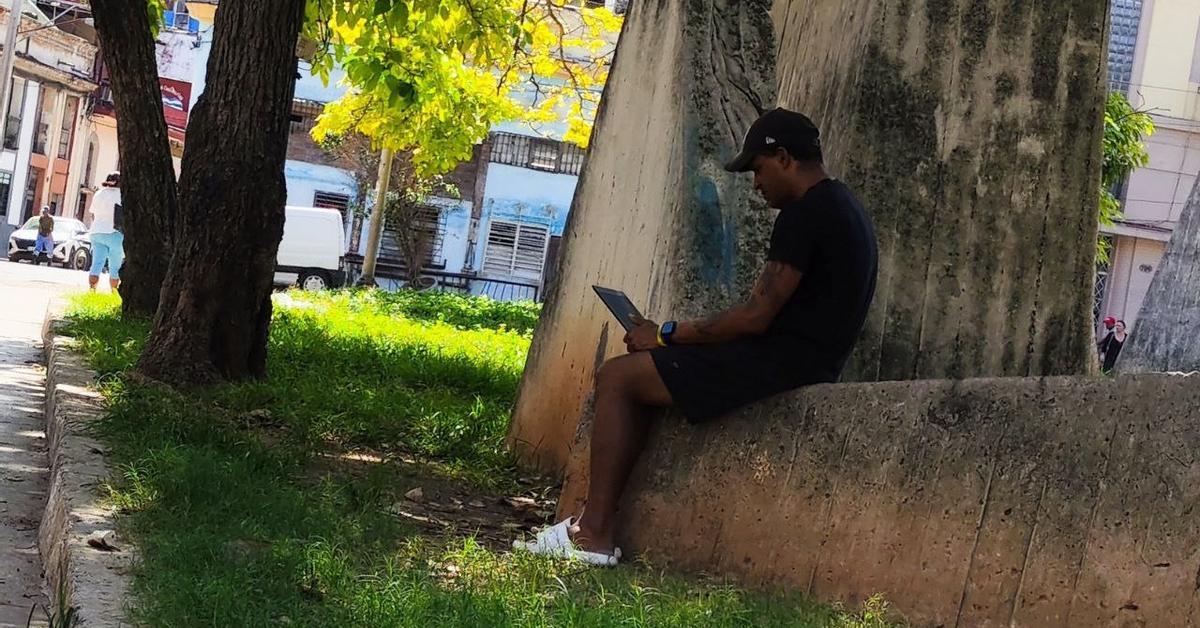
When it finally came into operation, around 2013, Alba-1 marked a before and after for Cuban connectivity. For the first time, the Island had an infrastructure capable of supporting real growth in data traffic. From there, concrete changes began to be seen: the opening of public Wi-Fi parks, the arrival of Nauta Hogar for domestic connections and, in December 2018, internet access from mobile phones. For millions of Cubans, that meant entering the global network for the first time, although with many restrictions.
However, the technological leap never translated into a fluid and free browsing experience. Internet access in Cuba remains expensive, unstable and deeply controlled. Complaints about low speed, frequent outages and poor coverage are constant, even after the installation of the Arimao cable, which connects the Island with Martinique and which has also been surrounded by mystery about its operation. Installed capacity under the sea collides with poor internal infrastructure and political decisions that prioritize control over service.
Censorship is an inseparable part of that model. Uncomfortable places for the ruling party, such as 14ymedioare blocked or slowed down on different occasions, especially at times of social protests or politically sensitive dates. The State, through the telecommunications monopoly Etecsa, decides what is offered, how and at what price. Connectivity, in Cuba, is not a right, but a monitored concession.
This approach is not limited to the national territory. Different researchlike the one contained in the book The consented invasion (Debate, 2019), document how, since the mid-2000s, Cuba was gaining ground in the Venezuelan telecommunications sector. As read in a report by Armando.infounder the influence of figures such as Ramiro Valdésfor whom communications are a matter of State security and a “wild colt” that must be tamed, Cuban companies such as Copextel and other state subsidiaries They were inserted as suppliers and technological advisors in key projects in Venezuela, especially after the renationalization of Cantv.
A general close to Maduro was placed in charge, reinforcing the idea that telecommunications were not just a service, but a tool of power.
Over time, this presence was integrated into the structures of the Venezuelan State itself. In 2019, the creation of the Socialist Telecommunications and Postal Services Corporation, which raised an umbrella over Cantv, Movilnet and the Gran Caribe mixed company, consolidated political and military control of the sector. A general close to Maduro was placed in charge, reinforcing the idea that telecommunications were not just a service, but a tool of power.
Beyond contracts and technical cooperation, what was exported was a model: that of telecommunications as an instrument of surveillance, social control and repression. Cuban universities, companies and advisors contributed to shaping in Venezuela an information management system very similar to the one applied on the Island, with profound implications for the digital sovereignty of that country.
All this helps to understand why the fate of Alba-1 is no small matter. Maduro’s capture has returned that cable to the center of the debate. Although there is no public evidence that it has been used directly for intelligence work, it is technically indisputable that whoever controls the infrastructure controls, to a large extent, the flow of data. In regimes where the Internet is seen as a political risk, this capacity acquires enormous strategic value.
For Cuba, Alba-1 has not only been a means of connection with the world, but also a lever to decide how, when and under what conditions citizens access information. With Venezuela in transition and new balances at stake, that cable at the bottom of the sea reminds us again: on the Island, connectivity has never been just a technical issue, but rather a deeply political one.