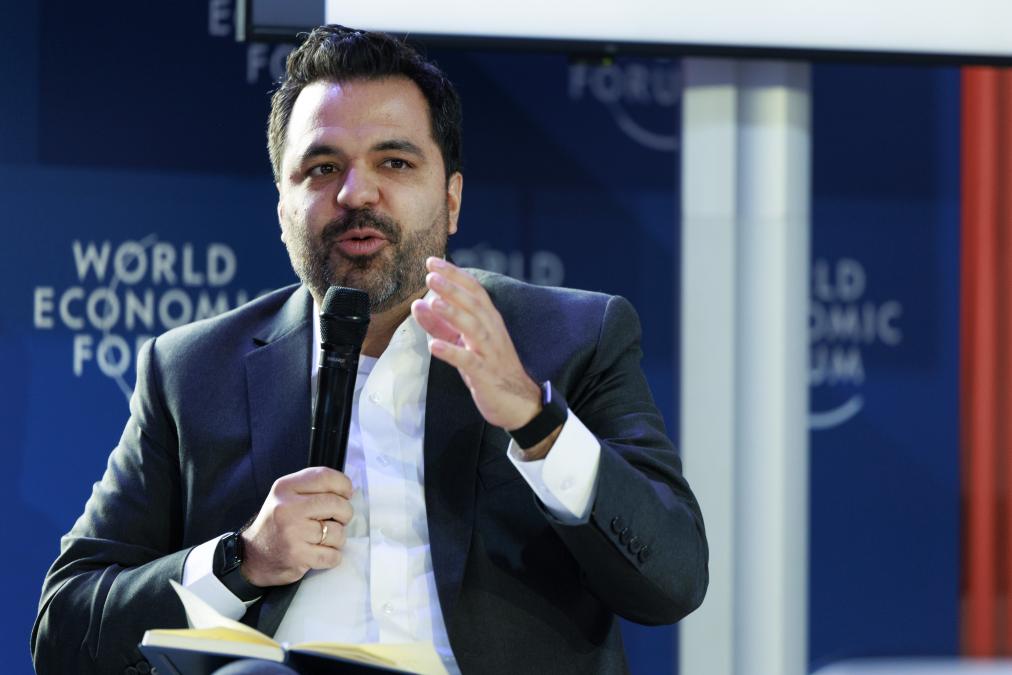
Felipe Valencia-Dongo, main partner of Grupo Economía, was one of the two Peruvians who presented at the World Economic Forum in Davos this year, along with Julio Velarde. From that space, he reflects on trust, artificial intelligence and opportunities for Peru.
From your experience in Davos, what were the main cross-cutting themes of the forum and which are most relevant for Peru?
The World Economic Forum organized in Davos, a small city two hours from Zurich, has become for many years the main space for dialogue between the public and private sectors and civil society. This year, the meeting had as its central theme the motto “A spirit of dialogue.” Among the main topics addressed, I would highlight, first of all, artificial intelligence; secondly, the need to strengthen more effective collaboration between governments and the private sector; and thirdly, a particularly relevant issue for Peru: energy and critical minerals, which we can delve into later.
Would you understand, then, that there is a concern about artificial intelligence right now?
More than concern, what was perceived was marked optimism. In this context, there were three ideas that are especially relevant for Peru. The first was raised by Satya Nadella, CEO of Microsoft, who pointed out that it is essential that artificial intelligence begins to solve specific social problems. Otherwise, he warned, there is a risk of losing the social acceptance necessary to sustain the high energy consumption that its use implies. A second focus was focused on how the private sector can leave behind the stage in which artificial intelligence is seen only as a fad or a trend, and move towards its application in concrete results. There was a lot of discussion about how to translate AI into tangible improvements within companies, reflected in performance indicators and measurable results.
And what would be the third idea?
The third point, which I consider especially important, was raised by the CEO of NVIDIA, today the company with the highest valuation in the world. He pointed out that when talking about artificial intelligence we usually think only of models or applications like ChatGPT, but that in reality the first stage of AI is energy. Artificial intelligence, he explained, requires intensive use of both energy and data. This opens a significant opportunity for Peru. For example, Meta, Facebook’s parent company, plans to build a data center on a scale comparable to that of Manhattan, facilities that require large volumes of copper. In this context, the country has the possibility of positioning itself as a provider of the resources that the expansion of artificial intelligence will require on a global level. I must add something else.
Is there a fourth chance?
I would add an idea raised by Larry Fink, CEO of BlackRock, the largest investment fund in the world. From the perspective of investors, he argued that the countries that will benefit the most from artificial intelligence will not necessarily be those that develop the technology, but rather those that manage to adopt and disseminate it more quickly. In that sense, a relevant opportunity also opens up for Peru. Although the country will hardly be able to compete with economies like the United States in the creation of technologies, it can advance in the use of artificial intelligence to improve results in education and health, strengthen State management and simplify the daily lives of citizens.
What do we need?
It is essential to start working on public policies. For example, I participated in a panel with Bill Gates, who commented that, since its founding, they have signed agreements with some African countries to intensively promote the use of artificial intelligence in public health, especially in the interpretation of X-rays and medical results. Gates pointed out that in the United States he often receives criticism with questions like: “What is going to happen to radiologists?” Their answer was clear: in many of the countries where they seek to close gaps, there simply are not enough radiologists to care for the entire population. This approach is relevant for Peru. I believe that all actors: public sector, private sector and civil society, must advance this enormous opportunity and take advantage of it.
Participated in the panel “Rediscovering trust”. How can it help to better take advantage of the opportunities presented by artificial intelligence?
One of the main ideas I shared is that you don’t have to agree on everything to work together and build trust. Even when there are important differences, it is possible to move forward if common objectives are identified and collaborate on them. Another lesson is that trust is not built only in dialogue, but in concrete work. When different actors, such as a company and a community, develop a specific project together, trust is consolidated based on the results.
Data
Davos It is the headquarters of the annual meeting of the World Economic Forum, is located in Switzerland and is two hours from Zurich.
In the most recent edition Nearly 3,000 leaders from more than 130 countries participated. Among them, sixty heads of state and more than 800 CEOs.
The forum addressed topics such as economic growth, technology and energy transition.
Peru needs us informed to make decisions. Subscribe for free to the Perú21 newsletter: THE TOP 5 NEWS YOU SHOULD KNOW TODAY. Click on the next link.
RECOMMENDED VIDEO