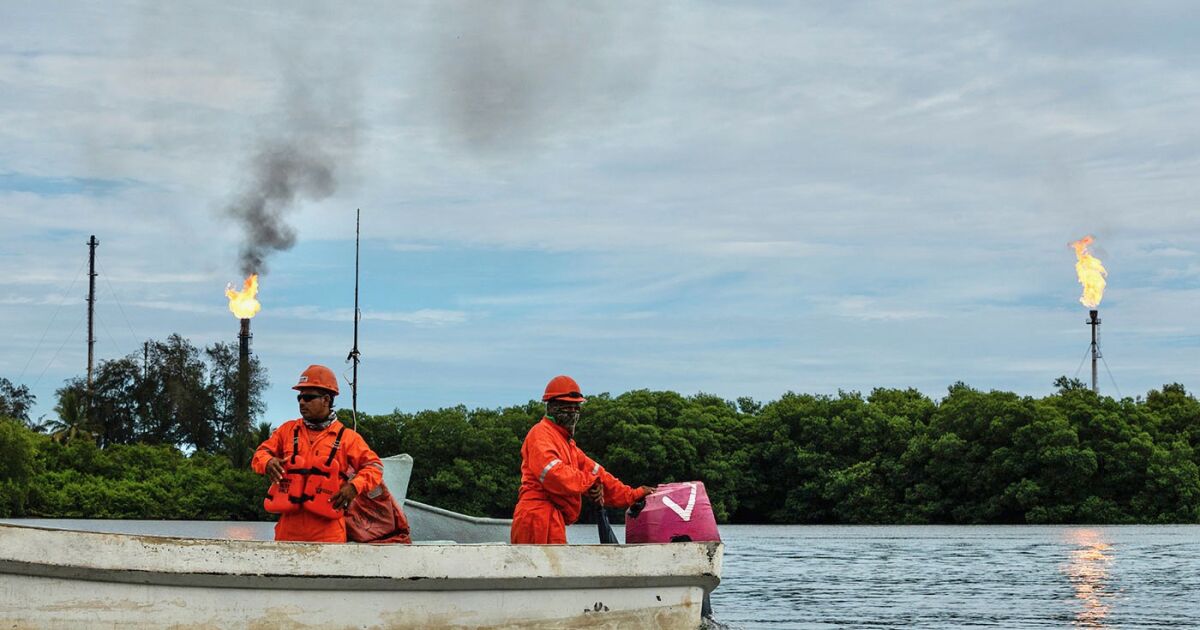
After a continuous fall that began in April 2018 and played background in April 2024, employment in the oil refining industry in Mexico began to rebound.
According to INEGI data, in April 2025 the personnel occupied in this activity grew 9.7% in annual terms, in contrast to the negative tendency of the rest of the manufacturing sector. In addition, average remuneration increased more than 4%, in a subsector that is already the best paid in the industry, with almost 500,000 pesos a year per worker.
This rebound occurs in parallel with the increase in national fuel production. In 2024, the production of gasoline by Pemex reached levels not seen since 2016, according to reports from the state company.
The growth is attributed, to a large extent, to the gradual entrance of the Olmeca Refinery – in two mouths – and the increase in the activity of refineries such as Cadereyta and Tula, which in May 2025 reported productive rebounds of 75.1% and 56.1%, respectively.
An expensive bet: “Refine for refining”
However, specialists question the viability of this strategy. For Óscar Ocampo, energy coordinator of the Mexican Institute for Competitiveness (IMCO), refine “a public policy goal became itself, not as a means to achieve energy security, but as an isolated goal”. And he warns: “A society that generates losses, such as Pemex Industrial transformation, is completely unsustainable.” In 2024, the refining concentrated losses for 585,000 million pesos.
The specialist emphasizes that, under the current conditions of the National Refining System, it is more profitable to export crude than processing it locally. To this is added the fact that the total production of crude oil by Pemex is below the goals: instead of the 1.8 million barrels planned, there are only 1.6 million.
The Olmeca refinery, opened in 2022, but operational since mid -2024, barely prosecuted 114,900 barrels per day in May 2025, which represents 33.8% of its installed capacity.
Restructure and profitability
Faced with this scenario, Gabriela Siller, director of Economic Analysis at Banco Base, considers that for Pemex to have a refining profitability window, “the organization would have to be thinner and first reduce the debt, not passing it to the government, but selling non -profitable assets to pay part of the liability. Strategic changes are needed,” he said in an interview.
In line with this vision, Pemex announced an internal restructuring in May 2025, approved by its Board of Directors. The plan includes eliminating duplicities, reducing administrative structures and reorienting resources towards operational areas, with an estimated savings of 4,798 million pesos in 2025 and 2026.
The oil company also limited the entry of new trusted personnel and began a liquidation scheme that will affect less than 1.4% of its permanent places.
Despite the adjustments, Ocampo points out that Pemex’s human capital is highly trained and that, in case of reconfiguration of the national refining system, these profiles could be easily placed in other industries, such as petrochemicals or the hydrocarbon sector in general.
“The qualified labor of oil engineers has a place in many industries. If it is decided to close or reconvert refineries, this can be done with a 10 -year planning that minimizes the social impact,” he said.