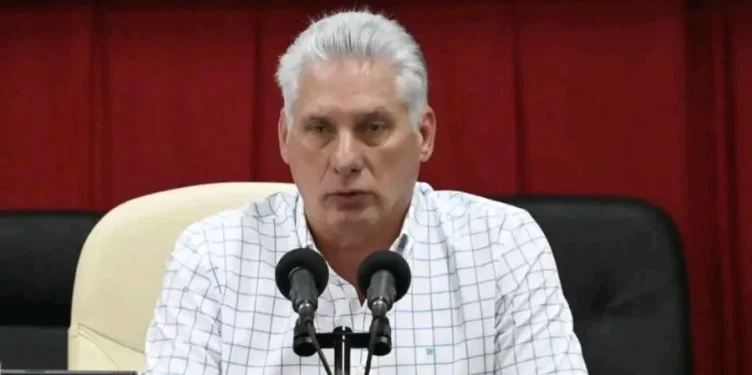
The Cuban dictator, when responding to Trump’s statements, denied political contacts beyond immigration issues; and reiterated the official discourse about “sovereignty” and “blockade.”
MADRID, Spain.- Cuban leader Miguel Díaz-Canel reacted this Monday to the recent statements by the president of the United States, Donald Trumpwho affirmed on Sunday that his administration “is talking to Cuba” and urged the Havana regime to negotiate “before it is too late.”
Through a series of published messages on social network X, Díaz-Canel denied that there are political conversations with Washington and limited contacts to “technical” exchanges on immigration matters.
Díaz-Canel insisted on the regime’s usual discourse on a supposed “dialogue on equal terms”, conditioned on respect for “sovereignty”, “non-interference” and the “principles of International Law”, without mentioning at any time the complaints of systematic violations of human rights or the absence of political freedoms on the Island.
“We have always been willing to maintain a serious and responsible dialogue with the different US governments, including the current one, on the basis of sovereign equality, mutual respect… without interference in internal affairs and with full respect for our independence,” he stated, in a narrative that contrasts with decades of internal repression and persecution of dissent. These statements are especially unfounded at a time when The regime itself confirmed the death of 32 Cuban soldiers in Venezuela during the US military operation that culminated in the capture of Nicolás Maduro, a fact that the authorities had denied for years regarding the military presence of Havana at the service of Caracas. The publication of the names of the deceased by the Cuban Government revealed this participation, in contrast to the official narrative of non-interference that it tries to maintain.
In his messages, Díaz-Canel also once again blamed the United States for the mass exodus of Cubans, attributing it to the embargo and the Cuban Adjustment Act, and separating the regime from its direct responsibility for the country’s economic and social collapse. According to the president, Cubans residing in the United States were “pushed there by that failed policy” and would now be “victims of the change in policies towards migrants and the betrayal of Miami politicians.”
The Cuban dictator also assured that Cuba “scrupulously complies” with the bilateral Migration Agreements and maintained that any improvement in relations with Washington must be based on “International Law” and not on “hostility, threats and economic coercion.”
While the Cuban president insists on a rhetoric of sovereignty and external victimization, the population on the Island continues to face one of the worst economic crises in its history, with prolonged blackouts, food shortages, collapse of basic services and an unprecedented wave of migration, realities absent in the official pronouncements of the regime.
Díaz-Canel’s response comes after Trump publicly warned the Cuban regime and urged it to negotiate in a regional context marked by the fall of Nicolás Maduro’s government and the weakening of the Caracas-Havana axis. The US president also stated that the United States seeks to protect Cubans who were forced to emigrate and who are now citizens of the North American country.
Trump, who in recent days has intensified his stance against the Cuban regime, recalled this Sunday that the Island was sustained for years thanks to large volumes of oil and financial resources from Venezuela, in exchange for the Castro regime providing “security services” first to Hugo Chávez and then to Nicolás Maduro.
“But not that anymore!” Trump emphasized. According to the president, after the recent capture of MaduroVenezuela now has the protection of the United States and its Army, which it described as “the most powerful in the world.”
“There will be no more oil or money going to Cuba. Zero! I strongly suggest that you reach an agreement before it is too late,” the president stressed.
Last week, in an interview with journalist Hugh Hewitt, He stated that the Government of Havana “is hanging by a thread” and is going through “big problems,” while maintaining that the pressure on the Island is already maximum.