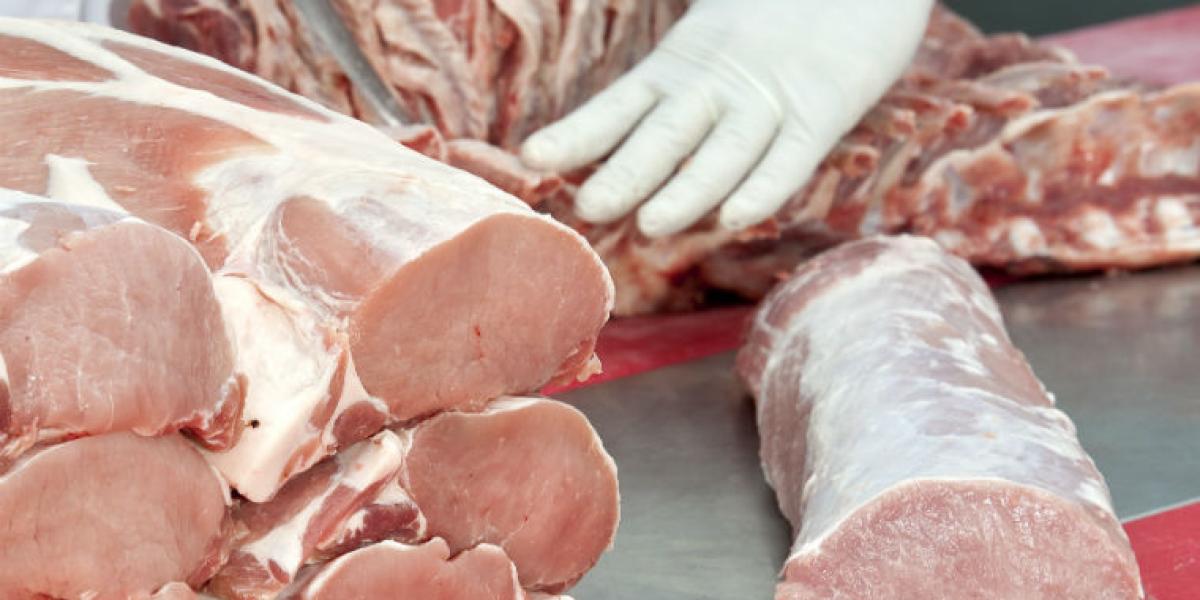
After the Federal Government announced that starting in 2026 The exemption from tariffs on various fractions of the basic basket will be eliminated that were part of the Package Against Inflation and Scarcity (PACIC), among them meat products, milk, beans, rice and oils, from the Agricultural Markets Consulting Group (GCMA) reported that for pork and beef Import quotas have already been established.
“In the case of beef and pork, they established import quotas of 71,000 tons and 51,000 tons annually, respectively, with the aim of taking care of the national production chains and avoiding distortions in the domestic market,” said the general director of the GCMA, Juan Carlos Anaya.
In an interview, the manager explained that these amounts were established in a recent meeting between the federal government and representatives of agribusinesswithin the framework of the PACIC, although they have not yet been officially published.
The decree published this Wednesday in the Official Gazette of the Federation (DOF) only states that, although it is considered necessary to eliminate the tariff exemption for said meat products, “the managed access to external offer of them under conditions that do not compromise food safety.”
When asked whether these import quotas will be enough to satisfy national demand, Anaya explained that, in the case of beef, a quota of 101,000 tons per year had been proposed, a volume that represents approximately 50% of what is imported.
“In the case of the pork The quota is low compared to what is imported, since it is only approximately 6%. Although currently the pork that Mexico imports from South America and Europe represents 5% of total purchases,” he explained.
The end of the exemption was already expected
A possible end of the tariff exemption for meat products within the PACIC It was already expected by the national industry, generating opposite reactions. At the beginning of December, the Mexican Meat Council (ComeCarne) had asked the Federal Government that these products continue to be part of the measure, this because the intention was already known that from 2026 the federal government would eliminate the tariff exemption and instead establish import quotas, that is, a certain amount of imports free of tariff.
“The information we have is that they are about to eliminate the zero tariff on beef and pork from the decree, they are going to publish other instruments such as import quotas,” Macarena Hernández, general director of the organization, said at the time, adding that thanks to the inclusion of meat products in the PACICits price not only stopped the escalation, “but it even decreased thanks to the possibility of being able to import from countries like Brazil, whose prices are 23% lower than those of the US.”
On the contrary, the Organization of Mexican Pork Farmers (Opormex) and the National Confederation of Livestock Organizations (CNOG) had requested that the “excessive import” of meat from countries without a free trade agreement with Mexico, such as Brazil, be stopped and maximum quotas be established.
In conclusion, for Juan Carlos Anaya, director of the GCMA, the impact of the tariff exemption will depend on the administration of the quotas, the evolution of international prices and the response capacity of national production, especially in meats and basic grains.
Meat consumption and import in figures
According to figures from ComeCarne, the consumption of beef in Mexico It reached 2 million 238,869 tons (and a per capita consumption of 7 kilos) in 2024, while production was 2 million 252,248 tons. In the case of exports, these reached 272,149 tons and imports 258,771 tons, of which 58.3% came from the United States. The second supplier was Brazil, contributing 16.4% (42,413 tons) and an exponential growth of 899 percent.
Based on information from ComeCarne, average annual inflation in beef fell from 14.1% in 2022 to 3% in 2023 and 0.3% in 2024, but has rebounded to double digits again in 2025.
In the case of porkIn 2024, 82.7% of the 1 million 619,864 tons imported came from the US; 13.7% from Canada; and from Brazil, 2.6%, although with a marked growth of 57.5% in its volume. National production amounted to 1 million 812,412 tons annually, while consumption was 3 million 251,957 tons. Exports amounted to 180,319 tons.