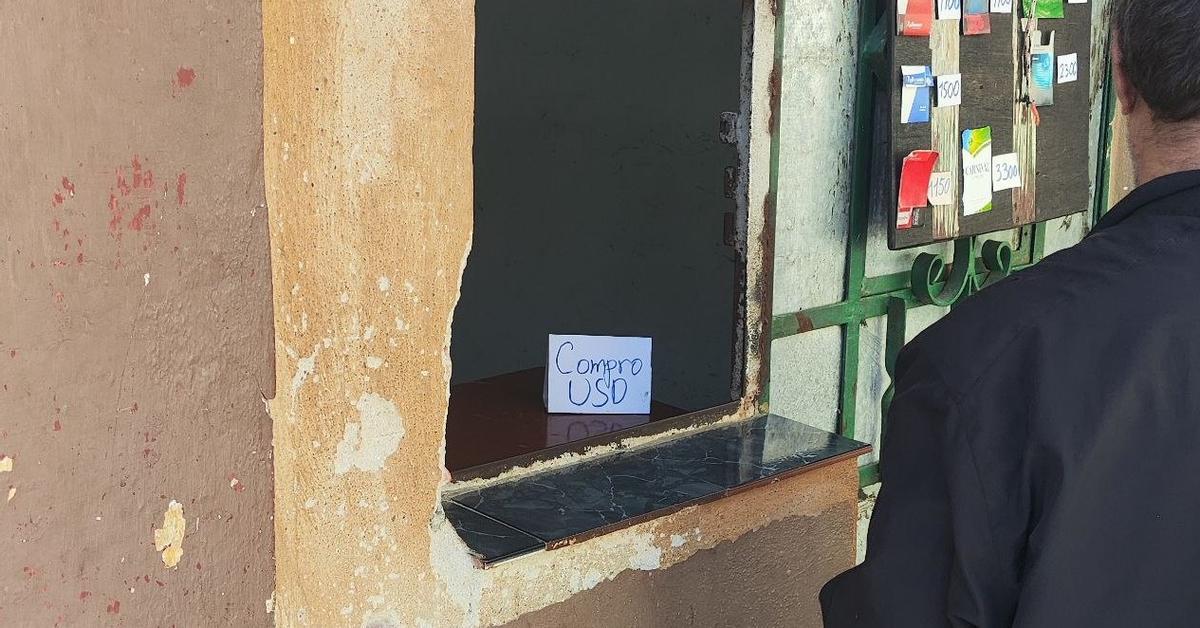
Madrid/As the specialists expected, after a few days of truce in which its price began a rapid fall from 490 pesos to 410the dollar rises sharply again in the informal market. The new war waged by the Government against The Touchwhich publishes street buying and selling rates daily. If this Saturday it had already started to rise to 415, the next day it already cost 420 pesos and, this Monday, 430.
The independent media itself never tires of illustrating how it extracts the information it offers, the most recent occasion this Sunday. Far from operating as denounces the regimewhich accuses him of “speculative manipulation”, being at the service of the United States as part of “a comprehensive destabilization program” and “usurping” the task of the Central Bank of Cuba, The Touch –without referring to this smear campaign– explains that it is based on advertisements and publications on networks collected daily and on user responses.
They exemplify this with the data collected on Saturday and Sunday. In a first graph they report the “histogram of published offers”, and detail: “The majority of offers are concentrated between 410 and 430 CUP/USD, with a midpoint of 420 CUP”, which “indicates that the majority of market participants coincide in that price range.” The average, 421.81 pesos, they continue, “is slightly above the median (420 CUP), which suggests that some bidders are beginning to request higher prices.” This “slight difference,” they conclude, “may indicate upward pressures; that is, an increase in the price of the dollar.”
Towards the end of that month, a change in trend is observed: purchase requests (demand) increase and sales offers (supply) decrease.
In a second graph, they present aggregated supply and demand, showing the evolution of the number of people interested in buying or selling dollars over time. The figures, the media insists, “are based on the amounts declared by users in their messages.” But they clarify: “Not all offers include precise amounts; therefore, the values presented constitute an under-record of the real movement, that is, the minimum detectable of transaction intentions. Consequently, the total market volume is probably much higher.”
And they conclude: “During the month of October, the volume of operations remained relatively stable. However, towards the end of that month a change in trend is observed: purchase requests (demand) increase and sales offers (supply) decrease. This imbalance – more people willing to buy and less to sell – usually anticipates increases in the price of the dollar if the trend continues.”
The article recalls that the economist Pavel Vidal, head of the Observatory of Currencies and Finance (OMFi), has also explained many times that movements in the informal exchange rate are given by the balance between supply and demand. “If the demand for dollars, euros or MLC (freely convertible currency) exceeds the supply – because many people or private businesses are looking for foreign currency to import, travel or protect their savings against inflation -, the price of those currencies in Cuban pesos tends to rise. On the contrary, if there are more people willing to sell foreign currency than those who want to buy them – due to an increase in remittances, tourism or a recent appreciation of the dollar -, the rate can go down.” This is the basic law of supply and demand, which is practiced throughout the world, except in Cuba, where the regime tries to ignore it, without success.
Also influencing, they continue, are “expectations”, such as “rumors about new sanctions, announcements of regulatory changes for MSMEs, remittances or banking operations, as well as modifications in monetary policy”, and other factors, such as liquidity or financial regulations.
In the case of the drop that occurred last week, some experts associated with OMFi link it to the effects of Hurricane Melissa, specifically the sending of foreign currency and donations to support the country and families.
In his report last October, Pavel Vidal asserted that the economic crisis on the island “has no time to hit rock bottom and there are no possible solutions in the short and medium term,” and he ventured that the dollar It could even exceed 500 pesos at the end of October, in an “extreme” scenario. Before the decline of recent days, he was close to reaching it.
Regardless of specific predictions, the scenario drawn by the Cuban economist living in Colombia for the unstoppable devaluation of the national currency remains in force. For example, the tourism debacleessential for the income of foreign currency. Also, what to have green It is the only way to be able to buy in dollarized stores, of which there are more and more; that the energy crisis and the “very limited access” to inputs and financing negatively affect production, which increases dependence on imports, and that “distrust in the future of the economy and in the Government’s ability to face the crisis” causes capital flight and encourages “accumulating savings” in hard currencies.