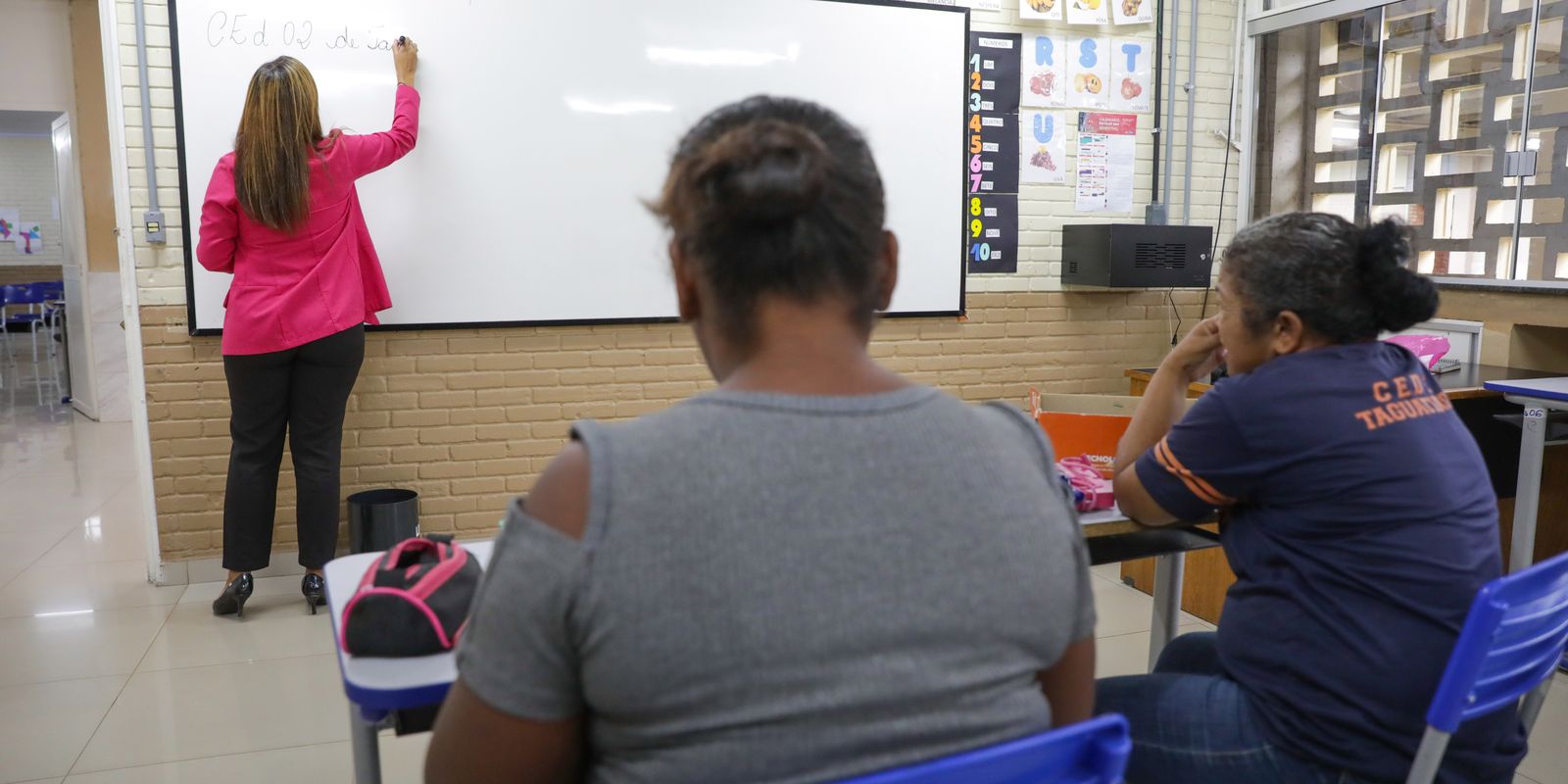
Youth and Adult Education (EJA) has a direct positive impact on income, occupation and formalization on the labor market of students who participate in this stage of teaching. This is what highlights an unprecedented study that mapped what is the economic return for those young and adults who did not complete their studies at the right age, but returned to school in EJA classes.
The sport is part of basic education and enables those who have not completed school at the expected age resume studies and obtain the elementary and high school diploma, in faster than regular classes.
The survey will be launched on Wednesday (10), at the National Seminar on Youth and Adult Education: 1st year of the pact for overcoming illiteracy and qualification in Youth and Adult Education (EJA Pact). The investigation seeks to “fill an important gap in research on the subject” and offer subsidies to expand the investment and access of the population to this stage of teaching. The analysis was commissioned by the Ministry of Education, in partnership with the United Nations for Education, Science and Culture (UNESCO).
What is EJA?
In recent decades, the country has significantly expanded access to formal education – the service rate between 6 and 14 years old, which comprises all elementary school, reached 96.7% in 2010, against 75.5% in 1991. However, it highlights the study, the high failure and dropout rates persisted. Thus, part of the students does not end studies at the expected age or leave the school before the completion of elementary or high school. In 2023, for example, 35 of every 100 young Brazilians had not completed high school until the age of 20.
To attend EJA Elementary School, you must be at least 15 years old; For the middle, 18 years, and for literacy classes (AJA), the only restriction is the minimum age is 15 years. The study also mapped what is the potential audience for each of the stages, considering regional, race and rural/urban housing differences.
“The generations they attended, or should have attended school, two decades or more for a period of great educational exclusion and, therefore, much did not conclude basic education. Despite the advances, even among young adults there are still a large contingent of people who have not completed basic education at appropriate age, and will also compose the potential audiences of EJA and AJA,” the study.
Income and Labor Market
In all stages of the sport, from literacy to the completion of high school, The study points to an increase in student income after attending and completing EJA. This increase varies according to the age group.
Literacy
For those who completed the literacy classes, for example, the average income had an increase of 16.3% in the group between 18 and 60 years. The impact is even higher in the age group between 46 and 60 years, exceeding 23%.
AJA also increases the likelihood of having a formal occupation of 7.7 percentage points (PP) and having a quality occupation of 2.3 pp, considering all age groups. It is considered a quality occupation when the worker receives at least one minimum wage and works up to 44 hours per week.
Elementary school
For those who have completed the final years of elementary school by EJA, average income has an increase of 4.6%. “This impact is particularly remarkable for the 26 to 35 -year group, with an increase of 14.9% in income,” says the study. The completion of the step also increases the likelihood of having a formal work by 6.6 pp and a quality occupation at 3.2 pp.
High school
In the case of High School, the conclusion raises the monthly income by 6%, on average, to the group of 18 to 60 years compared to those who stopped in elementary school. The biggest impact was observed in the 26 to 35 year, with a 10% increase in average income. The probability of having a formal occupation grows 9.4 pp and a quality occupation at 3.3 pp, with positive impacts on all age groups evaluated.
For the study author, Fabiana de Felicio, the results reinforce the strategic importance of youth and adult education in Brazil.
“The significant contingents of people able to attend literacy and EJA steps, added to positive economic returns identified, indicate a vast potential for the expansion of these teaching modalities. Life gains seem to be enough to justify short -term costs of return to studies, especially for younger age groups,” he says.
She also reinforces that Investment in EJA has, in addition to benefits to individuals, impacts on local social and economic developmenthighlighting the importance of education secretaries and managers look at the sport strategically.
“Increased income, formality and quality of occupations not only improves people’s quality of life, but also contributes to productivity and reduction of poverty and inequality,” the study highlights.
EJA Pact
Released last year by MEC, The National Pact for Overcoming Illiteracy and Qualification of Youth and Adults provides for the creation of 3.3 million new enrollment at EJA and its integrated offer to vocational education, with an investment of R $ 4 billion in four years.
According to data from the National Continuous Household Sample Survey (Continuous PNAD), from the Brazilian Institute of Geography and Statistics (IBGE), There are 9.1 million people in Brazil 15 years old and more unlipped, equivalent to 5.3% of the population in this age group.