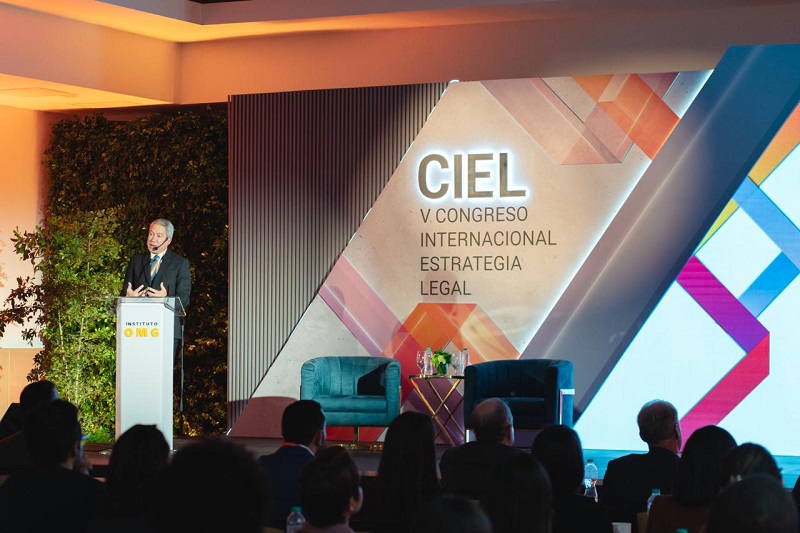
Santo Domingo.- Artificial intelligence is the engine of autonomous technologies, with a transversal impact on all sectors of the economy, said Leonel Melo Guerrero, president of the OMG Institute during the fifth edition of the International Congress of Legal Strategy.
He pointed out that AI does not replace human intelligence, but rather enhances it in each phase of the strategic process, giving rise to a new figure: the augmented legal strategist, capable of orchestrating human and artificial intelligence.
Melo explained that the impact of AI must be analyzed differently in each of the phases of the Legal Strategy model developed by the OMG Institute, since both the available tools and the effects of artificial intelligence vary from one phase to another.
This distinction reveals, in turn, the specific space where human intelligence must be concentrated to generate greater value, and he stressed that the most powerful opportunities arise precisely at the intersection between human and artificial intelligence, and it is in that convergence where what he defined as the Augmented Legal Strategy is born.
In a special intervention titled “The future of Dominican justice,” the Chief Justice of the Supreme Court of Justice, Henry Molina, stated that justice must be understood as a fundamental right that takes shape in a dignified, accessible and reliable service.
He pointed out that true progress is measured in people’s experience, in how they are guaranteed legal security and treated with dignity.
He stressed that artificial intelligence must serve justice: be explainable, fair and act as a bridge between the file and the history of each person, within the framework of a transformation that seeks a more human, closer and innovative justice.
For his part, the British economist Daniel Susskind, author of “A World Without Work” and “The Future of the Professions”, with his keynote presentation “The Future of Work in the Age of AI” analyzed how automation and AI are transforming professions and redefining the human role at work.
He explained that the real disruption is not that machines replace human work, but that they reconfigure it, displacing certain tasks and creating new opportunities.
Susskind emphasized the importance of not assuming that artificial intelligence reasons like humans, and suggested that the analysis should start from asking different questions, focused on the specific problems that you want to solve, beyond replicating traditional processes.
Their message was clear: adaptation will require education, ongoing training, and a results-oriented approach.
Chance
Other conferences were: “Upgrading Reality: Legal and Business Opportunities with AR”, by Daniel Castro, vice president of ITIF, on augmented reality with applications from commerce and construction to the judicial field and its ethical and security challenges. Likewise “This Year’s Generational Shift in Artificial Intelligence: Agentic and Autonomous AI for the Dominican Republic from a transnational approach”, by Jon M. Garon who analyzed the impact of AI on legal and economic frameworks.
Also, Daniel Tejada Plana, lawyer at Corporate Defense SLP, shared his conference “Behavioral Compliance: Criminal Compliance and Behavioral Ethics”, and the last conference of the event, titled “Technology with Meaning: Real Examples of Innovation with Impact”, was given by Prof. Dr. Christoph Lattemann (Constructor University) who presented concrete examples of how AI is transforming value creation.
The program included panels such as: “Augmented reality in action: how it impacts justice and business”, “Innovative proposals in times of change”, “From the algorithm to the customer”, “Smart compliance”, and “Technology with meaning”. The grand closing was led by the panel “Bits, laws, strategies and opportunities”, with the participation of prominent international speakers.
The meeting was held at The Westin Puntacana Resort and featured the participation of world-class experts who addressed the challenges and opportunities at the intersection of technology, compliance and legal strategy.
During two days of conferences, panels and networking spaces, CIEL 2025 reaffirmed its role as a platform for reflection on the future of law and business in a deeply digitalized environment. The closing left a common message: the path towards a more adaptive, technological and human legal strategy is underway, and requires constant interdisciplinary dialogue.