The official explains that the decrease in the population of gray whale not only responds to climatic phenomena, but also to the degradation of their food areas in the Arctic, which causes them to arrive in poor physical conditions after their long immigration journey.
“There is a decrease in food availability. Whales arrive skinny, without the energy needed to mate. That also explains why we see less young,” he says.
In that context, it makes an urgent call to strengthen the protection actions of this emblematic species of the Mexican coasts.
“We need to sit down with marine researchers and biologists, and that this information reaches decision makers to strengthen conservation actions,” says the official.
The Gray Whale is a natural treasure of Mexico, and its future is in our hands.
Antonio González Vizcarra, director of the El Vizcaíno Biosphere Reserve.
The Biscay: a vital sanctuary for the whale
The La Vizcaíno lagoon complex, composed of the lagoons Eye de Liebre and San Ignaciowas declared in 1972 as the first whale sanctuary in the world. In it, They are born and reproduced to 90% of the gray whales of the planet: 15% in the Magdalena Bay complex, 55% in the eye of hare and 35% in San Ignacio.
(Photo: Gob.mx/conanp)
For this reason, explains González Vizcarra, the Gray Whale is considered a Mexican species. However, its conservation status is at risk.
“We had 568 whales in Eye de Liebre and 91 in San Ignacio. The previous year were 758 and 125, respectively. The decrease is noticeable,” says the director of the reserve.
The increase in water temperature, associated with the phenomenon of “the girl”, is one of the causes that, he explains – modified their migration pattern. Instead of concentrating on the interior lagoons, the whales began to move towards other areas more south of the peninsula.
“We were reported to us in Cabo Pulmo, in the Bahía de Loreto National Park and even in the Los Angeles Bay, which is not normally given,” explains the director of the reserve.
On February 19, the National Commission of Protected Natural Areas (Conanp) reported 50 copies of gray whale in the waters of the Cabo Pulmo National Park, a phenomenon that marked the first time in the history of the park that was observed such a significant number of specimens of this species in the area. Its sighting generated great interest between the scientific community and the visitors of the Park.
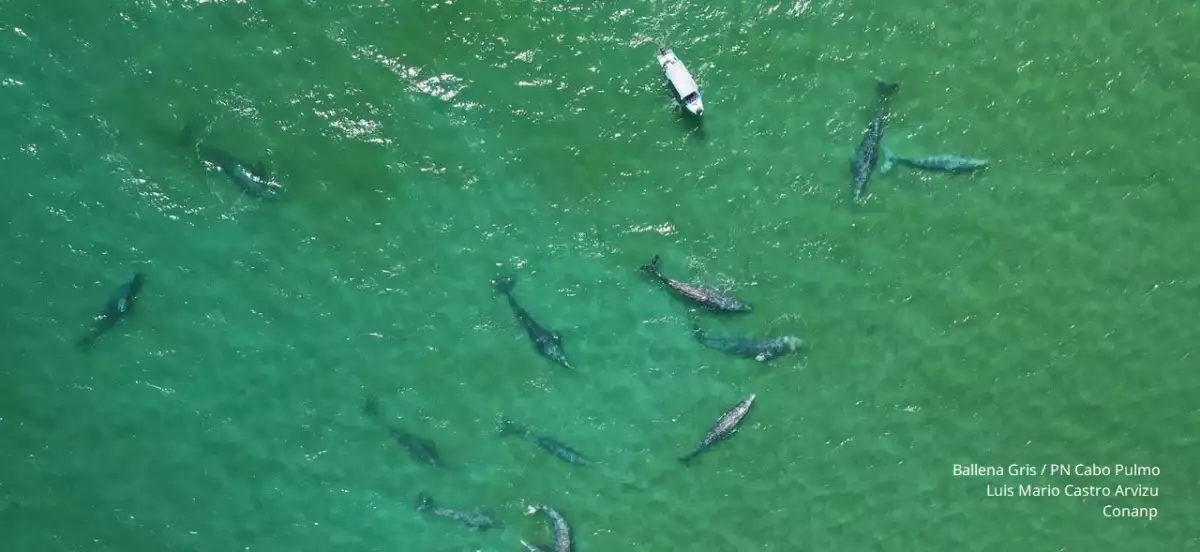
(Photo: Conanp)