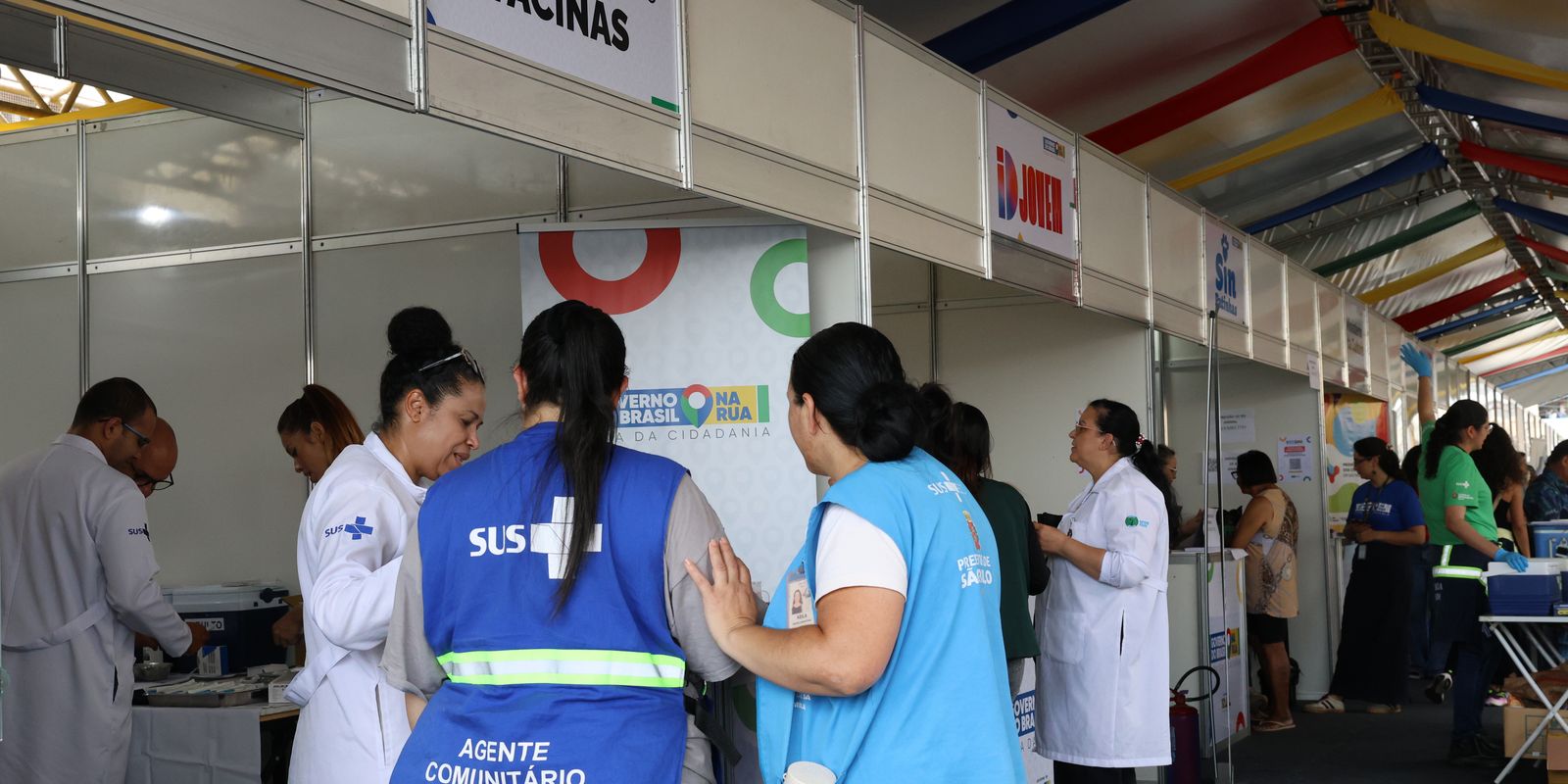
Residents of the community of Heliópolis, in the south zone of São Paulo, were able to access various services from federal agencies during the morning and afternoon of this Saturday (20). 
The federal government’s Government of Brazil on the Street initiative provided services such as dentists, INSS teams and services such as ID Jovem, as well as vaccinations for people and microchipping and vaccinations for dogs and cats.
Caixa was also present, with renovation credit lines, and the Ministry of Culture, with information on notices and grants.
“And what is the idea? It is to bring the programs, the services of the federal government to the people, where the people are, because sometimes the people have no way to go to the government”, said the Minister of the General Secretariat of the Presidency, Guilherme Boulos.
“Back there is the INSS counter. Many people who were waiting a long time in the INSS expert line, or needed a document, have difficulty using their digital or cell phone. Elderly people are coming here and solving the problem.”

Chief Minister of the General Secretariat of the Presidency, Guilherme Boulos, at the opening of the Government of Brazil on the Street in Heliópolis – Rovena Rosa/Agência Brasil
The initiative, explained the minister, serves both to make the public service reach areas where the government does not have direct equipment and to show the population services that they may not know about, such as the Reforma Casa Brasil financing line, with credit lines of up to R$30 thousand, from Caixa, or the documentation and microchipping of animals, through the SimPatinhas program.
The action in São Paulo is the second in the series of Fairs. The first, last Saturday (13), provided 4,400 visits to the Sol Nascente community, in Ceilândia, a municipality in the Federal District.

Vaccination of domestic animals against rabies in the second edition of the Government of Brazil on the Street – Rovena Rosa/Agência Brasil
From the second half of January onwards, the Fair will begin again, with plans to cover another 25 cities. The actions, in partnership with mayors and governors, will last until June 2026, ending shortly before the period of suspension of service activities, due to electoral legislation.
For the minister of the General Secretariat, although the idea is to integrate the federal government’s initiative with municipal and state entities – as happened last week, in Brasília – representatives from São Paulo were not interested in the initiative:
“Unfortunately, here in São Paulo, Mayor Ricardo Nunes and Governor Tarcísio showed no interest in getting closer, in bringing government policies to the streets. They are different visions of government, right? There are governors out there who receive a standing ovation in Faria Lima. President Lula receives a standing ovation here in Heliópolis, in Paraisópolis, in the communities and on the outskirts of Brazil.”
“It’s natural that governments have different positions and don’t want to collaborate, but that won’t stop us from continuing to bring the Brazilian government’s programs to the streets”, concluded the minister.
A little bit of everything

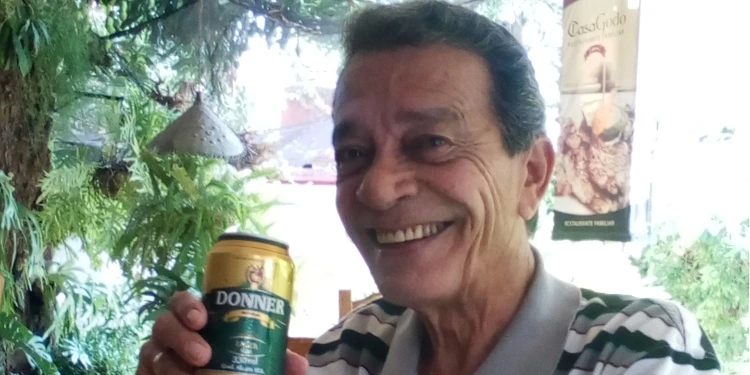
Musician Paulo de Ângelo at the second edition of the Government of Brazil on the Street, in Heliópolis – Rovena Rosa/Agência Brasil
Among the residents present, it didn’t matter so much who offered the service, but the fact that it finally arrived, effectively.
Ceará native Paulo Afonso de Ângelo, a resident of the region for 30 years, arrived a few days ago from a visit to relatives in the North. He intended to resolve pending issues with the INSS, visit the dentist and was checking whether his vaccinations were up to date.
“I think it’s been very good, but I arrived a little late, if I had known I would have arrived earlier, right? Because I don’t know if there will be time to do everything, but what I want to do is at least the main thing, which is the vaccine and the other part of the INSS, which I’m already waiting for with the form”, said Paulo, who works as a composer and singer.
With her cat in a carrier, diarist Luzinete do Carmo updated her cat’s vaccination record.
A little earlier he also brought his dog and made the animals’ ID cards for both of them.
She then took the opportunity to resolve Social Security issues:
“Boy, I just thought it wasn’t like that, like, very forewarned. I saw it on Google last night, out of nowhere. I was on Google and saw it, otherwise I wouldn’t even know. Then today I came early, with my dog. Now with my cat and I’m going back to go to the INSS”, said Luzinete.

Valdirene Souza seeks guidance on social assistance – Rovena Rosa/Agência Brasil
Waiting in line to talk to INSS attendants, metalworker Valdirene Souza came to the Fair because she lacks time during the week to look for this type of service.
“I came here to see that there was a discount on my INSS years ago. I even went to the Post Office to see it and I wanted to go back there, but I didn’t. So since it’s already here, I decided to take advantage of it. In everyday life you have to make an appointment. People who work have very busy lives, right?”, pondered the metalworker.
On the other side of the counter
The services were offered by employees from different agencies. Tathiana Bagatini, for example, works at the Superintendence of the Brazilian Institute for the Environment and Renewable Natural Resources, Ibama, in the state of São Paulo.
She came with four other colleagues and they were working together with city hall health surveillance workers, who vaccinated pets and performed microchipping, with workers from an NGO.
“It’s been different for us, because what we normally do is with wild animals. Domestic animals, we don’t even have a role, but we came to help here at the weekend and it’s been very interesting. The population has so many needs that we ended up helping with more than one. Many people we helped by registering with GOV.br, which people had to do to be able to get a microchip, and many didn’t have the registration”, explained the server.
According to Tathiana, the biggest difficulty was access, such as a data package or a compatible cell phone, or even people who did not know the procedures for accessing the platform.

Second edition of the Government of Brazil on the Street, in Heliópolis – Rovena Rosa/Agência Brasil
On the other side of the counter
There were also those who came to work, but took advantage of a break to catch up on their rights. This is the case of Brenda Goulart, who received the second dose of the Hepatitis B vaccine.
The employee, from the National Youth Secretariat, was at the Ceilândia action and will accompany the Fair caravan during the next semester, working on the registration and issuing of ID Jovem cards. This service served a few dozen people this Saturday, most of whom had difficulty resolving pending registration issues on the platform.
The Youth ID can be done by any citizen aged 15 to 29, registered with CadÚnico and with an average family income below two minimum wages. Among the benefits after registration are proof of a half-price discount on cultural events and the possibility of discounts or even free travel on interstate buses.
“We are here to help young people understand, explain what public policy is, explain what rights it brings. And whoever meets the requirements correctly, we issue the card too”, explained Brenda.