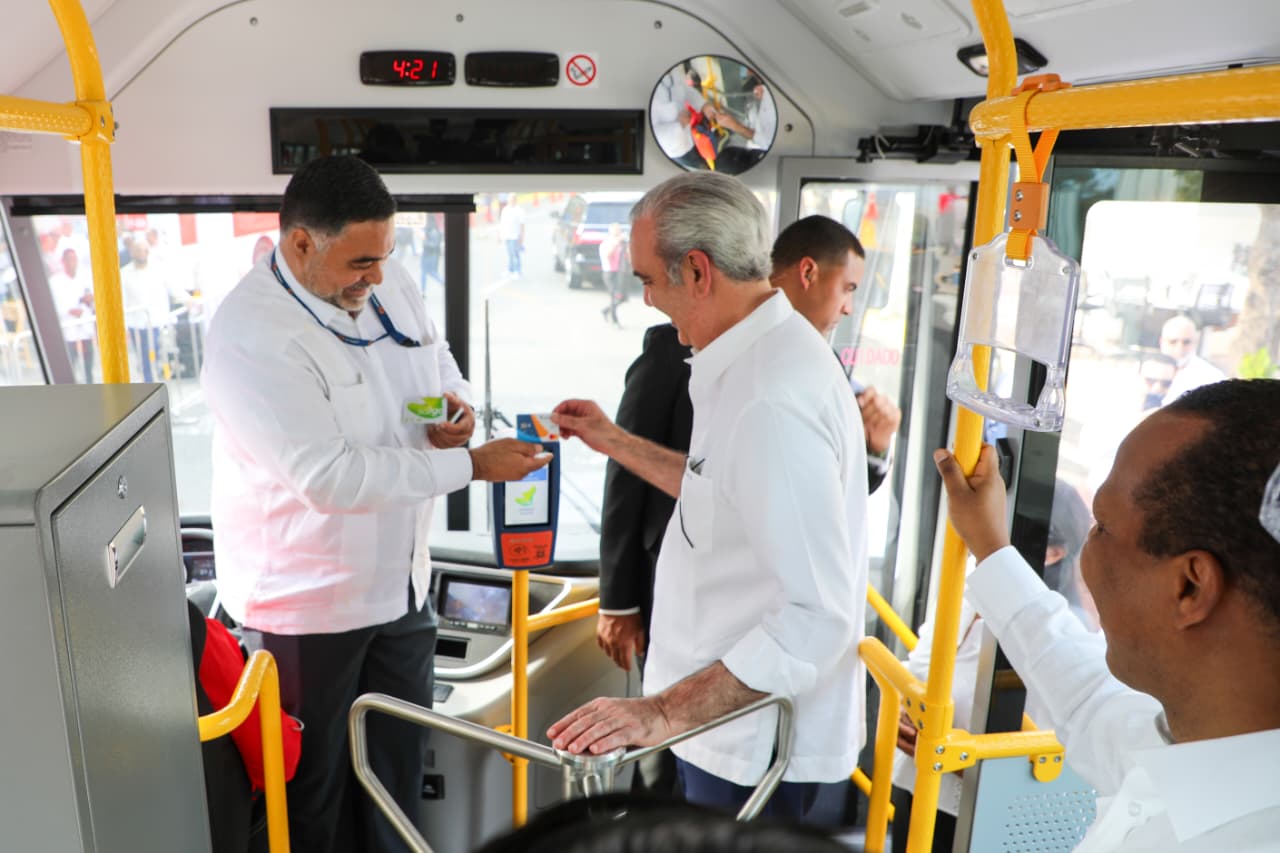
Santo Domingo. – President Luis Abinader formally left the Independence Corridor in operation, an initiative that will impact more than 40,000 passengers dailysy that consolidates the process of transformation of public transportation in Greater Santo Domingo.
With the incorporation of this new service, the network of renovated corridors reaches a total of 209 buses distributed in four corridors: 30 in the Núñez Corridor, 46 in the Churchill Corridor, 64 in the Charles Corridor and 68 in this Independencia Corridor. This network currently provides coverage of 500.93 kilometers, adding an additional 67.27 kilometers for its different branches with the implementation of the new corridor.
More initiatives to improve traffic
The Minister of the Presidency, José Ignacio Paliza, exclaiming: “Let Independence flow from today,” highlighted that the government of President Luis Abinader, in addition to this corridor, will launch other initiatives over the course of this year that seek to continue improving transportation.
Among them he mentioned line 2C of the Santo Domingo Metro, two additional lanes on the Duarte highway, the completion of work on kilometer 9 of the same road and the overpasses in the Plaza de la Bandera, as well as the new Santo Domingo Oeste cable car. And he recalled that to this will be added the Santo Domingo monorail that will link the Olympic Center with Santo Domingo Oeste and its bidding is already underway.
Likewise, Deligne Ascensión, coordinator of the Transportation Cabinet, expressed that the government of President Luis Abinader “has decided to face the challenge of transportation and transit with a complete and comprehensive vision as has never been done before in the Dominican Republic,” and highlighted the work of the technical team in charge of these works.
For his part, Antonio Brito, vice president of Fenatrano, described the president as a man of action, who keeps his word, not only for all the support received to launch the Independence Corridor, but also for previous experiences, when, when Brito was mayor of Quitasueño, he also received support from the government train for the execution of several community projects in favor of a healthier and safer coexistence.
More than 56 million users mobilized in the Núñez, Churchill and Charles de Gaulle corridors since 2021
Since the launch of the first renovated corridor in February 2021 to date, the system has mobilized a total of 56,461,684 passengers, consolidating itself as one of the main urban transport reorganization strategies in the country.
The new corridor will operate with 68 buses with capacity for 90 passengers each, from 5:00 a.m. to 11:00 p.m., with intervals of 5 to 7 minutes and 82 marked stops along the 18-kilometer route from origin to destination.
One of the most relevant aspects is its single rate of RD$35, which will allow users to access a modern service with completely electronic payment.
Additionally, through the Fare Stabilization Fund (FET) established in the central collection system, passengers will be able to experience an estimated saving of up to RD$60 per trip, as part of the direct subsidy aimed at guaranteeing accessibility and sustainability of the system.
Connectivity with the Santo Domingo Metro
Likewise, the first phase of the fare integration pilot with the Santo Domingo Metro will be launched, allowing transfers at no additional cost at enabled stations when payment is made electronically and with a bank card.
The project is coordinated by the Transportation Cabinet of the Dominican Republic and operationally supervised by the National Institute of Transit and Land Transportation (INTRANT), which will guarantee GPS monitoring from the Bus Control Center and inspection at stops.
As part of the implementation process, more than 200 drivers were trained, strengthening their skills in safe driving, user treatment, and compliance with traffic regulations. They will also benefit from social security, fixed working hours and pensions.
The new scheme incorporates service quality standards, which include punctuality, optimal condition of the units and frequency regularity, with permanent monitoring of these indicators to ensure a safe and efficient mobility experience.
With the launch of the Independence Corridor, the Government continues to move towards an integrated, sustainable and user-centered public transportation system, promoting reduced emissions, less congestion and a better quality of life for thousands of Dominican families.