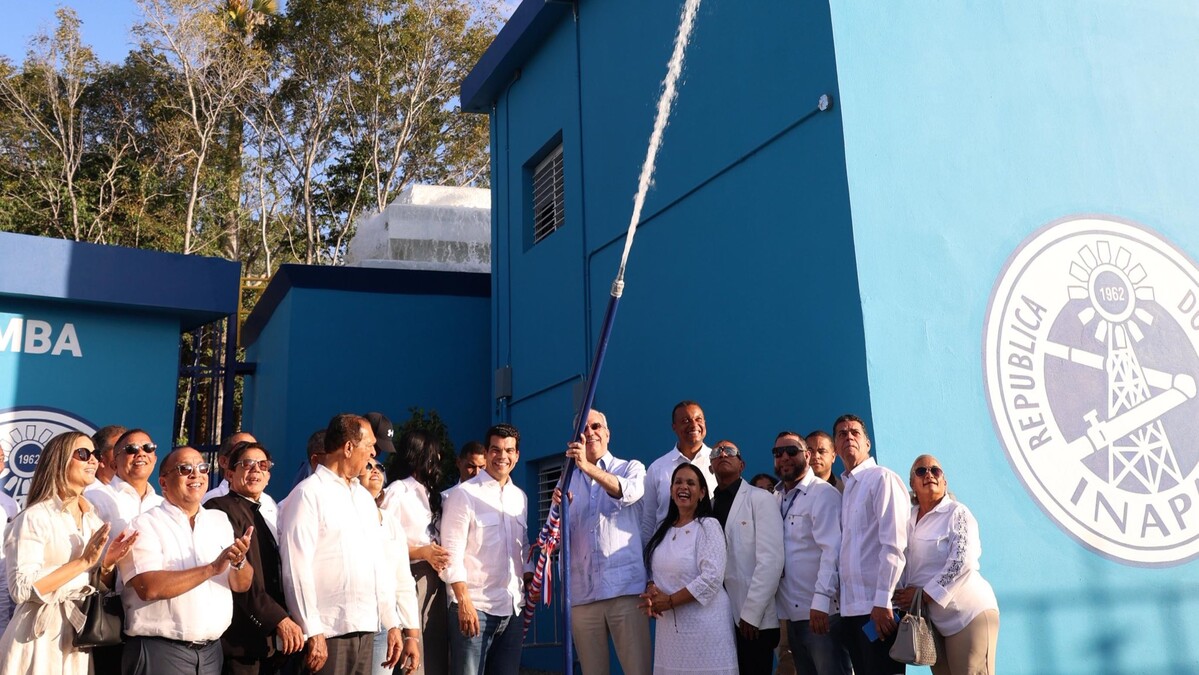
He President Luis Abinader left in operation this saturday Monción-Sabaneta multiple aqueducta water infrastructure claimed for more than 20 years and intended to ensure the supply of drinking water to more than 50,000 people in this district.
The work was developed for him National Institute of Drinking Water and Sewers (Inapa) and seeks to consolidate essential services in the province, by guaranteeing continuous and safe access to the resource.
During the event, the president pointed out that with the start-up of the system a pending commitment with the community, by providing it with a modern structure in an area that, despite having natural water sources, did not have an efficient distribution mechanism.
He indicated that this investment is part of the government strategy to carry concrete solutions to each territory of the country.
He expressed that Moncion owns productive dynamism and potential in the agricultural and tourism sectors, so the stable access to water will contribute to raising its economic development and social well-being.
The head of state also reported that the Government executes other interventions in Santiago Rodríguez, such as the construction of a road that will connect Moncion with Jarabacoa through the mountain range, in addition to projects in educationhealth and sanitation.
Investment greater than RD$1,645 million
The executive director of Inapa, Wellington Arnaud, explained that between 2004 and 2020 the investment in drinking water in the province was RD$24 million, while in the last five years exceeds RD$1,600 million.
He specified that the aqueduct required a investment of RD$1,645,677,050.00 and that its execution involved the network installation in all the streets of the benefited communities.
17 locations impacted
He system will supply to MoncionLa Cacique, Los Quemados, Veladero, Las Caobas, Los Tabacos, El Orégano, El Cepillo, Los Pinos, Guamachal, Los Bañaderos, Garabito, La Estancia, Gurabo, Loma del Tanque, Los Ingenitos and La Meseta.
The infrastructure includes a water treatment plant rapid filtration with a capacity of 70 liters per second, rehabilitation of the existing plant, pumping station, drive and driving line, as well as the placement of 4,000 home connections.
It also contemplates a regulating tank surface of 1,200 cubic meters and additional reinforced concrete tanks with capacities of 300 cubic meters in La Meseta, 200 cubic meters in Las Caobas and 300 cubic meters in Los Quemados.