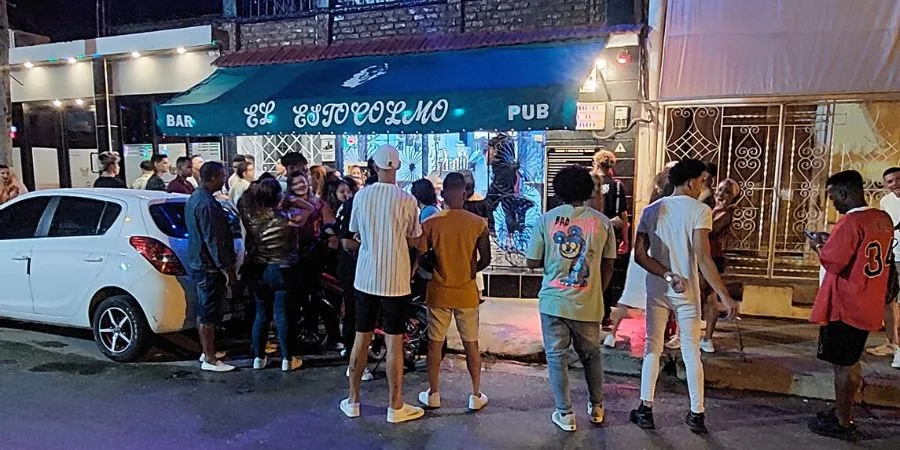
Cuba continues to suffer a brutal inversion of the social pyramid, where serving tables is more profitable than saving lives.
HOLGUÍN.- “Today people do not want to work with the government; they prefer to work privately. The state salary is not enough and everything is very expensive. The government does not let go of business, but it is going to have to do so, because people are leaving, especially young people. Look if this is the case, there are doctors working in private restaurants.”
The words of Roberto García from Holguín summarize, without euphemisms, the deep crisis of the Cuban labor market. This is not an isolated complaint or a casual comment, but rather a reflection of a widespread reality: the university degree has lost all practical value in the face of the basic urge to eat.
Cuba continues to suffer a brutal inversion of the social pyramid, where serving tables is more profitable than saving lives. Yordanis Tamayo, a resident of the Peralta neighborhood, confirms this with everyday examples.
“In the restaurant next door there are three doctors working as waiters. They earn more than in the hospital. They left medicine after six years studying and five years working.”
From vocation to survival
This forced migration to the private sector does not respond to a preference, but to an extreme need. Michel Fonseca, resident in the Alex Urquiola neighborhood, remembers the exact moment he abandoned his profession as a civil engineer.
“One day my shoes broke and I didn’t have enough to buy new ones to go to work. That’s when I said: ‘It’s over’. I started as a clerk in a private bar and today I’m a bartender. It was difficult, because you have your pride, but pride doesn’t put food on the table. On a good night of tips I earn what they used to pay me in a month. Sad, but real.”
Professional humiliation has become normalized. Dayana Tamayo, a graduate in Nursing, explains how the vocation becomes a luxury when there are children to feed.
“I studied for years, I did 24-hour shifts without sleeping, and today I am a clerk in a MSME. It is humiliating that a university degree in this country is worth less than a piece of toilet paper. But I have two children and with a vocation you don’t pay for a school snack.”
The testimonies find support in the official data themselves. The Statistical Yearbook of Cuba 2024, published by the National Office of Statistics and Information (ONEI), documents a massive attrition of health professionals.
In the last year alone, 5,399 doctors left the public system, representing a drop of 7%. The total number of doctors in the Ministry of Public Health increased from 80,763 in 2023 to 75,364 in 2024.
The impact is even more severe in primary care. According to the ONEI, the number of family doctors fell from 27,535 to 12,912 in just one year, a reduction of 53%.
The impossible mathematics of the state salary
The cause of this stampede of young people is in the domestic economy. Carlos Manuel Pérez, from the Pueblo Nuevo neighborhood, explains how much a basic breakfast costs.
“Only the bread, which you have to buy on the left because the one from the bodega fails, costs between 80 and 100 pesos a package. Add the coffee, at 500 pesos a pound, and forget about the milk. For four people to have a bad breakfast, you spend between 400 and 500 pesos a day. In a few days, an entire month’s salary is gone.”
Yordanis Tamayo agrees with the calculations: “For half a meal, buying the minimum, it costs more than 700 pesos a day. For two people you need at least 21,000 pesos a month, and that’s eating poorly. To eat decently you have to earn more than 50,000. With the state salary it’s not enough.”
Maritza Torres, a worker in the education sector, sums it up crudely: “My salary does not reach 5,000 pesos. That is enough for a carton of eggs and a bottle of oil. The rest comes from invention. I resell cigarettes and do nails on the weekends. If we lived only on salaries, we would already be dead.”
Extreme poverty with employment
The Cuban economist Pedro Monreal provides the technical framework. Applying the World Bank’s international extreme poverty line ($2.15 per day), 100% of Cuban state workers would fall into that category.
With an average state salary of 6,685 pesos and an official exchange rate of 120 CUP per dollar, daily income is equivalent to about 1.8 dollars. If the informal rate were used, Monreal warns, “the disaster would be much greater.”
Data from the VIII Study on Social Rights of the Cuban Observatory of Human Rights reinforce this diagnosis: extreme poverty reaches 89% of the population and seven out of ten Cubans have stopped eating at least one meal a day due to lack of money or food.
The State is no longer an option
Against this backdrop, state employment is no longer attractive. Yudith Almaguer, from the Lenin cast, observes how official job offers are ignored.
“The signs are there, but no one looks at them. In a private business, cleaning, they pay you at least 600 pesos a day. In the State, for the same thing, they give you 2,000 pesos a month. Who is going to work for that?”
Luisa María García adds that it is not just the salary, but the working conditions: “Without gloves, without detergent, with an old cloth and the boss yelling at you. In the private sector they demand you, but they give you lunch, means of work and they pay you instantly. With the State, the refrigerator is empty.”
Eusebio Batista blames the government directly: “This was caused by the inefficiency of the State. It reminds me of when in Bulgaria the engineers ended up driving taxis. The same thing happens here.”
Publications like The Economist They warn that Cuba is headed for a major collapse if there are no structural changes. The media highlights the government’s inability to define its relationship with the private sector and the permanent legal uncertainty.
Analysts like Diego Acuña reject the official narrative that attributes the crisis exclusively to the US embargo. “The problem is the model. There is no wholesale market, there is no freedom of imports, the State controls everything. So no one invests.”
Even during decades of Soviet subsidies, Acuña recalls, Cuban productivity never took off.
Meanwhile, the official discourse continues to appeal to ideological slogans that do not solve daily life. For citizens, the reality is different.
“My salary and that of my husband are not even enough for us to sit at a pizzeria one night,” says Yamilé Rodríguez, a state worker. “The weekend is for waiting in lines, washing by hand and thinking about what to eat on Monday.”
Caridad Hechavarría Aguilera, retired after 38 years of working in Commerce, sums up the feeling of abandonment.
“My checkbook doesn’t even cover my blood pressure pills. I feel helpless. If it weren’t for my children, I would have died already.”
In revolutionary Cuba, the social pact was broken. Study no longer guarantees dignity, state work does not ensure subsistence, and professional merit has been replaced by the ability to “invent.” In this scenario, more and more Cubans understand that the problem is not individual, but structural. And the model simply stopped working.














