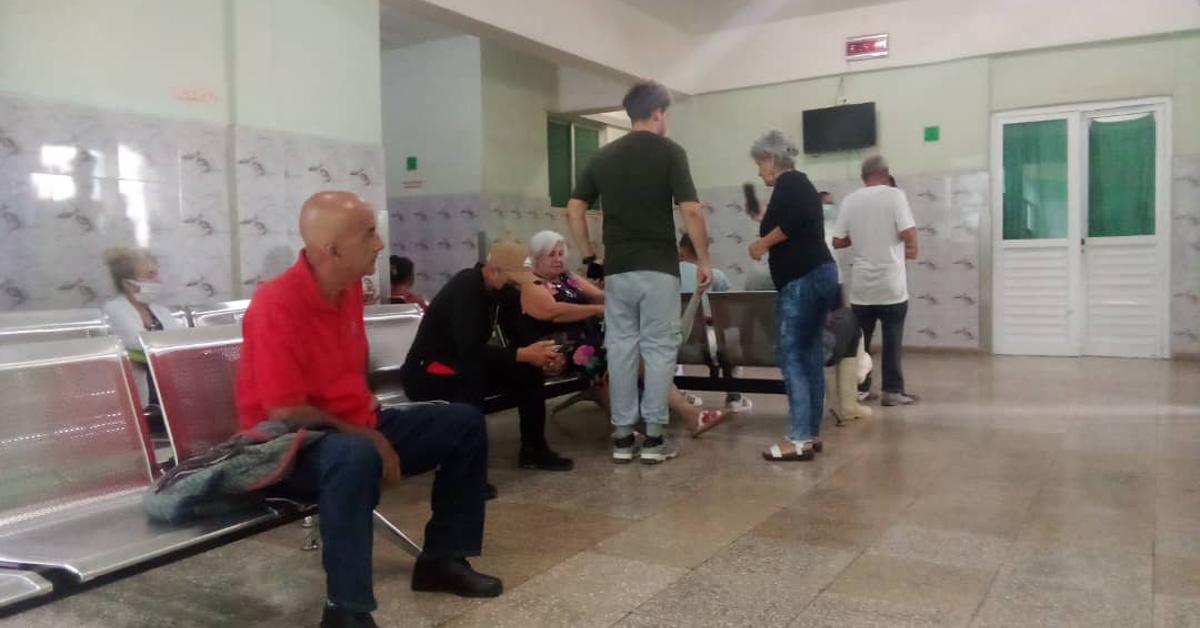
San José de las Lajas (Mayabeque)/In the guard room of the Leopoldito Martínez Rodríguez General Teaching Hospital, in San José de las Lajas, the benches are full this Tuesday. A dozen people look alternately at the only open office and at the digital clock in the room, which marks an hour that advances more slowly than worries. The avalanche of cases with arbovirus symptoms – which officially has caused 33 deathsa figure that the testimonies contradict published on social networks– overwhelms the few health personnel.
The doctor on duty tries to calm things down, but she cannot find the right words to explain the inexplicable: she is the only doctor available in the entire guard force, even though it is not early morning or the weekend. “Today I’m alone,” she repeats, as she tries to pass one more patient.
According to the National Office of Statistics and Information (Onei), the national health system has lost almost 30% of its doctors in three years: 106,131 in 2021 and 75,364 in 2024. Some 24,000, it is estimated, are deployed on international missions. This means that there are only about 55,000 doctors left on the Island, although the current situation could be even worse, because the Onei data is from 2024.
At the entrance to the office, Margot, 54, holds her chest with both hands. “I have a shortness of breath that I can hardly breathe,” he says. “I’ll see if there is oxygen to give me an aerosol, because I can’t even get a plate because the equipment is broken.” Rather than receiving a diagnosis, she waits for a friend who promised to bring her the necessary nozzle for the spray. There is only one in the place that patients pass from mouth to mouth, without sterilization. “One can come to be cured and leave with another virus,” he protests.
The scene reveals an overwhelmed institution, without enough staff and with patients wandering without clear orientation
The scene reveals an overflowing institution, understaffed and with patients wandering around without clear direction. An employee hastily picks up the trash accumulated in the living room, but the mess goes beyond what is visible. The companions walk through the hallways with bags of serums, medications that they have had to buy in the informal market; Others push stretchers because there are no stretcher bearers on duty.
“There are no reagents to do analysis in the laboratory. They sent the technicians home,” denounces a young woman who is looking for a referral to take her father to a hospital in Havana. In Mayabeque, one of the provinces hardest hit by chikungunya, the situation is especially critical. In this context, the lack of personnel becomes more than an administrative problem: it is a vital risk. The young woman knows well the feeling of helplessness. Just a few weeks ago, while he was sick with chikungunya, he went to this same guard unit. “The doctor who treated me didn’t know what to tell me or what to prescribe,” he laments. Today he advises friends and family to go directly to Havana hospitals in case of any complications.
Cuba accumulates 40,801 cases of the disease, according to the report from this same Fridayand the rate of transmission does not decrease. The previous day, 627 patients with chikungunya and 396 with dengue were diagnosed, according to the information offered on television daily by the Ministry of Health, on this occasion, for the first time, through the mouth of the director of Environmental Health, Susana Suárez Tamayo, replacing the vice minister Carilda Peña García – who in turn replaced the well-known director of Epidemiology, Francisco Durán.
Suárez explained that the total number of serious patients has decreased: there are 64 –14 less than the previous day– and 12 are in critical condition –one less than the previous day–, the majority of them –11–, under one year old, the age group that presents the most serious symptoms of chikungunya.
In a side hallway, another patient carries his own medication and a syringe. “I have to inject myself every eight hours and I’m having a hard time getting the injection. After 10 at night there is no one in the infirmary,” he says. He has learned to accommodate his treatment schedules to the availability of staff.
The lack of doctors not only impacts clinical care, but also the most basic logistics. The companions assume tasks that in any hospital should correspond to health personnel: moving stretchers, looking for medications, managing clinical tests, notifying doctors when someone deteriorates. In some cases, they must even clean and mobilize patients.
At the exit from the guard room, a woman comments that she has been waiting for three hours for a simple medical order for her son with fever and joint pain. Another patient, tired, leans against the hallway wall. The doctor who attends alone, almost without looking up, asks for “a little patience”, while knowing that she cannot offer much more.