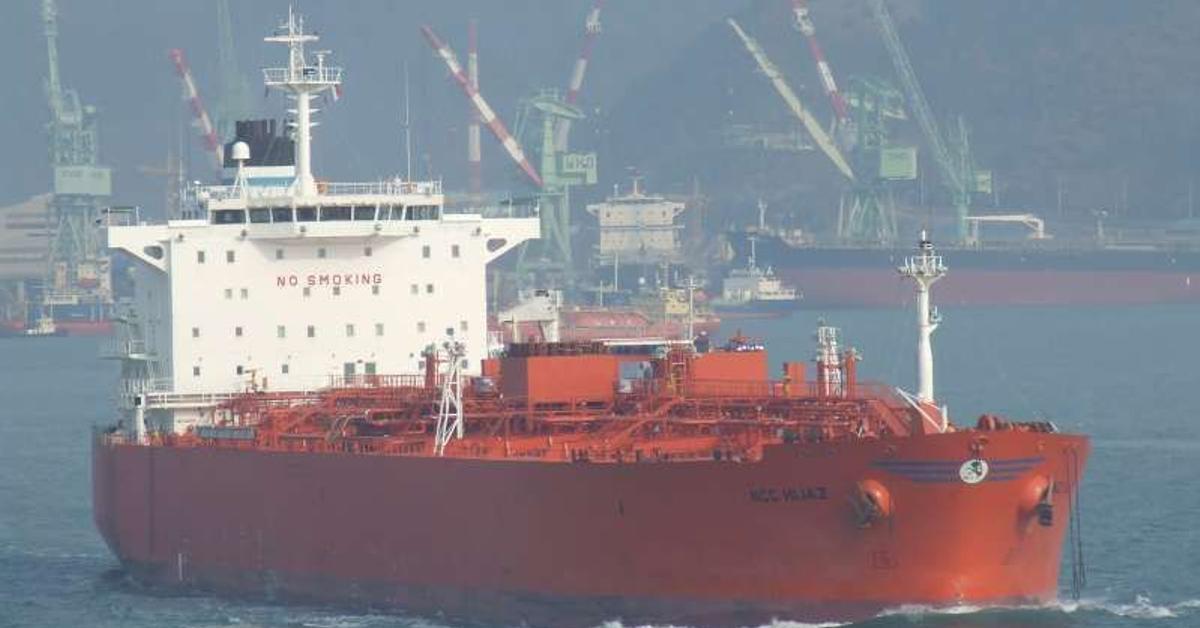
Havana/An oil tanker loaded with some 330,000 barrels of Russian crude oil entered Matanzas Bay, on the northwest coast of Cuba, this Thursday at a particularly critical moment for the national electrical system. The arrival of the ship, identified as the jaspersanctioned by the European Union, coincides with one of the most critical December months in the recent history of the Cuban electrical system, marked by generation deficits unprecedented in official records and prolonged blackouts in almost the entire country.
According to maritime tracking data, the ship sails under the flag of Vanuatu (some islets near Australia) and set sail from the Black Sea around November 14, 2025. According to its draft, the oil tanker is fully loaded, although it remained undocked in front of Matanzas, one of the most sensitive areas of the country due to its concentration of key oil and thermoelectric facilities.
The information was confirmed by Cuban expert Jorge Piñón, who points out that this would be the third ship to arrive in Cuba in less than a week, after two shipments from Mexico, within “the support that has historically been given to Cuba,” according to the president of that country, Claudia Sheinbaum. In large areas of the Island, blackouts exceed 20 hours a day, a situation that has ceased to be exceptional and has become the norm.
The context in which this shipment arrives could not be more adverse. On Tuesday, December 23, the national electricity deficit reached 2,184 megawatts, according to the Electrical Union. The figure was only one megawatt away from the historical record recorded on December 8, when the gap was 2,185 MW. For a country whose current demand is around 3,200 MW—one of the lowest of the year due to cooler temperatures—the magnitude of the deficit confirms December 2025 as the worst month in the recent history of the electroenergy system.
Cuba needs around 110,000 barrels per day to cover its basic energy needs
For more than half of this month, the difference between the electricity needed and what is actually generated has exceeded 2,000 MW. The direct consequence has been a scheme of prolonged, disorderly blackouts that are increasingly difficult to justify by the authorities, who repeat a discourse of “contingency” while the system accumulates structural failures.
The Government recognizes that the crisis has its origin in the frequent breakdowns of obsolete thermoelectric plants and in the lack of foreign currency to purchase fuel in international markets to operate large generating plants. In just twelve months, the national electrical system has suffered five total collapses, in addition to several partial ones, a record that illustrates the accelerated deterioration of the energy infrastructure.
In this scenario, the 330,000 barrels sent by Russia barely represent temporary relief. According to official estimates, Cuba needs around 110,000 barrels per day to cover its basic energy needs, of which about 40,000 come from national production.
About half of Cuba’s fuel needs are covered by imports from Venezuela, Mexico and, to a much lesser extent, Russia. However, those flows have been drastically reduced. In recent years, Venezuela contributed around 50,000 barrels per day, but since 2024 the average volume has fallen to between 10,000 and 30,000 barrels. Mexico, for its part, has reduced its shipments from an average of 22,000-25,000 barrels per day to just about 5,000. Neither Caracas nor Havana make this data public, which is disclosed by the Reuters agency or experts such as Jorge Piñón.
The decision by US President Donald Trump to confiscate sanctioned oil tankers from the so-called “ghost fleet” further complicates deliveries of Venezuelan oil destined for Cuba. In this scenario, each ship is presented as a salvation, although reality shows that it only postpones, for a few hours, the next electrical collapse on the Island.