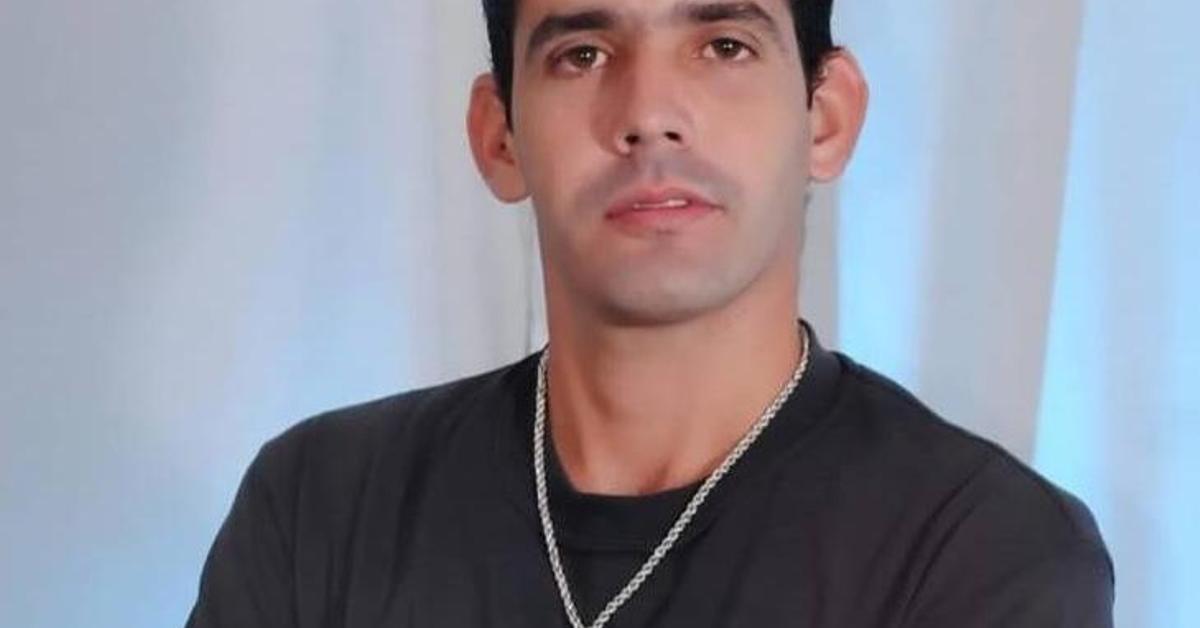
Havana/A teacher from Sancti Spíritus, Ariel Manuel Martín Barroso, is serving a 10-year sentence in the Nieves Morejón prison, in the Sancti Spiritus municipality of Cabaiguán, for carrying out several anti-government graffiti between the last months of 2024 and the first months of 2025.
Arrested on February 25 of that year, Martín Barroso was prosecuted for the crimes of propaganda against the constitutional order and contempt in a trial held in Santa Clara last September. The case was made known this Sunday by activists on social networks and was confirmed this Tuesday by the Academic Freedom Observatory
The NGO denounces that the sentence served by the professor, 42 years old and a professor at the Faculty of Technical and Business Sciences of the University of Sancti Spíritus, is “for strictly political reasons.”
If the case of Martín Barroso has not been known until now, it has been due to the reluctance of those close to him to report it, they refer to 14ymedio nearby sources. “The father belongs to the Communist Party and the family initially thought that telling him publicly would make things worse,” declares one of them.
If the case of Martín Barroso has not been known until now, it has been due to the reluctance of those close to him to report it.
According to the sentence, to which this newspaper had access, Martín Barroso made graffiti such as “down with Díaz-Canel”, “Patria y Vida”, “Díaz-Canel singao” or “fire with the communists”, with a “permanent black marker – pen – brand Erich Krause”, which was confiscated as evidence of the crime, along with a computer and a cell phone.
Before detailing dates and places – from October 17, 2024, when for the first time he painted a poster in a hallway of the university where he teaches, and until a vague date the following February -, the legal text establishes as a “proven fact” that Martín Barroso “from a date not specified exactly, but for several years, had been showing disagreement with the revolutionary and socialist process, mainly due to the measures that, from an economic point of view, have been implemented by the State Cuban.”
For this reason, the sentence continues, he “conceived the illicit idea of creating several posters to make them public in different places” both in the municipality of Sancti Spíritus and in the province. The court accuses the professor of having contacted “different ‘youtoubers’ mainly based in the United States” to carry out his actions, using “propaganda from the counterrevolutionary organization abroad” Self-Defense of the People, which he defines as “neoterrorist” and based in Florida.
The text allows itself to boast of a freedom of expression that does not exist on the Island by saying that “instead of showing its disagreements through established legal channels, it chose to create posters with counterrevolutionary content,” taking advantage, it continues, “of the tense situation that exists in our country with electricity.” The court judges, in fact, regret that the posters were painted in the middle of a blackout.
The text allows itself to boast of a freedom of expression that does not exist on the Island by saying that “instead of showing their disagreements through established legal channels”
The case of the university professor has been made known at a time when the regime is currently breaking records for political prisoners, coinciding with the worsening of the energy crisis after the fall of Nicolás Maduro in Venezuela. According to the Madrid-based NGO Prisoners Defenders, there are a total of 1,207, 18 of them imprisoned so far this year.
One of the most recent cases of repression is that of Ernesto Medina and Kamil Zayas, members of the El4tico project, who were arrested on February 6 in Holguín for freely expressing their opinions on social networks. The videos produced by these young people from Holguín have gone around the world and, today, their Facebook and Instagram accounts exceed 138,000 followers. State harassment against these young people had been brewing for several months before their arrest.
On February 4, a group of Cuban activists submitted a citizen petition to the National Assembly of People’s Power to promote an amnesty law in order to free political prisoners. The initiative For an Amnesty Now! I counted until now of delivery, with more than 1,500 verified signatures, of the 10,000 necessary to request the drafting of a law.