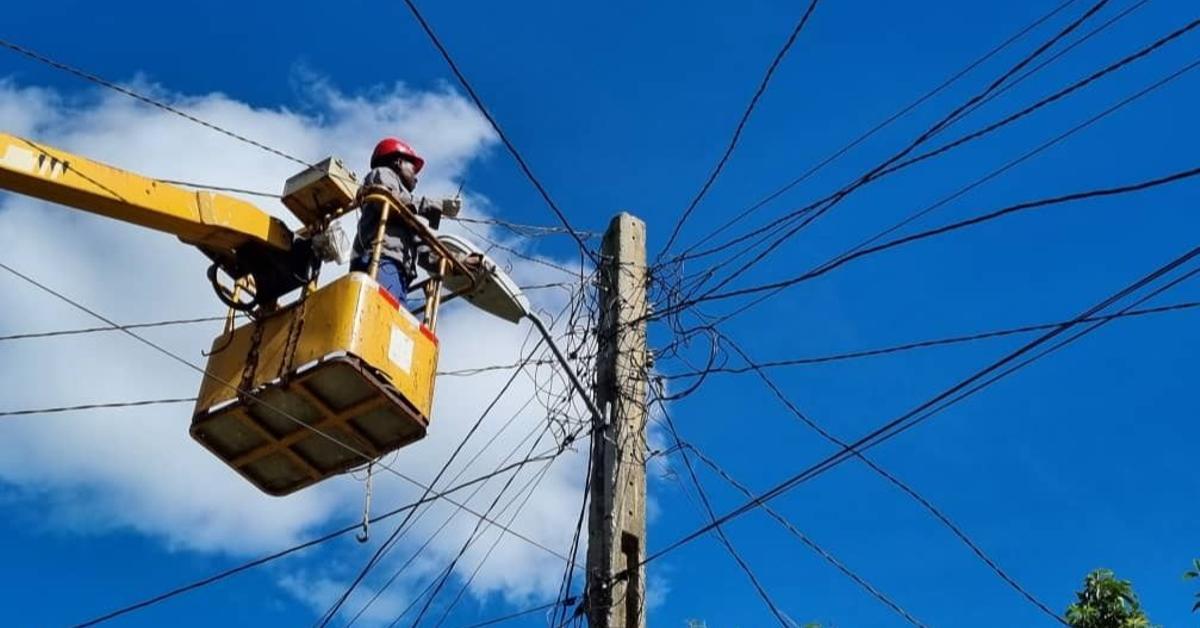
Havana/A new failure in the National Electrical System (SEN) this Thursday caused a partial disconnection that affected several areas of the country, according to official sources. The breakdown occurs at a time when citizen concern is growing over the advance of the Tropical Storm Melissa. This partial blackout is added to the five total blackouts that have been recorded on the Island in the last twelve months, the most recent last september.
The official note appeared on the X profile of the Ministry of Energy and Mines, which reported “an oscillation” that would have caused the interruption of service. He messageof just three lines, assured that work was already underway “on the total recovery that must occur in a short time,” without offering details about the causes of the oscillation or the real extent of the blackout.
Shortly after, the Havana Electric Company published an update in which it recognized damages equivalent to 120 megawatts (MW) in the capital, with a partial recovery of 60 MW between the Talla Piedra and Diezmero substations, in addition to some circuits in Naranjito. Finally, the Electrical Union (UNE) declared that the system was operating “in a stable and complete manner”, after having restored 60% of the affected circuits, although user complaints continued to multiply.
On social networks, the comments were a reflection of the growing fatigue with the recurring blackouts and the lack of institutional transparency. “Leave it like this, if there is never electricity anyway,” wrote one Internet user in a tone of resignation, while another questioned the official explanation: “Oscillation of what and partial for whom?” Irony, anger and distrust dominated the digital debate.
Thermoelectric plants operate today with a high degree of obsolescence, the result of decades of continuous exploitation and a chronic deficit in investment and maintenance.
In the editorial office of this newspaper, located in the neighborhood of Nuevo Vedado, the power outage scheduled for this Thursday was to begin at 2:30 pm, but the neighbors were faced with the bitter surprise that the electricity was cut off shortly after 1:00 pm. After several comings and goings, the power service was suspended again around 3:30 pm and has not returned as of this writing.
Cuba’s thermoelectric plants, a historical pillar of energy generation in the country, operate today with a high degree of obsolescence, the result of decades of continuous exploitation and a chronic deficit in investment and maintenance. Added to this is that numerous distributed generation engines remain out of service due to the shortage of foreign currency that prevents the import of fuel, lubricants and spare parts, which aggravates the fragility of the system.
The UNE had forecast for today’s night peak hours an availability of 1,595 MW compared to a maximum demand of 3,320 MW, which would generate a deficit of 1,725 MW and an estimated impact of 1,795 MW “if current conditions were maintained.”
Among the main breakdowns were units 2 of the CTE Felton, 3 of Santa Cruz, 8 of Mariel and 6 of Renté, while three other units in Santa Cruz, Cienfuegos and Nuevitas were undergoing scheduled maintenance. There were also 72 distributed generation plants paralyzed due to lack of fuel and other effects due to a “shortage of lubricants.”
Estimates from unofficial sources estimate that reactivating the national electrical system would require between 8,000 and 10,000 million dollars.
The state solar program, which has added 32 photovoltaic parks so far this year, offers some relief during daylight hours, although its impact is limited, due to the lack of storage batteries to harness that energy at night.
According to independent specialists, the Cuban energy crisis has its roots in prolonged underfinancing of a sector that has remained under absolute control of the State since 1959. Estimates from unofficial sources calculate that reactivating the national electrical system would require between 8,000 and 10,000 million dollars, a sum outside the financial reach of Havana in the current scenario.
This new episode of partial blackout revives the recent event in which Cuba remained “in the dark” for more than 24 hours after a total disconnection of the SEN on September 10, when the country was left with local microsystems incapable of restoring general service. That failure, which left large territories without electricity even for more than 40 hours while the authorities barely managed to turn on essential circuits, starkly illustrated the fragility of the national electrical system that today is collapsing again under the umbrella of partial explanations.
Meanwhile, Storm Melissa advance slowly over the central Caribbean with sustained winds of 85 km/h, and meteorological authorities warn that it could strengthen in the coming hours. In this context, the fragility of the SEN once again exposes millions of Cubans to a predictable scenario: prolonged blackouts, little information and an increasingly dark electrical future.