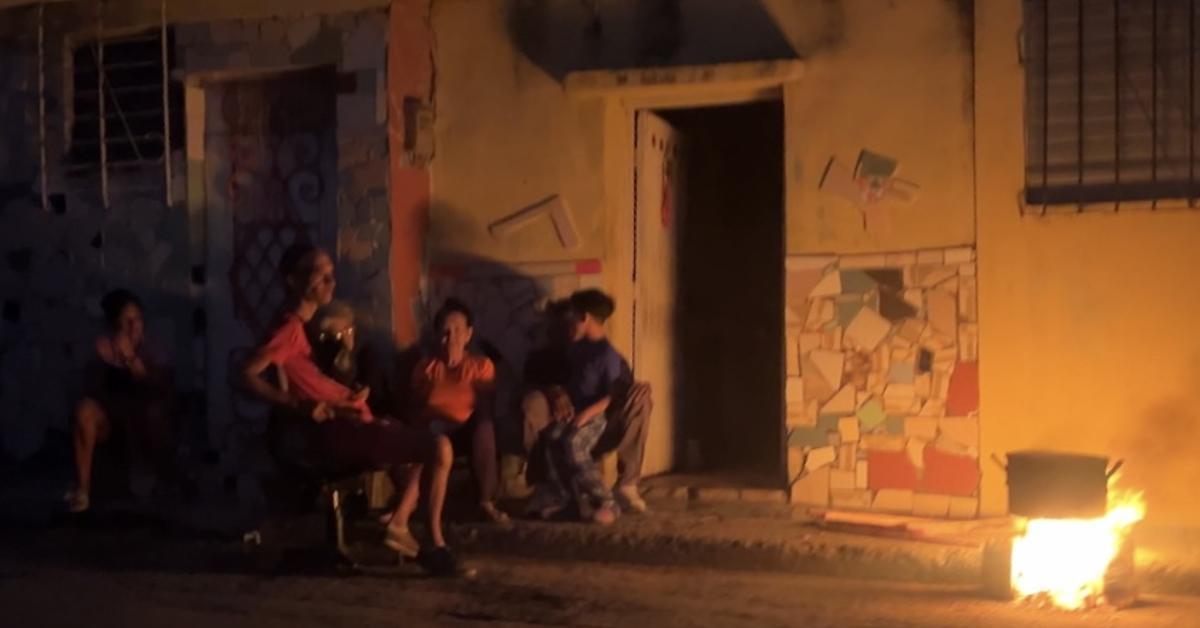
Havana/The Cuban capital experienced a black day this Thursday, literally. Diana, a second-year veterinary student from Havana, went without eating all day. There is no gas left in his house, where he lives with his grandparents who are two elderly people, he tells 14ymedio. “They say that cauldrons rang. I didn’t have the strength to hear or touch a pot, but I don’t lack the desire,” says the girl. “To make matters worse, I had an exam today, hungry, because there comes a time when bread is not filling, and it is not that cheap either.” And she laments: “I don’t know where this is going, but I’m tired.”
Irma, a 40-year-old Facebook ad promoter, lists her ordeal: “The power goes out and the connection disappears. I caught a cold going out to the balcony looking for cover and hanging up at night, because the clothes accumulate, and when the power comes, run, wash, make rice, iron the child’s uniform.” The woman says that her sister, a seamstress, pulls her hair because she can’t have light to work. “They turn on the power for an hour during the entire day, if things continue like this, he will have to sleep during the day and work at night. And the worst thing is that it seems that those who you know don’t care.”
“Here people live as they can. Many skip meals and baths, they resign themselves,” says a resident of Guanabacoa. “Yesterday the kettles rang in several areas here, and very loudly. We will have to see when the heat arrives, and all of this is added to the lack of sleep.”
“Here people live as they can. Many skip meals and baths, they resign themselves”
On the streets at night, illuminated with candles used to cook at the doors of houses or with the light of a cigarette, there are neighbors who take it with all the humor they can. “I don’t have electricity, I don’t have soap,” says a girl almost singing, to the tune of Juan Gabriel, who continues: “I don’t have money or anything to give.”
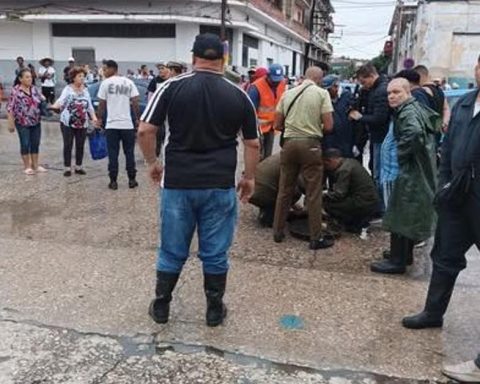
Several municipalities in the capital reported more than nine hours in the dark, such as in Marianao, where at 3 in the afternoon they turned off the power and at midnight there was still no light. In the La Güinera neighborhood, in Arroyo Naranjo, residents reported up to 13 hours without electricity and in La Lisa protests were held with cauldrons. “I just confirmed by video call that they turned on the power a few minutes after the demonstration… So, to the best of your knowledge, you already know,” said journalist Mario Pentón.
Mercedes and Antonio, two retirees who live alone, had to prepare some peas on Tuesday at 11 pm, when the power arrived after 14 hours. “It was crazy,” says the man, an accountant when he was active – his wife was a doctor. However, “on Wednesday the blackout was worse.”
Fuel shortages are also observed at gas stations. Since January 10, the Ticket system does not provide a list of the 24 gas stations open in the eastern sector of Havana, which could indicate that they are all closed. Yes, they continue to give the list for the western sector: this Thursday there were 5 of the 14 open.
/ 14ymedio
Meanwhile, in the informal market, fuel prices are rising at a dizzying pace. In Holguín, local sources report, a liter of gasoline reaches 1,200 pesos and a can of oil, up to 15,000. In Havana, some users claim to find a liter of gasoline on the left at 1,000 pesos, although in most places they ask for between 700 and 750. In Sancti Spíritus is where you can find the cheapest product: five liters of “oil for the stove,” explains a neighbor, costs between 1,850 and 1,900 pesos, that is, between 370 and 380 per liter.
The situation does not ease and the ship on the horizon dissipates. In a strange turn of events, the Mia Gracehe oil tanker heading to Cuba from Togo to deliver some 314,500 barrels of diesel or 280,500 barrels of fuel oil – according to the University of Texas expert, Jorge Piñón – has changed its route. The geolocation data that this week announced its departure from the port of Lomé with a scheduled arrival in Havana for February 4, have been modified.
The ship, flying the flag of the Marshall Islands, now appears off the coast of Guinea after having left Takoradi (Ghana) on January 13 and bound for Río Haina (Dominican Republic), where it should arrive on February 2. It is unknown why the route detected last Monday by Piñón, who warned of the tanker’s destination and told 14ymedio that it could be a “cash purchase” from the state-owned Cubametales, sanctioned by the United States, “through a European intermediary.”
The expert noted that “Togo does not refine oil, but it exports refined oil and has extensive logistics and maritime transit infrastructure.” Now, the origin points to a port in Ghana, which is located about 500 kilometers away from Lomé.
The most significant thing is that since this week the UNE has stopped reporting the deficit by type of energy
The Ghanaian oil industry has established itself in recent years as one of the most flourishing, along with the gold industry, although it is still a medium power in African crude oil, especially when compared to Libya, Nigeria or Algeria. This last country, which maintains excellent relations with Cuba, has contributed a small amount of oil to the Island, but only around two million barrels annually, the equivalent of 18 days of national consumption.
After this Thursday at peak hour a deficit of 2,000 megawatts (MW) was almost reached – well above the 1,775 MW announced – a similar amount is expected this Friday. Officially, the Electrical Union (UNE) has forecast 1,970 MW, but even in the middle hour scandalous figures are being thrown out, with 1,200 MW affected. The figure is even unusual in a context in which the solar parks are functioning correctly, since this Thursday the 49 generated 3,186 MWh, with 711 MW as the maximum power delivered. This data is enough to get an idea of what would happen if they were not even contributing.
And the thermoelectric plants come and go as if they spent the day stuck in a revolving door. This Thursday, the post of the electric company announcing shots were so numerous that the users could not take it anymore. “All those shots go straight to the town, thank you very much for your efficiency,” one responded bitterly. The “offline” and “enter the system” announcements multiplied until they generated some more humorous comments, out of desperation. “Whoever meets the UNE profile must enjoy their work, they work harder than everyone else in their company. The incapacity there is is incredible,” noted another.
The most significant thing is that since this week the UNE has stopped reporting of the deficit by type of energy. This same Friday, the detail indicates that there are breakdowns in units 5 and 8 of the Mariel CTE, 3 of the Carlos Manuel de Céspedes CTE, 5 and 6 of Nuevitas, and 2 of the Felton CTE. While the 2 of the Santa Cruz del Norte CTE and the 4 of the Carlos Manuel CTE are under maintenance, 466 MW are out of service in thermal generation. But there is a complete absence of fuel shortage data, a figure that has been reported for months and generally exceeds 1,000 MW.