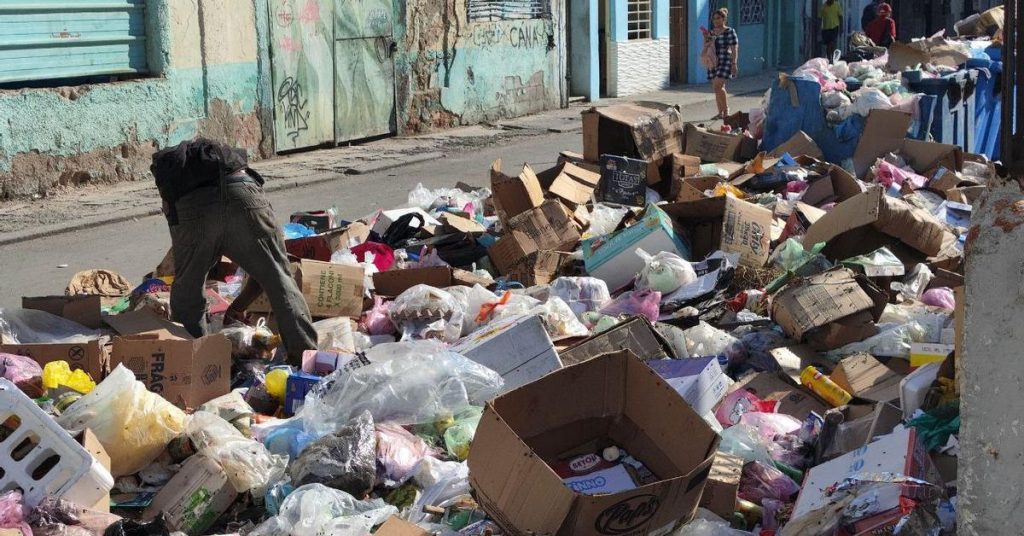
That proud, musical Havana, full of character, spirituality and sensuality, is today a filthy, precarious, dull and sick city.
HAVANA, Cuba – The Cuban state press continues to surpass itself in its vocation to falsify national reality or evoke a parallel island that its own editors do not even recognize. If until last year they made it up, this year they have had to invent chimeras of sustainability and development, in addition to shrinking and closing the plans even more so that the disaster is not noticeable. TO Havanaon its 506th anniversary, is no longer saved by the emblematic photo, taken a thousand times with infinite variations, of the coastal arch on the seawall wall. With that image, retouched to the maximum to avoid, unsuccessfully, the damage being noticed in the buildings located directly opposite, the portal Cubadebate He invited citizens to send their own view of the city to the editorial office, also emphasizing that “the people, with their energy, keep the city alive.”
In response, users launched an avalanche of comments that illustrate the decline of a capital that was the envy of America before the Commander arrived and ordered it to stop, even for some time afterwards. January 1959. The opinions are unmissable, well-founded, some brimming with humor and irony, others with bitterness. “The revolutionary Gaza Strip,” is how one netizen describes Havana on its anniversary, and as for the enthusiastic human factor, another user questions: “What energy? What people? What Havana?”
The joke of Cubadebate It comes three days after a headline in the Granma newspaper announced, without any modesty, that Havana is moving towards a smart and sustainable city model. In addition to being a liar, he Granma It is inaccurate, because the Havana it refers to is not Marianao, Cotorro, La Lisa or Guanabacoa, but the Historic Center of Old Havana – there was more to go – the experimental lentil, the little piece that serves as a showcase to make the international community believe that something is being done with the funds allocated for development. That node of colonial imprint, with electrical system buried and that still retains a certain attraction in the face of the lack of tourism that is coming, has served as a pretext for a newspaper as senile and ineffective as the historical direction of the country to publish the biggest nonsense of this year.
Havana, which was “a small Vienna, a miniature Paris” during the republican period, is today a city in darkness where twenty-four consecutive hours of electric current are a luxury. That proud, musical Havana, full of character, spirituality and sensuality, is today a filthy, precarious, dull and sick city, where a celebration seems more like an exorcism against all the evils that loom over us than an expression of the joy of living. Havana has become a horror for the regular tourist, who returns in good faith only to lament the state of the city and say “I give up, I won’t come back again.” Havana is a pain with no possible relief for its legitimate children, who are becoming fewer and fewer, and for the adoptive ones who love it well.
This accumulation of sadness, silence, rubble, hardship and garbage dumps that is today the Cuban capital deserves, on his mournful anniversary? at least the delicacy of not having to put up with editorial jokes or boasts of progress. The publications of Cubadebate and Granma can only be justified through evil and indolence, as profound as those that led former minister Marta Elena Feitó to affirm that in Havana there were no beggars, but people disguised as beggars.
Before playing into that cowardly habit of denying reality or manipulating it so that it doesn’t look so crude, it is better to remain silent. A regime whose spokespersons constantly minimize the suffering of the Cuban people, who estimate that in a capital almost buried by waste there is not enough garbage to turn it into an international problem, could order its propaganda organizations to ignore this date, to forget about a Havana that does not matter at any time of the year beyond the need to prevent a social outbreak from occurring there. Havana, which reaches its 506th anniversary today, counts among its privileges as a capital city having a little more electricity, drinking water, and transportation than the rest of the Cuban provinces. But only a little bit. It is not surprising that in the comments to the post of Cubadebate one user stated that “in the Colony we were better.” At least Havana was, considering the level of development at the time.
Centuries later, socialist revolution through, you have to resort to the latest version of Photoshop to make a photo of Havana look presentable, without success. It’s like botoxing a face that has aged tremendously badly. But despite the hatred that Castroism has always professed towards the town of San Cristóbal, there are still faithful Havana residents who today will come to turn the ceiba tree around, they will ask freedom for Cuba everything and they will toast their beloved city with whatever they have on hand, if the pain caused by Chikungunya allows them to raise their glass.