The leak occurred in the early hours of Wednesday morning.
MIAMI, United States. – The escape of a sacred baboon from the Zoological Park of Sancti Spiritus It kept a neighborhood adjacent to the facility in suspense for at least four hours and forced the deployment of an extensive operation with Special Troops, officials from the Ministry of the Interior (MININT) and veterinary personnel.
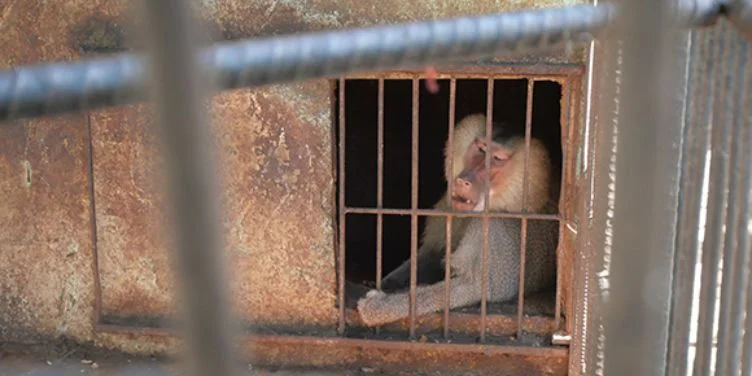
The animal, an adult male named Victor and described as the father of the center’s “clan” of baboons, was finally captured without harm to people or the species itself, but the incident exposed vulnerabilities recognized by the zoo’s management.
According to the story spread by official mediabased on statements from the park director, Tahimí Meneses Venegas, and the veterinary technician Adalberto Piloto Cepero, the leak occurred in the early hours of this Wednesday. Victor forced the lock on his cage, something he had done before, although until now he had stayed inside the enclosure.
“Víctor is a sacred baboon, very intelligent,” stressed Meneses Venegas, who remembers that “there were times when he broke the lock, but he stayed inside, as if showing us that he knew and this time he came out.” The animal, father of a group of Papio hamadryas who lives in the Sancti Spiritus zoo, left the facility and went to the adjacent hamlet, a proximity that the director herself describes as an urban planning irregularity: “Zoos should not have neighbors so close, but that’s how it is here.”
When they located him, Víctor was on the wall of an outdoor bathroom in the La Ford neighborhood, observing the surroundings. The report describes a scene of contained tension: the primate “observed, breathed, calculated,” while the authorities activated a protocol focused on evacuating the closest area, securing the homes, protecting the people and informing the Cuban Zoo Company.
Special Troops and MININT officials arrived at the scene, along with the veterinarian in charge of anesthesia. He fired three tranquilizer darts without success, until a fourth impact managed to destabilize the animal enough to allow the approach without completely losing consciousness, a key detail to avoid sudden reactions in a primate of great strength.
While the operation was taking place, a veterinary technician ran from Villa Clara: Adalberto Piloto Cepero, responsible for the daily care of the baboon for three years. “When I arrived, there were already members of the MININT, workers from the center… all trying to capture him,” he remembers. “I spoke to him, and he immediately calmed down.”
Piloto Cepero described Víctor as an animal with a complex character, but with a particular bond with his closest caregivers: “For how aggressive his species is in its natural state, he has been docile with me, he even welcomes me.” That bond, built from routine and mutual recognition, was decisive: while the technician’s voice lowered the animal’s pulse, the small capture team advanced, threw a mesh and held it without violence until leading it back to its cage.
However, behind the positive outcome, the zoo’s own management admits “an uncomfortable truth”: the security of the facility must be rethought. Meneses Venegas announced that “the monkey classrooms will have bells to protect the locks,” a technical solution that, as he explained, will not only be applied to Víctor, but also to other species, with the aim of protecting the mechanisms from water, rain and repeated manipulation.
The case also puts the coexistence between the zoo and the La Ford neighborhood under the magnifying glass. The official report itself recalls that the Sancti Spíritus Zoological Park is “one of the most visited recreational spaces in the province”, but its proximity to the hamlet implies noise, constant human traffic and, now, the antecedent of an early morning with a baboon on a wall, a few meters from homes.
Beyond the specific episode, Víctor’s species requires extreme precautions. The sacred baboon (Papio hamadryas), native to the Horn of Africa and the Arabian Peninsula—and not India, as is often believed—it is a species with very rigid social hierarchies and great physical strength. In the Sancti Spiritus zoo, it is also the only primate that consumes meat, which increases the perception of risk and management demands. “He is aggressive in his nature,” acknowledges the director.
The institutional memory of the center carries a serious history: Víctor’s grandfather bit a child years ago, and as a consequence it was necessary to amputate his hand.
In the specific case of the escaped baboon, the workers claim that it has never attacked an employee, but it has shown dominant behavior towards other baboons. An attempt was made to pair him with a female from Camagüey, without success: “He is an animal that cannot tolerate coexistence with a female. We already have him separated. And one of his male offspring comes looking very similar to him…”, warns Meneses Venegas, which suggests that the character characteristics could be repeated in the genetic line.
Furthermore, it is not an isolated event in the country. In 2024 images of the capture of an escaped monkey from the Caibarién zooin Villa Clara, in an operation where Red Berets from the MININT participated along with dogs, and that same month the escape of another monkey was reported at the 26 Zoo, in Havana.