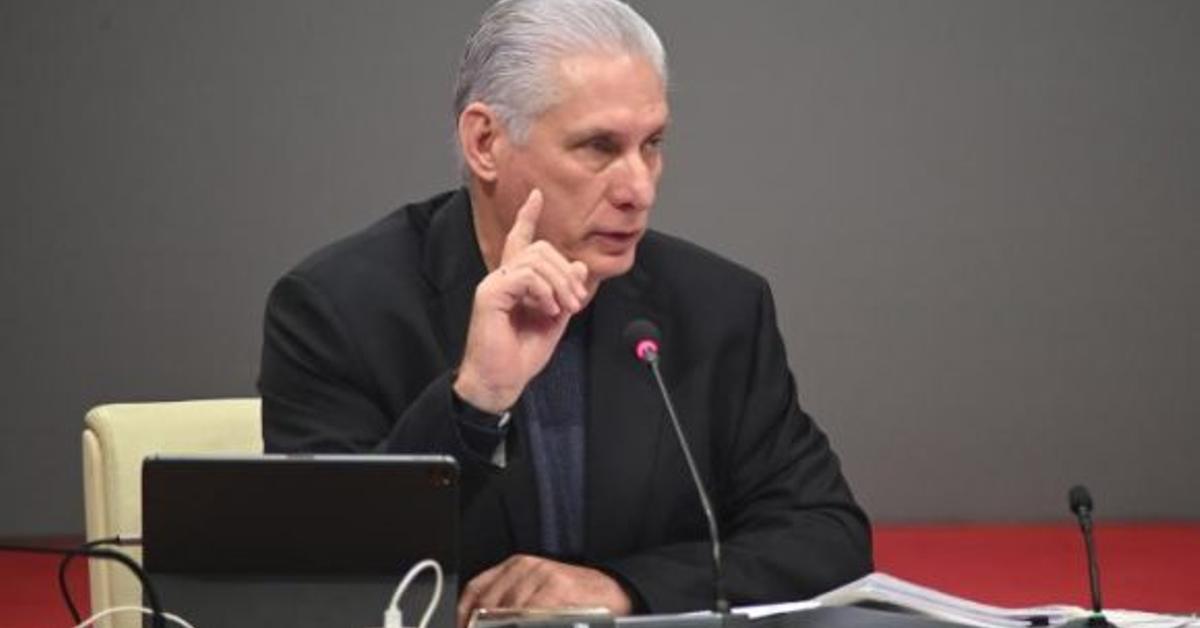
Havana/The lessons of the past do not penetrate the leadership of Cuba, which continues to stumble, time and again, over the same stone in its failed attempts to save “the economic and social model.” After the Ordering Task, in 2021, which has plunged the country into misery, Miguel Díaz-Canel now asks his ministers to focus “immediately on implementing the urgent, most necessary transformations”, without touching the socialist model in force.
Associated Press (AP) echoed the claim of the Cuban president and countless newspapers –including to the Washington Post– have replicated a note that, if you go beyond the headline, contains no news. implement the urgent, most necessary transformations that must be made to the economic and social model.”
The president’s words raised widespread expectations, not only in the US agency, which emphasized the context in which they occurred – the oil blockade – but in other sectors critical of the Government, such as the economist based in Spain Pedro Monreal, who was nevertheless disappointedat a first glance, with the original information, published in Granma. “What the press release describes does not allow us to identify that the Government has a robust notion of transforming Cuba’s economic model. It would be necessary to go beyond the 10 aspects mentioned,” he said.
Hours later, the economist did a tougher analysis. “The current economic model cannot be improved by replacing obsolete parts. The current model is exhausted, but maintains an internal coherence that must be dismantled and replaced by another, also internally coherent, discordant with the previous one,” he explained in his X account. Monreal pointed out that “the structural crisis expresses the nature of a impasse economic that cannot be overcome within the model” and that if the word reform is not to be mentioned, it is at least imperative to call it “structural transformation.”
The current model is exhausted, but it maintains an internal coherence that must be dismantled and replaced by another, also internally coherent, discordant with the previous one,” he explained in his X account.
In any case, the expert believes that the document called ‘Conceptualization’, which defined “centralized socialist planning as a ‘central component’ of the model and ‘property of all the people’ as the basis of the economic system” are “precisely two crucial aspects to modify in a structural reform.” Monreal believes that it is imperative to have the entire society to reach an agreement on the necessary changes and accuses of maintaining an “error of casting” by “entrusting the transformations to the same team (…) that designed and applied the programmatic nonsense of the ‘Ordination’, the ineffective patches that followed, and the bureaucratic artifact they call the ‘Government program’.”
What was discussed in the Council of Ministers was widely reported by the official press, it is clear that there is no change announced. The mere list that Díaz-Canel made of these transformations shows it: “They are fundamentally related to business autonomy, municipal autonomy, the resizing of the state apparatus, the Government and institutions; national food production, municipal balances, the change in the energy matrix, which is not only renewable sources, but everything related to national crude oil; exports, linking them with the flexibilities that were approved for foreign direct investment; taking advantage of economic associations between the state sector and private, especially at the municipal level; and the promotion of business with Cubans residing abroad,” he said. Each and every one approved a long time ago.
The meeting focused on the role of municipalities and the importance of them taking the reins of the decisions that were placed in their hands years ago. Manuel Marrero, the prime minister, insisted a lot on this idea, which is not very original. For at least two years, the Government has resorted insistently to the concept of municipal decentralization, which although it could have advantages – that decisions were made locally and knowing the needs of each territory – served more, in the end, as a mechanism to dilute responsibilities. Since mid-2024, for example, the approval of MSMEs is a municipal power, so Marrero’s words did not mean any change either.
“Municipalities have to manage foreign direct investment; municipalities have to manage their own closed foreign currency schemes; municipalities have to manage economic associations between the state and non-state sectors; municipalities have to design and propose their local productive systems; and they have to manage investments with Cubans residing abroad,” he said.
It is true that the approval of the decree, at the end of December 2025, on the Decentralization of Competencies and Transfer of Resources to the Territories is recent. But in its resistance to giving up control, the Government reserved “the final possibility of approving everything, as well as the ability to add more exclusions to decentralization, concentrating the power of veto and redefinition of the process at the central level,” how he criticized himamong others, the editorial staff of the official The Young Cuba, which also admitted the lack of training and capacity in the municipalities to suddenly make decisions. “Decree 140/2025 is more a declaration of intentions than a true decentralizing public policy,” he concluded.
The Council of Ministers revealed, as a big deal, the rebaptism of the “Government Program to correct distortions and re-boost the economy”, which will now be called “Government Economic and Social Program for 2026”
The Council of Ministers revealed, as a big deal, the rebaptism of the “Government Program to correct distortions and re-boost the economy”, which will now be called “Economic and Social Program of the Government for 2026”. But what does not change much is the progress of the economy. The minister of the branch, Joaquín Alonso Vázquez, said that “in general, exports of goods are not fulfilled,” except for honey, tobacco, lobster, rum and medicines. The sale of services is doing better at the moment, although the outlook is bleak. Tourism remained at 85% of what was projected, but February predicts the worst, after the suspension of countless flights due to lack of fuel. Exports in Health are almost 100% fulfilled, they stated, although announcements of suspension of mission agreements abroad occur day by day.
Regarding agricultural production, very bad news, all attributed to “the hostile US policy”, which means that despite the effort “they still do not satisfy the demands of the population, they are insufficient and do not cover the deficits in imported food provided for in the plan.”
There was also talk, on behalf of the Minister of Energy and Mines, Vicente de la O Levy, of the energy transition –nothing new, on the other hand–. “There has been progress but there is a lack of concrete actions in each of the provinces and municipalities to make them more sovereign,” he said.
There was no clear data on debts and non-payments, although Marrero warned that the actions taken to clean up the debts are abundant but “insufficient” and there was, finally, an unknown that they do not want to talk about. “The Council of Ministers learned of the results of the Development and Business Program of the Mariel Special Zone at the end of 2025, an important economic enclave of the nation that, despite the tense situation that Cuba is experiencing, confirms its strategic value for the establishment of national and foreign investments.” There was no figure that allowed us to evaluate the situation of this free zone, which was supposed to raise some 2.5 billion dollars a year and had barely achieved this amount in its first decade of life.