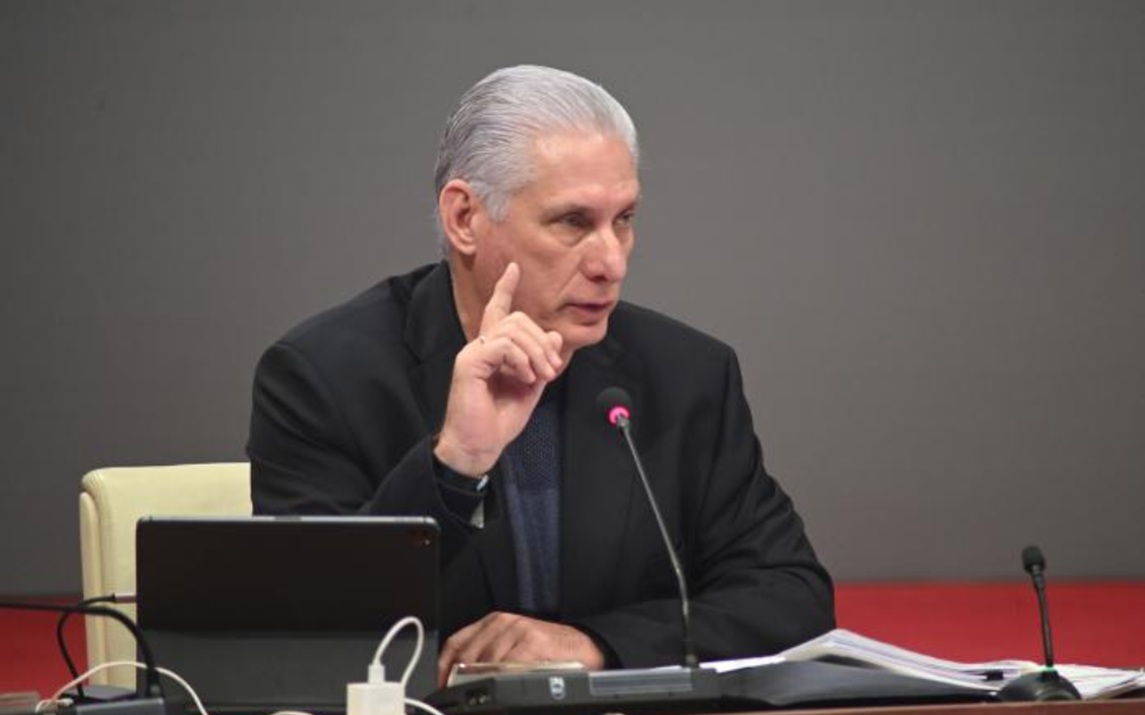
The Cuban president Miguel Díaz-Canel asked accelerate fundamental changes in the functioning of the state apparatus, the Government and the business system, in the midst of a subsistence economy, now critical after the oil blockade to the island ordered by the president of the United States, Donald Trump.
With a view to stabilizing the economy and increase national production, particularly food, the president insisted that the country must focus “immediately” on the most urgent transformations of the economic and social model, aimed at strengthening business and municipal autonomy, according to what emerged from the government meeting reviewed by Granma.
Among the priorities mentioned are the resizing of state structures, the expansion of powers for companies and greater management capacity in municipalities, where, according to Díaz-Canel, many of the powers already approved for the business sector are not fully used and are even unknown in some cases.
Díaz-Canel pointed out that the municipalities must take a more active role in managing foreign direct investmentas well as in the creation of closed foreign currency schemes and in the articulation of economic associations between state and non-state actors.
At the meeting, led by the prime minister Manuel Marrero Cruz from the Palace of the Revolution, the president also pointed to the need to promote business with Cubans residing abroad and to design local productive systems with greater autonomy.
Another central axis of the reforms is the promotion of food production, linked to municipal balances, as well as progress in changing the energy matrix; which includes not only the development of renewable sources, but better use of national crude oil.
Díaz-Canel emphasized that these transformations must translate into greater foreign exchange income, increased exports and a more efficient use of productive capacities, as part of the effort to achieve macroeconomic stabilization of the country.
Decentralization in state agencies
The task of decentralizing powers and transferring resources to the municipalities and, exceptionally, to the province, is carried out in the first quarter of this year, by the agencies of the Central State Administration and other state bodies and institutions.
Cuba runs aground as the most lagging economy in Latin America and the Caribbean, ECLAC warns
The process, defined by the Cuban News Agency (ACN) as having “extraordinary administrative, economic and social scope” was determined by Decree 140/2025, of the Council of Ministers of last December.
This step, he noted ACNis governed by what is established in the Constitution and consists of “the transfer of functions, powers, activities, responsibilities, structures and resources, of the system of entities served by the organizations and bodies, to the municipality and exceptionally to the province.”
The essential objective would be “to implement municipal autonomy through the distribution of powers between the different levels of government, which contributes to the comprehensive, harmonious and sustainable development of the country.”
“It must necessarily be accompanied by the structures, workers and financial and material resources directly linked to the activities and services transferred, which ensure their continuity and efficiency.”
Without fuel, devastating impact for the private sector
One month after executive order signed by US President Donald Trump that sanctions the sale and delivery of fuel to Cuba, the island’s private trade faces an immediate and devastating impact.
Almost 80% of MSMEs report drops in sales due to the US oil fence
Although the Office of Foreign Assets Control (OFAC) recently authorized private micro, small and medium-sized businesses (MSMEs) to purchase fuel, the reality is that 78% of them report drops in their sales, according to a report by the consulting firm AUGE.
The measure, added to the suspension of shipments from Venezuela after the capture of Nicolás Maduro, has left Cuba practically paralyzed.
“We are not just talking about small businesses. When actors like Supermarket 23, Cubamax, Meliá or Sherritt reduce operations, the signal is clear: the impact is systemic,” says the document signed by the consultant and co-founder of AUGE, Oniel Diaz.
The report compares the current energy crisis with the 2020 pandemic, when businesses were able to reinvent themselves through teleworking, home deliveries and reconversion of services. “Today the question is different: what happens when what is missing is not a client, but the energy itself to operate?” says Díaz.
Cuba’s economy has reached a critical limit, after two consecutive years of contraction and the lowest level of current gross domestic product (GDP) per capita in the entire region, according to the 2025 Statistical Yearbook of the Economic Commission for Latin America and the Caribbean (ECLAC).
The ECLAC report It places the island in last place in Latin America, even below Haiti, and reflects a gap of almost 90% with respect to the regional average. According to the entity, the Cuban GDP at current prices reached just 12,099.9 million dollars in 2025, equivalent to 0.2% of the regional total estimated at 6.79 trillion.
Specialists agree that the Cuban crisis is not temporary. The lack of profound reforms, other internal failures and inefficiencies, the dependence on external subsidies and the impact of US sanctions—combined with the recent oil blockade imposed by the Trump Administration—have further weakened the country’s productive capacity.