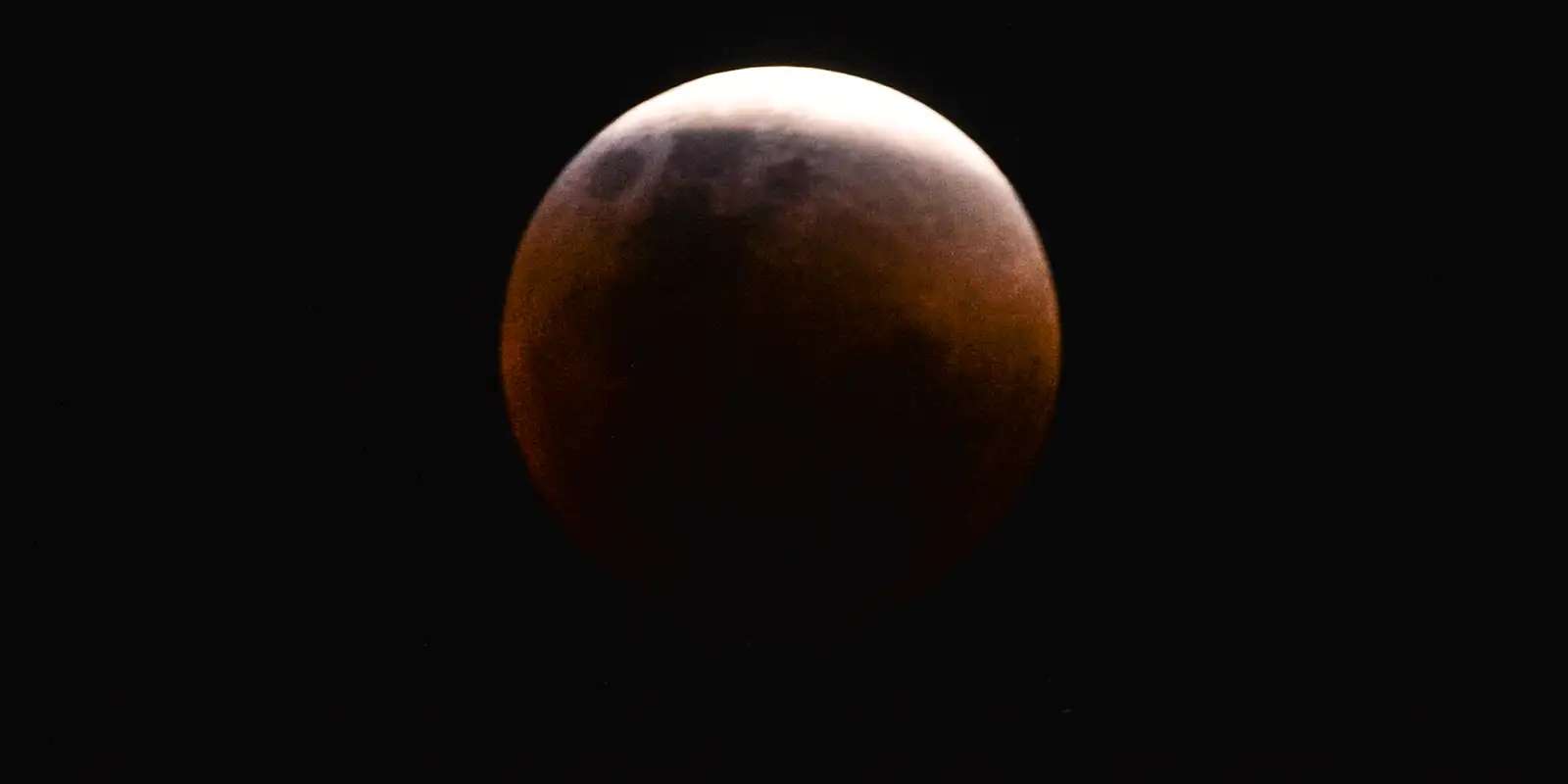
A new lunar eclipse is scheduled for March 3rd. The phenomenon always mobilizes curious people and experts, but this time, Brazil will not be in the best geographical position to follow the full spectacle of the so-called Blood Moon.
The phenomenon occurs when there is a precise alignment between the Sun, Earth and Moon.
“The Earth is placed between the Sun and the Moon. So the Moon is behind the shadow that the Earth projects. It is an alignment of these three bodies”, explains astronomer Thiago Signorini Gonçalves, director of the Valongo Observatory at the Federal University of Rio de Janeiro.
According to him, in the partial eclipse we see the Earth’s shadow advancing over the lunar disk, as if it were “a bite” darkening the full Moon. During the total eclipse, the most anticipated phenomenon occurs.
“When it is perfectly aligned, the Sun’s light can no longer reach the Moon’s surface directly. But it passes through the Earth’s atmosphere before getting there. Only the red part of the light can pass through, while the blue part is scattered. That’s why the Moon turns red, like at sunset”, he states.
The nickname Blood Moon, according to the astronomer, is more of an expression of popular impact than a scientific term, but it translates well the visual effect caused by atmospheric filtering.
The news, however, is not encouraging for most of the Brazilian territory.
“Unfortunately, in most of Brazil we will only see the penumbral eclipse, which is a slight darkening of the full Moon and which is a difficult effect to notice”, says Thiago.
In cities like São Paulo and Brasília, the phenomenon occurs around 6 am, with the Moon very low on the western horizon and just before sunrise, which makes observation even more difficult.
The situation improves slightly in the North region. In Acre, Rondônia and western Amazonas, it will be possible to follow part of the partial eclipse. “In Acre, around 5 am, it is already possible to see the shadow advancing. The maximum amount of concealment occurs around 5:45 am, when almost the entire Moon will be covered”, he explains.
Still, he points out that Brazil is not the best spot on the planet for this eclipse. Ideal conditions will be in the Pacific, in regions like New Zealand and islands like Fiji, where totality will be fully visible.
Steps
Astronomer Josina Nascimento, from the National Observatory, details that every total lunar eclipse goes through five stages: penumbral, partial, total, partial and penumbral again.
“The penumbral eclipse occurs when the Moon enters the Earth’s lightest shadow. At this stage, we hardly notice any difference in brightness. Then, when it begins to enter the dark shadow, the partial eclipse begins, when we see the Moon becoming increasingly darker, in the shape of a bite”, he explains.
A total eclipse happens when the Moon is completely immersed in the umbra — the darkest part of the Earth’s shadow.
In the case of the March 3 eclipse, however, Brazil will only see the initial phases. “When the Moon is completely eclipsed, it will already be below the horizon for us. Brazil will not see the total eclipse”, says Josina.
Schedule (Brasília time):
- 5:44 am – start of the penumbral eclipse
- 6:50 am – start of partial eclipse
- 8:04 to 9:02 – total phase (not visible in Brazil)
The further west the location, the greater the percentage of obscuration. In the far west of the country, the concealment could reach 96% — very close to totality, but still technically classified as partial.
According to the astronomer, lunar eclipses are relatively frequent in Brazil, but we will have to wait to see a complete spectacle. “Only on the night of June 25th to 26th, 2029 will Brazil have a total eclipse of the Moon with all phases visible throughout the country”, highlights Josina.
Still in 2026 there will be an almost total partial eclipse (93% magnitude) visible throughout the national territory, on the night of August 27th to 28th. In 2027, the three predicted eclipses will only be penumbral. In 2028 there will be partial eclipses, but no total eclipses visible in Brazil.