Brazil must adopt a cautious stance in relation to attacks by the United States and Israel on Iranthis Saturday (28). This behavior is explained by a scenario in which the Brazilian government conducts tariff negotiations with the Americans and has an ally in the Iranians that forms the Brics, a group of nations from the so-called Global South.
The assessment is made by experts in international relations consulted by Brazil Agency. This Saturday morning, the Brazilian government issued a statement in which he condemns the offensive and defends negotiations as the path to peace.
Negotiation is the “position traditionally defended by Brazil in the region”, says the government note, released by the Ministry of Foreign Affairs.
“Brazil calls on all parties to respect international law and exercise maximum restraint, in order to avoid the escalation of hostilities and to ensure the protection of civilians and civil infrastructure”, adds the statement.
Even amid negotiations over the future of Iran’s nuclear program, the United States carried out a military offensive against targets on Iranian territory. Israel also carried out attacks.
THE Iran retaliated with the launch of missiles to neighboring countries that boast American bases. The Middle Eastern country maintains that the development of nuclear technology is for peaceful purposes.
Caution
Professor Feliciano de Sá Guimarães, from the Institute of International Relations at the University of São Paulo (USP), argues that the Brazilian Ministry of Foreign Affairs has to find an “intermediate position” between Iran and the United States.
“As Iran is now a member of the BRICS, Brazil puts itself in a difficult position to create a type of position in which it is not openly against Iran and is not openly against the United States, given that Brazil has this negotiation with the United States”, he assesses.
There is an expectation that the president Luiz Inácio Lula da Silva meets with Trump in the United States, at the end of March.
The negotiation to which Feliciano refers concerns import tariffs imposed last August by the Trump administration. Brazil came to have products priced at up to 50%.
By raising taxes on imported products, the United States government justifies that it intends to protect the American economy, since, with taxation, Americans would tend to manufacture products locally instead of purchasing them abroad.
Since then, the Brazilian and American governments have been negotiating ways to seek agreements for the commercial partnership. There were removals of products from the tariff list.
On February 20th, a decision by the US Supreme Court overturned Trump’s decisionwho reacted imposing a 10% tariff to different countries.
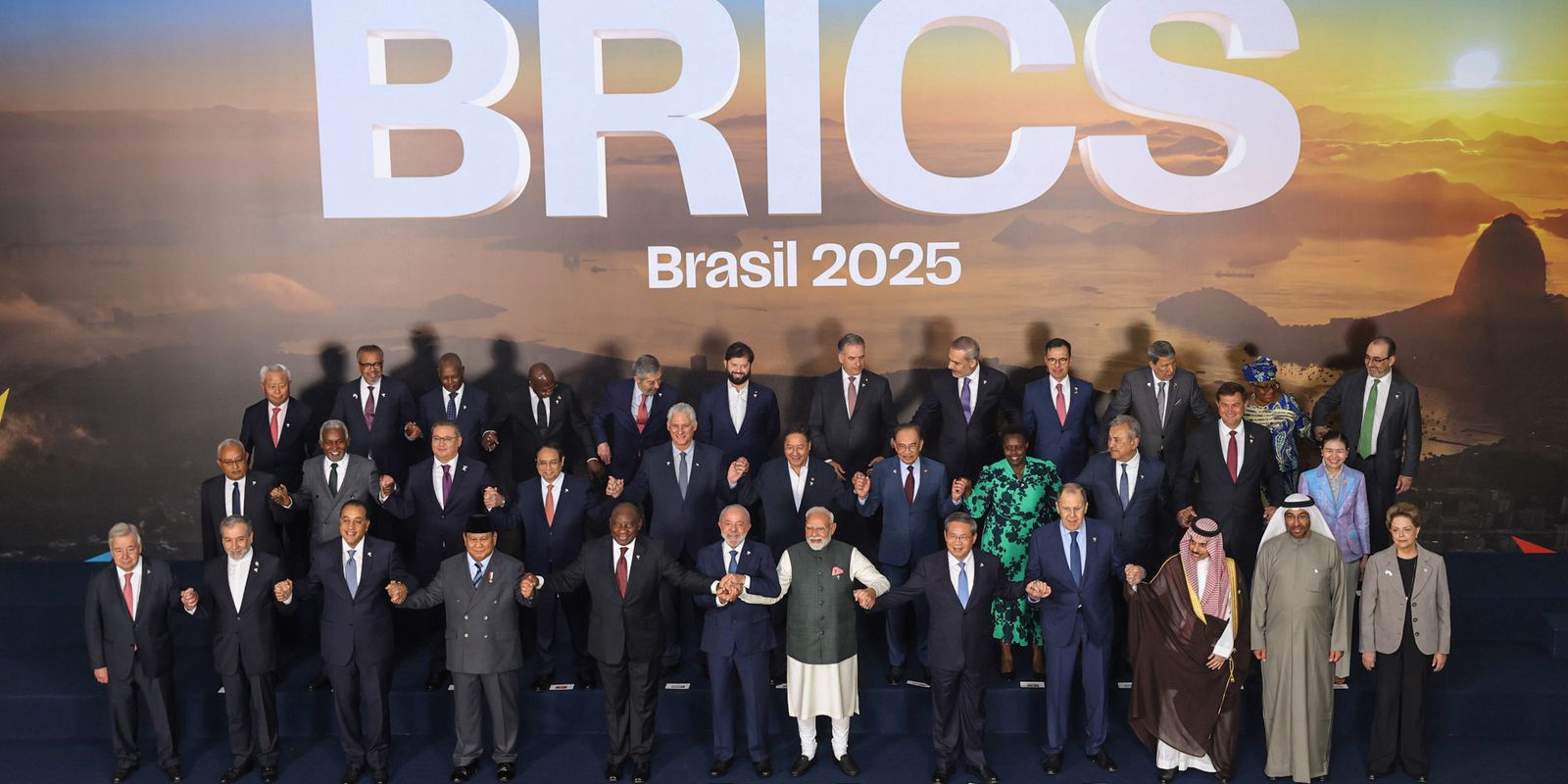
Retired professor of International Relations at the State University of Rio de Janeiro (Uerj) Williams Gonçalves highlights that the cautious position that needs to be adopted by Brazil has to do with the fact that the country is founder of BRICSa group that brings together 11 member countries and 10 partner countries that define themselves as the Global South.
Russia and China, two important allies of Iran, are also founders of BRICS in 2006. Iran became a member country in 2024.
“Brazil has a strong relationship with Russia and China and a not so strong relationship, but it has a relationship with Iran”, points out the professor.
“They are all [países] in the same Brics boat, all engaged, at least theoretically, in the idea of changing the international order”, emphasizes Gonçalves.
Determination of the people
Williams Gonçalves recalls that Brazil has also adopted caution due to Trump’s actions in Venezuela.
“The Trump regime went there and kidnapped a president of the Republic in South America, our neighbor”, he quotes, in reference to capture of Nicolás Maduroon January 3rd.
“Our position has been very cautious, trying not to do anything that appears to be a provocation or a strong reaction”, he states.
However, Gonçalves understands that the unfolding of events may require stronger positions from Brazil. He cites the United States’ stated intention to change the regime in Iran.
“Brazil, which has always defended the self-determination of the people, which has always defended the principle of non-interference, cannot now support governments that intervene in other states with the aim of changing the political system chosen by their people”, he assesses.
Criticism and negotiation
Leonardo Paz Neves, a researcher at the International Intelligence Center at Fundação Getulio Vargas (FGV), believes that Brazil may be affected to a limited extent by the conflict in the Middle East.
According to him, the government’s position was “protocol”, criticizing the attack.
“I don’t think President Lula and Brazil are going to get very involved in this conflict. It’s very far from Brazil, there are no major specific interests for Brazil in this process. Obviously Brazil is in a very prolonged attempt to negotiate with the United States”, he assesses.
When commenting on Lula’s possible trip to the United States in March, the researcher says he believes that the country must maintain an “institutional critical” position, calling on Iran and the United States to return to the negotiating table.
“But without getting too involved because you have a lot to lose”, he highlights.
“He [Lula]you know how Trump works, and to antagonize Trump now is to attract a lot of negative attention to Brazil”, he explains.
Trade with Iran
For Leonardo Paz Neves, the economic effects that Brazil may suffer from the escalation of the conflict involve oil, which may increase in price.
“What generates inflation. Every time oil rises ─ oil is the basis of the chain ─ then it impacts several sectors.”
Another reflection, adds the researcher, is in international trade with Iran.
“Iran is an important importer of Brazilian products, especially soy, corn and some protein”, he lists.
According to the Ministry of Development, Industry, Commerce and Services, in 2025, Brazil-Iran trade flow would reach US$3 billion, equivalent to more than R$15 billion. THE Brazil has a surplus in trade relationshaving exported US$2.9 billion and imported US$85 million.
Last year, Iran was the 31st country to which Brazil exported the most. The main export product is unground corn, which accounts for 67.9% of the value of shipments. Next comes soy, with 19.3%.
“If the conflict escalates significantly and Iran is surrounded by the American navy, it will be a problem to send Brazilian exports there. There will be some sectors here in Brazil that will suffer a little, losing an important buyer”, he says.