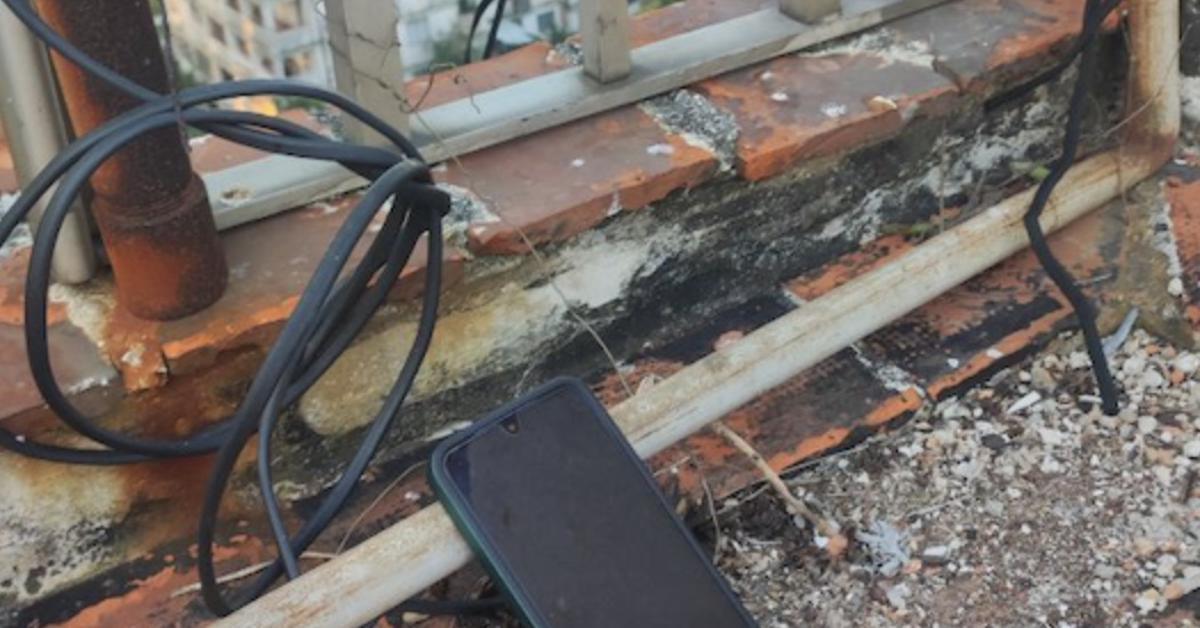
Havana/I walk to the corner of the roof, raise my arm, tilt my torso. A coverage bar appears on the mobile screen. All the accumulated messages begin to leave and many others fight to enter. Only the purring of a nearby ministry’s power generator can be heard. The neighborhood is silent in the silence of a blackout, heavier and denser than the peace of the tombs.
Nothing that depends on internet access is guaranteed in Cuba. Local mobile applications, which until a few years ago organized food delivery, passenger transportation or contact with bricklayers, are useless most of the time. Only in the early morning, web browsing seems to unwind somewhat and flow, but who thinks of ordering a pizza at four in the morning? What’s the point of hiring a plumber shortly after midnight?
There are neighborhoods and neighborhoods. A relative who lives in El Vedado tells me that I can go to her house whenever I want to check my email inbox. Yours is a privileged area. There are almost no blackouts because it is connected to “a circuit of hospitals” that long ago ran out of fuel to supply their generators and must keep the surrounding houses lit, even when all of Havana is dark. I do the math: about forty minutes walking there, as many for the return. Almost an hour and a half just to download my emails.
Sometimes I miss the time of telegrams. When in the quarters where he lived the loud voice of the postman shouted a name, we all knew that it was brief, quick and most likely urgent. People wrote short sentences, without prepositions or phrasal verbs. Every word cost money and could not be wasted on frills. “Dead aunt, burial tomorrow”; “Born, eight pounds”; “There is no wedding, the groom left” or “Send money for a wake.” This is how we found out the most important thing.
But not now. Now there are memes to see, emails loaded with images of several megabytes that are sent to us from anywhere in the world, postcards for Valentine’s Day that take minutes to download, audios that a friend recorded in the Madrid metro, taking his time, without remembering that here we envy the speed with which the smoke signals travel. There is reels, fierce debates to follow on Facebook, discussions where everyone wants to say the last word and films, with their faces very close to the lens, made inside cars parked outside huge shopping centers in Miami or Tampa.
Anxiety grows. We are not aware nor could we be aware. The call fomo (fear of missing out or fear of missing out) makes people in this city climb a water tank to see if it catches the 4G signal and the lucky ones posts from Facebook have just been uploaded to your mobile. It was one thing when we didn’t know what we were missing and another now, when the terrible telecommunications service takes away from us that Internet user that we already are, that we have built ourselves with years of presence on social networks. More than a deficiency, this is an amputation.
/ 14ymedio
An architect friend has arrived, after more than a decade living in Europe, to bury her mother. Now he has to organize someone to take care of his father, who has serious mobility problems and is almost 80 years old. But most of the contacts with possible candidates for the position, which will pay in euros, are through mobile phones and WhatsApp. Already lacking training to deal with the low internet speed in Cuba, my friend insults the cell phone screen every time she dials and gets a recording that “the number you are calling is turned off or outside the coverage area,” one of the many ways in which the state monopoly Etecsa masks its inefficiency.
The emigrated architect must finish and deliver a job that was asked of her on the other side of the Atlantic. Her employers cannot understand that, by boarding that plane to this Island, she has entered a kind of Faraday cage where communications are very unstable or impossible. His finished sketches are stuck in Havana waiting for the long-awaited connectivity bars to appear on his cell phone. But my friend has already lost the ability to wait. He says that time is worthless here and that every minute that passes he loses money.
I can’t help her much. The closest Wi-Fi zone to our house no longer works. After the initial hubbub with these wireless connection parks, the arrival of internet on mobile phones and the lack of maintenance have gradually turned them off. In December 2018, the navigation service from cell phones began and we believed that the time had come to abandon the hard benches in some squares where the darkness and the assailants forced us to have one eye on the screen and the other constantly checking the surroundings.
This Wednesday I visited several of those wifi plazas. Some lost their antennas a while ago and in others the little bandwidth has been absorbed by nearby neighbors who installed antennas that carry the wireless signal to the living room of their house, collapsing the service for the rest of the customers. However, the biggest problem now is getting the recharge cards that allow you to access the Nauta portal with a username and password.
“Do you have a card for Wi-Fi zones?” I asked a telecommunications agent who until recently made a living selling mobile recharges and other Etecsa services. “No, that hasn’t arrived in a while, they’re just selling them in some central offices,” he warns me. To alleviate the drop in his offers, the man has improvised a timbiriche where he also offers soft drinks, beers and cookies. If you can’t get online, at least drink and chew something, seems to be the new motto of their tiny business.
At the Etecsa office on Obispo Street they tell me that they have run out of cards for the Wi-Fi zones. My relative from El Vedado is not at home to sit on her couch and download my emails, so I decide to return home. On the stairs I meet my architect friend who is literally climbing the walls of despair. He hasn’t been able to check his Linkedin account for more than a week.
I go up to the roof. I put my phone in a corner and dedicate myself to working in my small garden. An hour later I heard a familiar sound. I just received the first WhatsApp message of the day. Faraday, this time, I have defeated you.