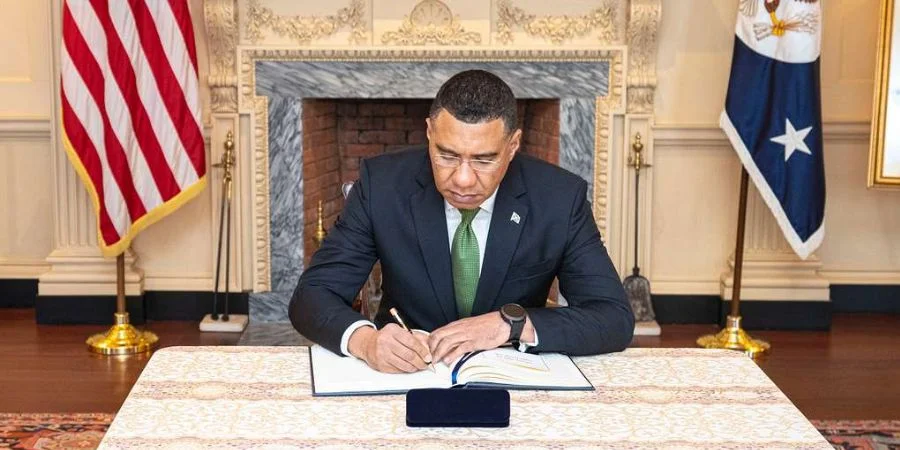
MIAMI, United States. – The Prime Minister of Jamaica, Andrew Holness, defended this week the position of the Caribbean countries towards Cuba during the annual summit of the Caribbean Community (CARICOM), in a context of pressure from Washington for the region to review its ties with Havana, which caused a public exchange with the Cuban-American congressman. Carlos Gimenezthe only US legislator born on the Island.
During his speech at the opening of the meeting of the regional bloc, held in Saint Kitts and Nevis, Holness stated that the crisis in Cuba cannot be analyzed in a simplistic way and warned of its possible repercussions for the entire Caribbean. “We must address the situation in Cuba with clarity and courage,” declared the Jamaican president, according to an Associated Press (AP) report.
Holness stressed that the doctors and teachers of the largest of the Antilles “have served” the entire region. In this context, he noted that “the Cuban people face serious economic difficulties, energy shortages and growing humanitarian pressure.” He also warned that “a prolonged crisis in Cuba will not be limited to Cuba. It will affect migration, security and economic stability throughout the Caribbean basin,” according to the same office.
The prime minister added that Jamaica “remains firmly in favor of democracy” and supported a “constructive dialogue between Cuba and the United States” aimed at “de-escalation, reform and stability.”
🚨I harshly condemn this & find it regrettable that the JLP would cover-up for the moribund dictatorship in #Cubawhen the Castro regime repeatedly intervened in #Jamaica‘s politics to exacerbate partisan tensions & undermine the JLP!
Jamaica will face the consequences! https://t.co/wJahLrYLQw
— Rep. Carlos A. Gimenez (@RepCarlos) February 25, 2026
The statements occurred in the run-up to the visit of the US Secretary of State, the Cuban-American Marco Rubio, to the CARICOM summit, where he held meetings with regional leaders amid tensions over Washington’s policy towards Cuba and over Cuban medical missions in the Caribbean.
Holness’s positioning did not go unnoticed in Washington. Congressman Carlos Giménez, representative of Florida and critic of Cuban medical programs abroad, which have been described as “forced labor,” questioned the position of some Caribbean governments towards Havana. Giménez has repeatedly maintained that medical missions constitute a form of “labor exploitation” and a key source of income for the island’s regime.
“I strongly condemn this [las declaraciones de Holness] and I find it regrettable that the JLP [Jamaica Labour Party, liderado por el primer ministro] cover for Cuba’s moribund dictatorship, when the Castro regime repeatedly intervened in Jamaican politics to exacerbate partisan tensions and undermine the JLP,” wrote Giménez in his X account.
The clash reflects the delicate balance that Caribbean governments are trying to maintain. On the one hand, several of them have depended for years on the so-called Cuban medical missions in matters of health and education, and, on the other, they are involved in human rights violations of the island’s professionals.
According to Reutersin private meetings with CARICOM leaders, Rubio raised the need for greater regional cooperation on security and transnational crime issues, in a context where relations with Cuba and the influence of external actors in the Caribbean are also discussed.