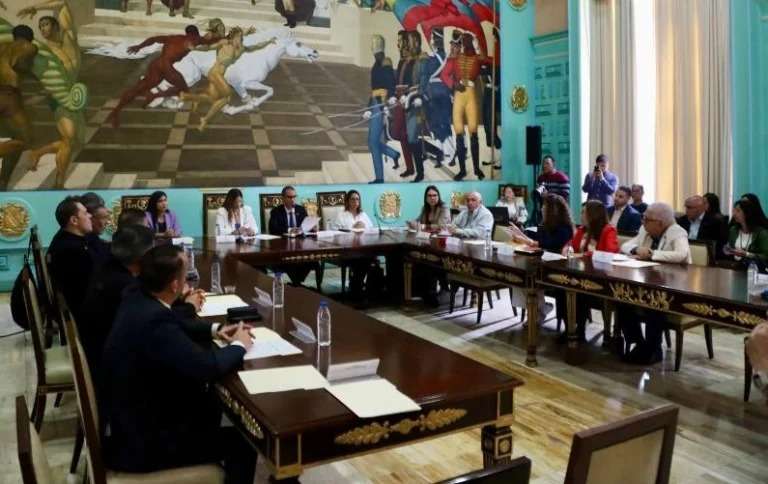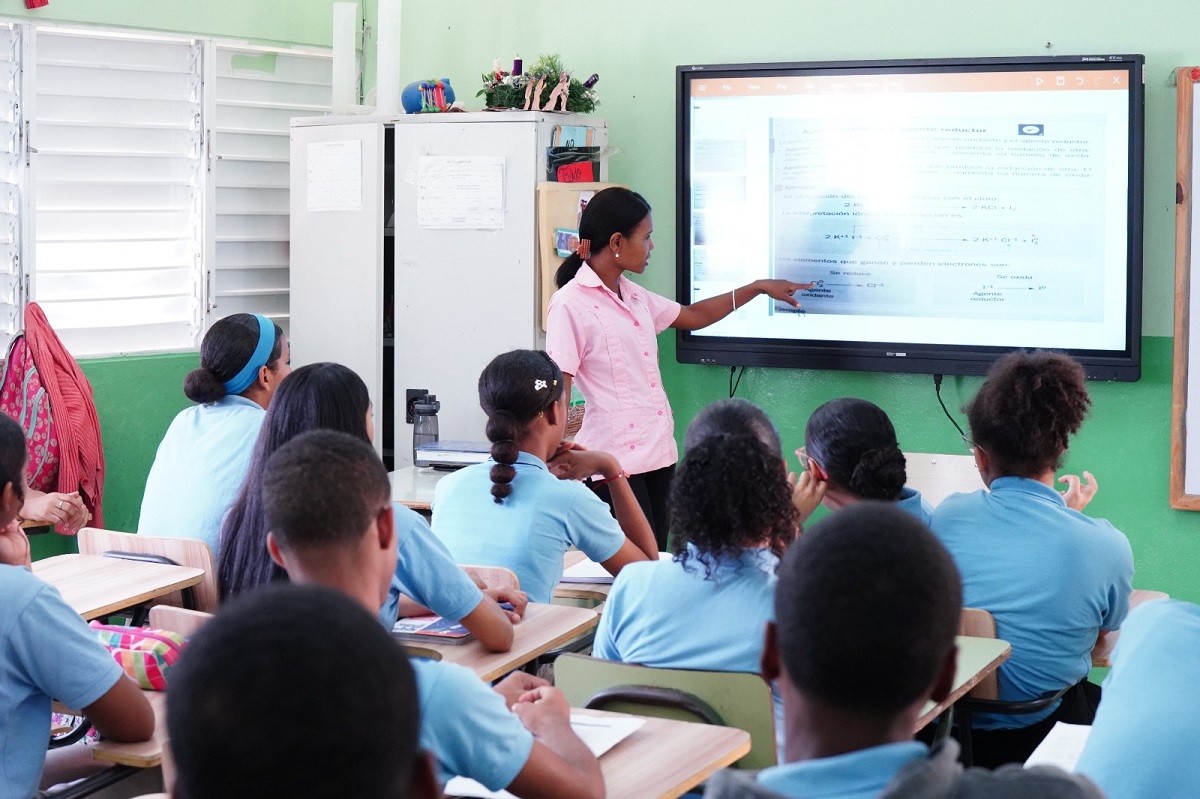
President Luis Abinader announced that the Government will promote a legislative and curricular reform to design a new national educational system, aimed at forming the human capital necessary to double the size of the Dominican economy by 2036.
“No country develops only by decree. No country is transformed only with laws or investments.
“Nations advance by training their people,” said the president when presenting the balance of the sector and the roadmap for the coming years.
In this context, he assured that education and health have been assumed as permanent national priorities, beyond ordinary government policy.
The reform, he explained, will be subject to a broad national consultation and consensus-building process, under the premise that “education is not a government policy: it is everyone’s project.”
Early childhood: expansion of coverage and comprehensive care
The head of state stressed that the strengthening of the system begins from the first years of life.
Together with the National Institute of Comprehensive Early Childhood Care, 15 new centers were inaugurated that impacted more than 13,000 boys and girls, expanding coverage to 155,937 minors in 739 CAIPI and CAFI centers throughout the national territory.
A total of 44,715 infants received food according to their nutritional requirements, while 6,807 families benefited from comprehensive support in health, nutrition, education, protection and inclusion.
In addition, 131 communities were intervened to ensure favorable environments, and 2,662 children with disabilities received specialized care.
In the 2024-2025 school period, 40,024 children were enrolled in the first cycle of the initial level, an increase of 2,796 compared to the previous year. In the second cycle, 350,000 students were enrolled, with 87.52% progress toward the presidential goal of 400,000 children by 2028.
At the secondary level, enrollment reached 861,000 students in 2025, equivalent to 96% of the projected goal of 900,000 by 2028.
The net coverage rate increased from 70.7% to 71.6%, reflecting improvements in access and permanence.
The president highlighted the Timely Literacy and Advanced Secondary programs as axes to raise quality. In the 2025 Diagnostic Evaluation, applied to 129,000 students with 89% coverage, progress was recorded in all the areas evaluated.
In Mathematics, the average went from 300 points in 2019 to 305.96 in 2025. More than 76,000 students passed the National Tests.
Likewise, 1,433 educational centers were integrated into SISMAP, a digital platform for school performance with citizen access was consolidated, and more than 56,000 educational actors were trained to prepare 200,000 students with a view to PISA 2025.
STEAM Focus
The Government promoted the STEAM approach by delivering 1,178 robotics equipment and training 1,729 teachers.
One million students participated in science and technology fairs, while the “Girls in ICT” program impacted 3,000 girls, promoting the reduction of gaps in technological areas.
In the Secondary Professional Technical Modality, enrollment rose to 102,616 students, with a growth of 5.6%. In addition, 26,280 students completed the Workplace Training Module, strengthening the link between education and the productive sector.
Technical and higher training
The president highlighted the strengthening of the National Vocational Technical Training Institute, which in 2025 served more than 1,083,000 participants throughout the country. More than 6,600 companies received training assistance and nine new training centers were opened, increasing facilities from eight to 67 since 2020.
1,012 new professionals graduated from the Technological Institute of Las Americas, reaching 6,519 historical graduates. With extensions in San Francisco de Macorís and Cotuí, technological coverage was expanded to 12 locations, impacting more than 24,000 young people.
At the Community Higher Technical Institute, enrollment increased by 2,543 students (22%), with 980 certified technicians, of which 963 are already inserted in the labor market.
In alliance with the IDB and the Dominican Institute of Telecommunications, more than 30,500 scholarships were awarded in STEM areas and 3,000 in cybersecurity.
Regarding classrooms, one of the most criticized axes in educational matters, it was reported that
Since 2021, 252 schools have been inaugurated, totaling 4,690 classrooms.
In 2025 alone, 1,702 new classrooms were delivered and 516 schools were intervened with corrective maintenance.
Regarding the teaching career, 3,625 new teachers entered through a competition; 5,604 were impacted by the National Induction Program; and more than 115,000 participate in the Teacher Performance Evaluation, a process that has not been carried out for almost a decade.
Morals, civics and citizenship
The president highlighted that in 2025 the teaching of Morals, Civics and Citizen Ethics was formally integrated into the national curriculum, accompanied by initiatives such as “Citizens at 100”, aimed at strengthening democratic values and a sense of duty.
“We have taken on the challenge of turning the school into the Center of Development and Public Policies,” he stated.