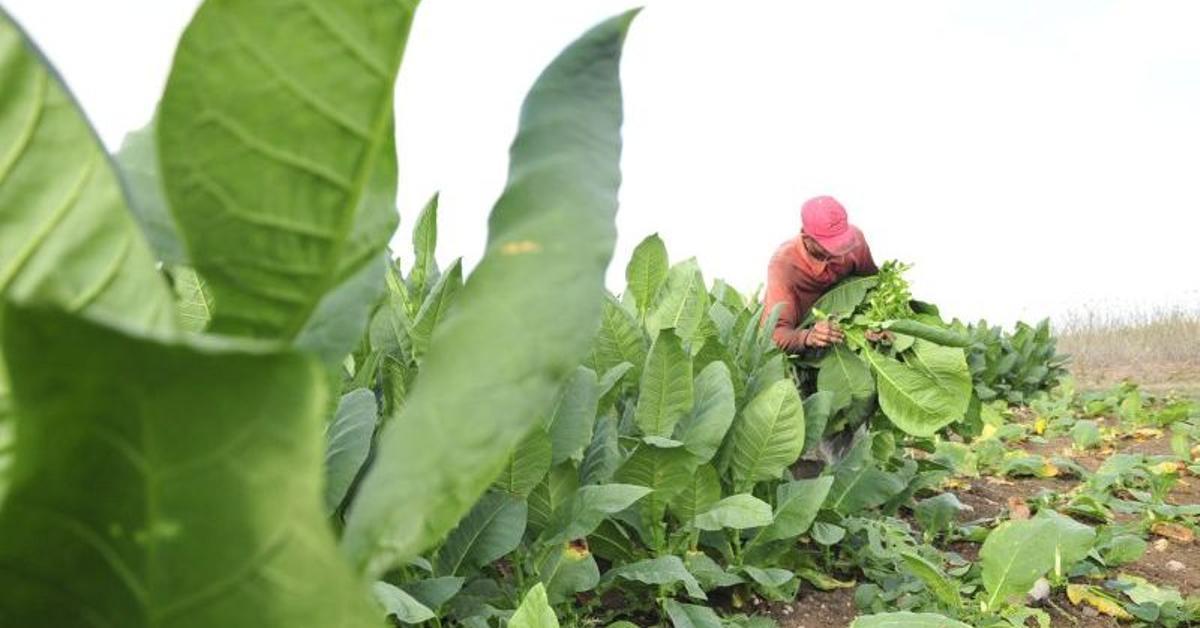
Havana/Tobacco is the only thing saving the plummeting production in Sancti Spíritus. The province, which two years ago lost the second place it held in the sector behind Pinar del Río, last year regained its title as the country’s second largest vegetable power.
This was possible, details a long report published this Wednesday in Escambraydue to a varied number of measures taken, among which are Tabacuba’s investment in high-quality leaves quality.
In the text, signed by veteran reporter Elsa Ramos, it is explained that incentives for producers have increased. In this regard, Isidro Hernández Toledo, agricultural director of Acopio, says that there is an incentive in freely convertible currency (MLC) “for the sol en palo, for which last year 3% was applied to the amount of the value of tobacco, the upper classes, exportable; in this (campaign) it rose to 3.6%.”
Added to this measure is that salaries for vegueros reach around 20,000 pesos per month, which is almost three times more than the average salary of any Cuban, which does not reach 7,000.
The problem is, the official acknowledges, that these resources are delayed no less than 11 months after the tobacco is collected. In addition, there is a debt from these stimuli in MLC of close to five million pesos, of which they have only settled one and a half million. In the case of covered tobacco – made with leaves grown under a fabric cover that filters sunlight, of higher value – the contract is direct with the producer, and in sol en palo – which is used to make cigars –, it is with the cooperative, which is the one who deals with the producer.
“There are cooperatives that have incurred debts with the company that they have not been able to pay and we are in that conciliation process,” says Hernández Toledo, who explains another way to settle the debt: sell “resources with a component in MLC” to the producer as a discount. Thus, he specifies, “they have acquired solar panels, supplies, household appliances, tractors.”
Added to this measure is that salaries for vegueros reach around 20,000 pesos per month, which is almost three times more than the average salary of any Cuban, which does not reach 7,000, a salary that has brought new hands to the industry in the province. With Tabacuba being one of the crown jewels for export, you can afford it.
The authorities also explain that they have created more jobs. “Today about 600 people are employed, many of them women and young people who were unemployed, says Carlos González, director of the UEB Tabaco Tapado. In total, there are up to 836 people working in the industry in Sancti Spíritus, including individual producers from agricultural production cooperatives, credit and service cooperatives, state-based business units that are in agricultural companies and a new productive form: the Youth Army of the Work, in Development.
Likewise, not depending on the national electrical system, subject to continuous blackouts, has contributed to the improvement in production. Now, say the officials interviewed, “all these places are supported by renewable energy with solar panels.”
Regarding planting, the report highlights that all municipalities fulfilled what was planned, especially those that it describes as “crop wonders”: Cabaiguán and Taguasco. In the first, what was planned since 2017 was not met.
In total, 1,200 hectares were planted last year (twice as much as a year before), although less than what they had projectedmore than 2,200. For this campaign, 1,490 are planned – 1,100 of the sun-on-stick technology and 390 of covering -, which should report about 1,700 tons of production. “The company found the path to development and efficiency in a sustainable manner based on a development program that we have until 2033, when we intend to reach the potential of nearly 3,200 hectares and more than 4,000 tons,” adds Hernández Rojas.
Last year, Tabacuba in the province reported that it closed 2025 with 38 million pesos in profits. However, this capital is now used to alleviate part of the debt
Last year, Tabacuba in the province reported that it closed 2025 with 38 million pesos in profits. However, this capital is now used to alleviate a part of the debt that was accumulated in three consecutive campaigns, and which exceeded 100 million, a period in which the province experienced the worst production of its history (2023, when only 351 tons of sol en palo tobacco were collected, 67% of the plan, while capped tobacco, to make cigars, barely 315 tons were collected).
Tabacuba has opted for investment to revive an industry that, in any case, yields great profits. At the end of February of last year, during the Habano Festival, the company Habanos SA (a joint venture formed equally by Cubatabaco and the Spanish company Altadis) celebrated having achieved a record income of 827 million dollars – 106 million more than a year before – that is, a 14.7% increase. The current intensified crisis, however, threatens this prosperity. The Festival, which would take place this week, was suspended ten days ago due to lack of fuel.