Jorge Arreaza, president of the special commission for compliance with the Amnesty Law, in Venezuelareported that as of Tuesday morning more than 3,200 people had been released in compliance with that legislation.
According to the Chavista deputy, the courts had granted full freedom to 3,231 people, of which 3,052 were under precautionary measures and 179 remained imprisoned, according to the international media report.
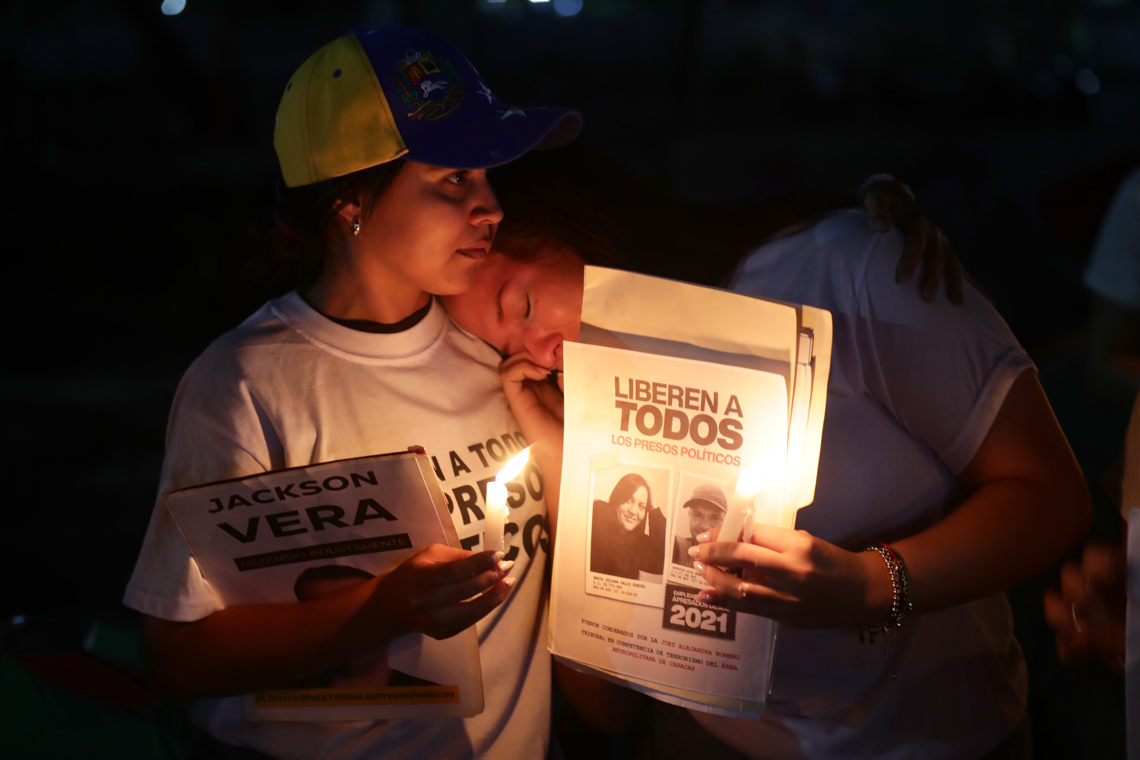
The announcement comes while dozens of relatives of political prisoners wait anxiously outside prisons such as El Rodeo, near Caracas, awaiting new releases after the rule comes into force.
The expectation has become routine for mothers, wives and children who have remained in makeshift tents since early January.
Massiel Cordones, mother of the soldier José Barreno, detained more than five years ago, expressed her hope that the amnesty will reach her son, although she acknowledged that her case is “critical” for being linked to Operation Gedeón, a frustrated maritime attack in 2020 excluded from the law and whose objective was the overthrow of the government of Nicolás Maduro.
“Their food is not adequate, their condition is not adequate for them to be able to endure this hunger strike,” said Cordones, referring to more than 200 political prisoners who are protesting inside the prison, in statements to the agency EFE.
For its part, the NGO Foro Penal has so far verified the release of just over a hundred detainees in prisons for political reasons, a figure much lower than that announced by the government.
The independent organization assures that nearly 600 people remain deprived of liberty for political reasons and that more than 11,000 citizens have had restrictive measures in recent years.
Humanitarian groups consider it “nonsense” that the same judges and prosecutors who accused the detainees are now interpreting the law to grant benefits. For this reason, they demand the appointment of ad hoc judges and the dismantling of what they consider a repressive system.
A law with limits
The Amnesty Law, passed on February 19, covers cases of political prisoners from 1999 to 2026, but specifies 13 events that occurred in different years. This excludes other periods and situations, especially those related to military operations.
The acting president Delcy Rodríguez, promoter of the initiative, asked Parliament and the Judicial Revolution Commission to give “maximum speed” to the application of the norm, which seeks – as she said – to enhance coexistence in the country after decades of political confrontation.
The president described the law as “an act of greatness” when promulgating it in the Miraflores Palace. “You have to know how to ask for forgiveness and you also have to know how to receive forgiveness,” he said.
In addition, he requested the evaluation of cases that are not contemplated in the new legislation to, he said, “heal wounds, redirect democratic coexistence” and justice.
Rodríguez took office on January 5, two days after the capture and transfer of former President Nicolás Maduro to New York by US forces to face federal drug trafficking charges. Since then, the interim government has insisted that the amnesty is a step toward national reconciliation, while making concessions to Washington.
Expectation in the courts and statistical differences
Arreaza assured that the pace of application is “extraordinary” and that the majority of applicants will obtain their amnesty within a period of 15 days. However, relatives reported that on Monday some courts did not receive applications, which generated confusion and unrest.
The former vice president and former chancellor during the Maduro governments explained that the judges and prosecutors worked “straight from Friday afternoon to Monday morning” to process the cases.
Meanwhile, the government speaks of more than 3,200 full freedoms, while Foro Penal confirms only 109 verified releases.
The NGO differentiates between “full freedom” and “release.” In the latter, the beneficiaries are released from prison but under precautionary measures, such as a prohibition on leaving the country or periodic appearances in court.
Russia and Venezuela strengthen cooperation
While the amnesty process is developing, Caracas and Moscow reaffirmed their intention to strengthen strategic cooperation.
In Geneva, during the 61st session of the UN Human Rights Council, Venezuelan Deputy Minister Rubén Darío Molina and his Russian counterpart Dmitri Liubinski ratified their governments’ willingness to consolidate bilateral relations in key areas such as economy, energy and mining.
Both countries reiterated their commitment to the defense of the United Nations Charter and the self-determination of the peoples, in a context marked by the capture of Maduro by US forces.
Moscow recently lifted the recommendation not to travel to Venezuela, considering that local authorities maintain public order and that the tourism sector is ready to resume operations.
The strategic partnership treaty signed in 2025 by Maduro and Vladimir Putin establishes a ten-year roadmap to strengthen cooperation in sectors such as oil, gas and air transport, in addition to coordinating actions with OPEC and the Forum of Gas Exporting Countries.
According to the most recent report by Transparencia Venezuela in Exile (May 2025), since 2018 there have been no new direct investments or Russian loans in Venezuela.
The economic relationship has been maintained mainly through bilateral trade, with a trade balance that averaged 968 million dollars annually between 2022 and 2025, a figure well below the exchanges that Russia maintains with other Latin American countries such as Brazil, Mexico, Chile or Argentina.