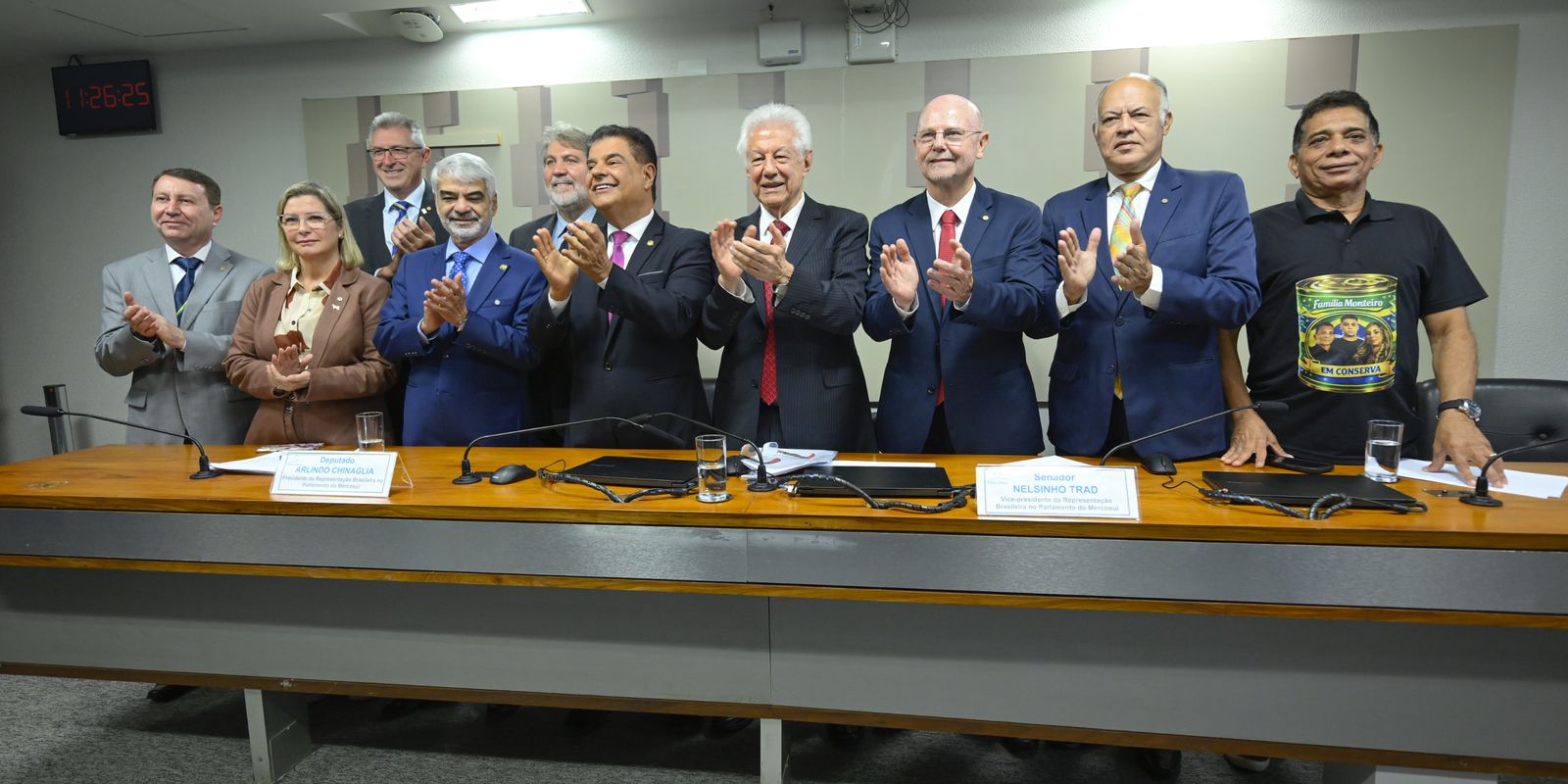
The Brazilian Representation in the Mercosur Parliament (Parlasul) unanimously approved this Tuesday (24) the Trade agreement between Mercosur and the European Union. The debate on the text began on February 10, when deputy Arlindo Chinaglia (PT-SP) read his report on the agreement, but a request for review postponed analysis.
With approval, the agreement goes to vote in the plenary sessions of the Chamber of Deputies and the Senate, respectively.
The text still has to be ratified by the Congresses of Argentina, Paraguay and Uruguay, as well as by the European Parliament. Entry into force will only take place after all procedures have been completed.
Signed on January 17thin Paraguay, the agreement was sent for analysis of Brazilian representation in Parlasul by President Luiz Inácio Lula da Silva on February 2nd
The agreement creates a free trade area between the two blocs, with a gradual reduction in tariffs and the preservation of sectors considered sensitive, in addition to providing for safeguards and dispute resolution mechanisms.
The text contains 23 chapters that deal, among other points, with reducing import taxes and creating rules for various sectors. Mercosur is expected to eliminate tariffs on 91% of European goods within 15 years. The European Union will eliminate tariffs on 95% of Mercosur goods within 12 years.
The agreement establishes the largest free trade zone in the world, with more than 720 million inhabitants. The Brazilian Export and Investment Promotion Agency (ApexBrasil) estimates that the implementation of the agreement it can increase Brazilian exports by around US$7 billion and expand the diversification of Brazilian international sales, even benefiting the national industry.
1. Elimination of customs duties
Gradual reduction of tariffs on most goods and services;
Mercosur: will eliminate tariffs on 91% of European goods within 15 years;
European Union: will eliminate tariffs on 95% of Mercosur goods within 12 years.
2. Immediate gains for the industry
Zero tariff from the beginning for various industrial products.
>> Sectors benefited:
Machines and equipment;
Cars and auto parts;
Chemicals;
Aircraft and transport equipment.
3. Expanded access to the European market
Mercosur companies gain preference in a market with high purchasing power;
EU has GDP estimated at US$ 22 trillion;
Trade tends to be more predictable and with fewer technical barriers.
4. Quotas for sensitive agricultural products
Products such as beef, chicken, rice, honey, sugar and ethanol will have import quotas;
Above these quotas, a fee is charged;
Quotas grow over time, with reduced fares, rather than allowing unrestricted entry;
Mechanism seeks to avoid abrupt impacts on European farmers;
In the EU, quotas are equivalent to 3% of goods or 5% of the value imported from Brazil;
In the Brazilian market, they reach 9% of goods or 8% of the value.
5. Agricultural safeguards
>>EU may temporarily reintroduce tariffs if:
Imports grow above defined limits;
Prices are well below the European market;
Measure applies to chains considered sensitive.
6. Mandatory environmental commitments
Products benefiting from the agreement cannot be linked to illegal deforestation;
Environmental clauses are binding;
Possibility of suspending the agreement in case of violation of the Paris Agreement.
7. Health rules remain strict
EU does not relax sanitary and phytosanitary standards.
Imported products will follow strict food safety rules.
8. Trade in services and investments
>>Reduction of regulatory discrimination against foreign investors.
>>Advances in sectors such as:
Financial services;
Telecommunications;
Transport;
Business services.
9. Public procurement
Mercosur companies will be able to compete for public tenders in the EU;
More transparent and predictable rules.
10. Intellectual property protection
Recognition of around 350 European geographical indications;
Clear rules on brands, patents and copyrights.
11. Small and medium-sized enterprises (SMEs)
Specific chapter for SMEs;
Customs facilitation measures and access to information;
Reduction of costs and bureaucracy for small exporters.
12. Impact for Brazil
Potential to increase exports, especially in agriculture and industry;
Greater integration into global value chains;
Possible attraction of foreign investments in the medium and long term.
13. Next steps
Approval by the European Parliament;
Ratification in the Congresses of Brazil, Argentina, Paraguay and Uruguay;
Entry into force only after completion of all procedures;
Agreements that go beyond trade policy need to be approved by the parliaments of each country.
Check out the information from Repórter Brasil Tarde, from TV Brasil