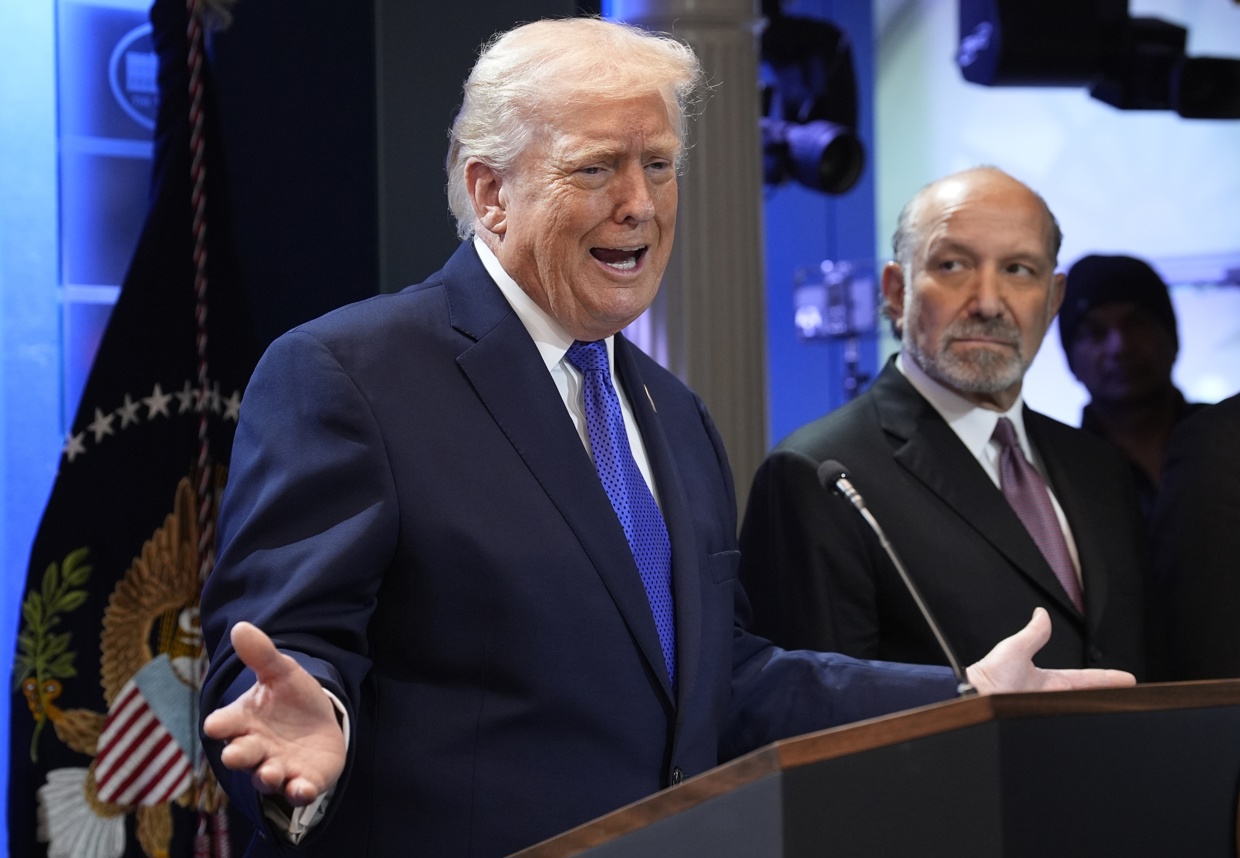
Starting this Tuesday, the US will begin applying a global tariff of 10% to foreign products, despite the fact that the president donald trump had recently announced its intention to raise it to 15%which has generated uncertainty about US trade policy.
Last Friday, after the United States Supreme Court annulled most of the tariff agenda promoted by Trump, the president announced that he would quickly implement a flat 10% tariff for all trading partners using a different law.
Subsequently, Trump published on his Truth Social network that he would raise that global tariff from 10% to 15% “effective immediately,” ensuring that the new level was completely legal.
However, US Customs and Border Protection informed importers that the initial rate will be 10%according to several media outlets.
USA, Trump and the tariff policy
According to EFE, The 10% will apply to “all countries for a period of 150 days, unless specifically exempt.”
According to the President’s proclamation of February 20, 2026, the temporary 10% surcharge applies to all merchandise entering for consumption or removed from storage on or after 12:01 a.m. (Eastern Time) on February 24, 2026, regardless of its country of origin, except for specific exemptions.
In this way, it is confirmed that the global tariff starts at 10%, while the administration is working on a separate order to raise it to 15%, still pending presidential signature.
The new tariff was applied under section 122 of the Trade Act of 1974 and will be in effect for approximately 150 days, until July 23, after which it can only be extended with congressional approval, he said. Investing.
Who is exempt?
The White House detailed that agricultural products such as beef and tomatoes, medicines, critical minerals, metals intended for coins, certain energy and aerospace products, as well as donations and related luggage are exempt.
Nor will sectors that were already taxed outside the framework of the IEEPA and not included in the Supreme Court ruling be affected, including the 50% tariff on steel, aluminum and their derivatives, in addition to products that are part of the T-MEC treaty with Canada and Mexico.
The Supreme Court ruling impacts the so-called “reciprocal” levies imposed by Trump to reduce the trade deficit, as well as the additional 25% tariffs on Mexico and Canada linked to combating the flow of fentanyl.
Likewise, the increase of up to 50% to Brazil and India is invalidated, in retaliation for the prosecution of former Brazilian president Jair Bolsonaro and for the purchase of Russian crude oil, respectively.
Also The tariffs announced at the end of January against countries that supplied oil to Cuba are invalidatedin the context of oil blockade of Washington on Havana.
However, the White House maintains economic pressure against the island.
Trump suspends tariffs against oil suppliers to Cuba: does the energy fence remain?