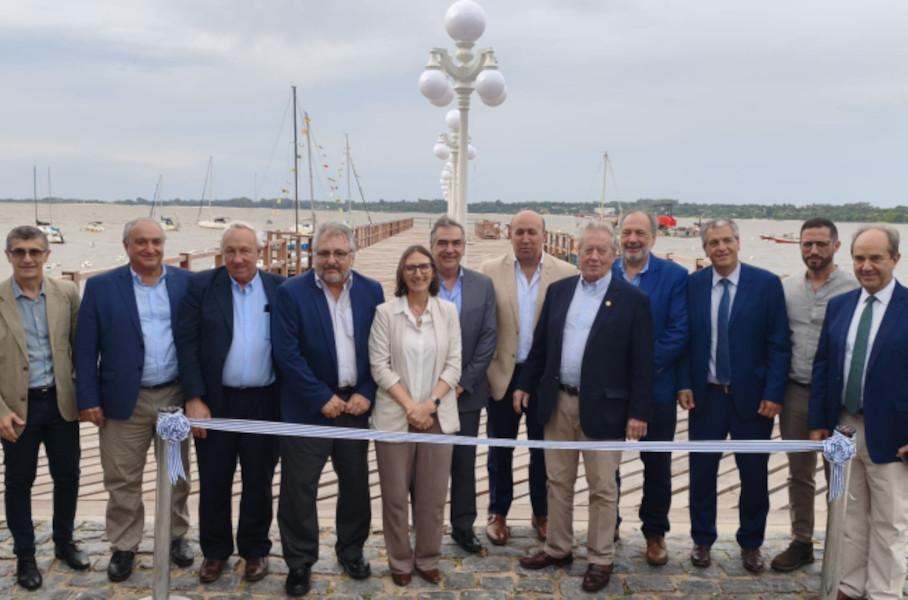
The management of the port infrastructure in the Historic District of Colonia has come under scrutiny after the recent statements of Juan Pablo Pereira, a resident of the Historic District, who in dialogue with EL ECO exposed a series of deficiencies that affect both heritage and nautical safety. The criticism points to three central axes: the low quality of the materials in the new dock, the lack of transparency in the construction of a walkway and the vulnerability of the port to northerly winds.
Neighbor Juan Pablo Pereira
A “new” dock with an expiration date
Despite having been recently inaugurated, the dock is already in a state that, according to Pereira, “leaves much to be desired.” The main complaint lies in the use of “green wood” for its construction. Expert carpenters in the area would have confirmed that the material did not receive adequate treatment, which has caused the boards to bend, split and the railings to look crooked in a short time.
“If that is what you see on the surface, the worst is what you don’t see, which is what is from the water down,” warned Pereira, questioning the durability of a work that should have been designed for decades and not months.
The controversial catwalk: Public work or administrative whim?
The most critical point of the complaint is the construction of a walkway that would connect the dock with the breakwater. According to the testimony collected, the work would have been awarded without any type of public bidding by the ANP and, furthermore, without the necessary heritage or archaeological studies.
Pereira highlighted the contradiction with what the residents of the Historic District experience: “when you live here, you have to wait three or four years for a construction permit subject to heritage and archeology to be approved. But for this work, there are no heritage studies or archaeologists.” In addition, he described the structure as unnecessary, since it is projected in an area of low water where they cannot even moor boats.
And Pereira stressed that “they are spending money on nonsense, really on nonsense, because what is the point of the walkway? People already have a place to go fishing, they already have a place to walk, they have a place for everything they want to do. That walkway does not have any kind of port meaning because it is not even designed in a place for mooring, it is in a low-lying area where boats do not even reach.”
An unprotected port that scares away tourism
Finally, the claim focused on the port’s operation. Despite being one of the busiest nautical points on the Río de la Plata, Colonia lacks a northern shelter or floating breakwater. This lack turns the port into a “beater” every time the north wind blows, causing severe material damage.
“I personally lost my boat in a storm because it is completely unprotected,” said the neighbor. The lack of nautical safety is causing a constant loss of Argentine boaters, who opt for other destinations due to the risk of leaving their boats in a port that, according to users, prioritizes “aesthetic works” over basic security infrastructure.
“It is the most unprotected port in the Río de La Plata, and with all the nautical influx it has, it does not have a minimum northern protection, such as what would be called a floating breakwater, something that something that protects the port does not have,” he closed the interview.
The pier will reopen in December 2025. Cost of the work 4 million dollars
This dock was closed to the public in 2020 and its reconstruction only began in July 2024 by the Stiler company, under the administration of Luis Lacalle.
The pier has been closed to the public for the past five years due to deterioration and structural risks. Its recovery was through the signing of a contract between the ANP and the Stiler company, in July 2024.
The structure, 92 meters long by 12 meters wide, is once again integrated into the urban landscape after an eighteen-month reconstruction process that included the assembly of new porticos with pillars, beams and diagonals, a completely renovated planking, the integral reinforcement of the piles, the installation of a new lighting system and the construction of concrete marinas with 34 moorings for boats up to 15 meters in length.