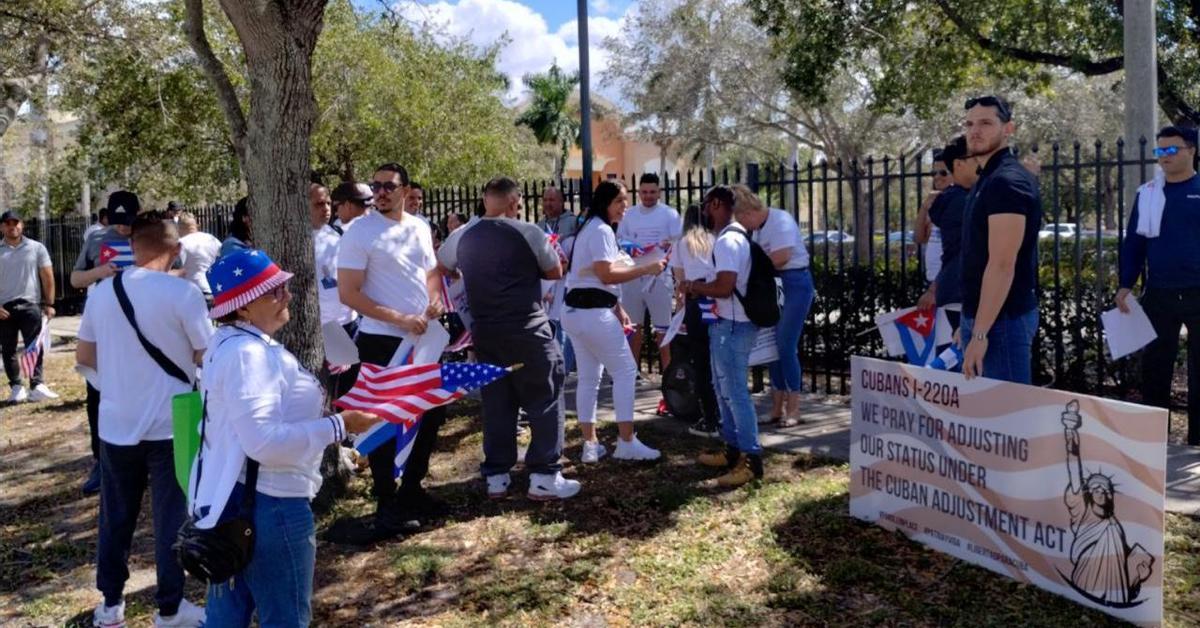
Madrid/Frustration is the most generalized feeling in groups of migrants residing in the United States with I-220A [también conocido como libertad bajo palabra]. Pending the decision of an Atlanta court that would clarify their uncertain future, the ruling, although not negative, will keep them in a waiting period again, since it returns to the previous instance –the Board of Immigration Appeals (BIA)– the case. “So many unjustly detained and deported and we still do not have an answer, we are still in an immigration limbo,” lamented one of them, a resident of Texas.
Expectations were high surrounding this lawsuit, an appeal to the Eleventh Circuit Court in Atlanta filed by a Miami attorney, Mark Prada, to review the case of two Cuban women whose application for permanent residence was denied under the Cuban Adjustment Act.
In 2023, the BIA established that the I-220A form could not be considered a parole and, therefore, to request residence it was mandatory to process political asylum in a court in the ordinary way. That was the position defended by the US Government, which considered that these entries were illegal and the document only allowed them to be free until the courts decided if they had the right to asylum.
That was the position defended by the US Government, which considered that these entries were illegal and the document only allowed them to be free until the courts decided if they had the right to asylum.
Prada decided to appeal that ruling, arguing that the document received by her clients, and by any person detained and subsequently released, should have been the parole. The Immigration Law indicates that a humanitarian permit is the only option to release a detainee, so it was only a matter of applying it correctly, without creating other mechanisms.
In addition, he considered that federal legislation had been confusing in recent years. Now, the Court admits that the Government did not have a firm criterion regarding admission, with the consequences that this entailed later, when it came to obtaining an immigration benefit.
The Government, however, has argued that there was never any intention to “grant the benefits of a status of parole which he never intended to grant.”
“After reviewing the record and with the benefit of oral arguments, we conclude that we have jurisdiction over the matter, vacate the BIA orders in both cases and remand the records for subsequent proceedings,” reads the opinion, which is just six pages long.
In this way, the decision remains open, since it will once again depend on the BIA to rule on the particular case of both migrants and whether it affects the more than 300,000 Cubans who live in the United States with an I-220A permit. The ruling could also determine to establish some criteria on requests for bail or appeals for bail. habeas corpuscurrently highly debated due to the new immigration regulations of the Donald Trump Administration.
“It is not the decision we wanted, but we have won several points in this battle,” said the lawyer after hearing the ruling. The lawyer at least showed satisfaction in some aspects. “The Eleventh Circuit rejected the BIA criterion that a person with I-220A is not eligible for Cuban Adjustment and none of the Government’s arguments were accepted.” In addition, Prada said that the decision opens the door to a class action lawsuit in Florida, since the Atlanta court declared itself competent in this case.
“This is a long fight, there is a lot to do and we have many moving pieces,” the lawyer, who has another similar case open in New York, told the media.
“This is a long fight, there is a lot to do and we have many moving pieces,” the lawyer, who has another similar case open in New York, told the media.
Last AugustJorge Lázaro García, a Cuban with I-220A became the first known case to which a New Orleans immigration judge granted a parole and residence through the Adjustment Law. The decision, however, depended on a possible appeal from the Government about which there has been no information, but experts warned at the time that the case had no precedent and it was too optimistic to think that there would be more.
Those affected, although they are more frequent the arrests of those who do not have crimesthey keep the faith, but it is becoming more and more difficult for them. “This is unprecedented. None of us could imagine leaving that prison island to arrive here and experience this uncertainty of being returned to where we fled. All politics is shit, they play with our lives as if we were dolls. They use the money and sweat of the people to sink us instead of saving us.”