The imminent departure of the Cuban doctors of Hondurasunder pressure from Washington, represents a new blow for the island’s health missions abroad.
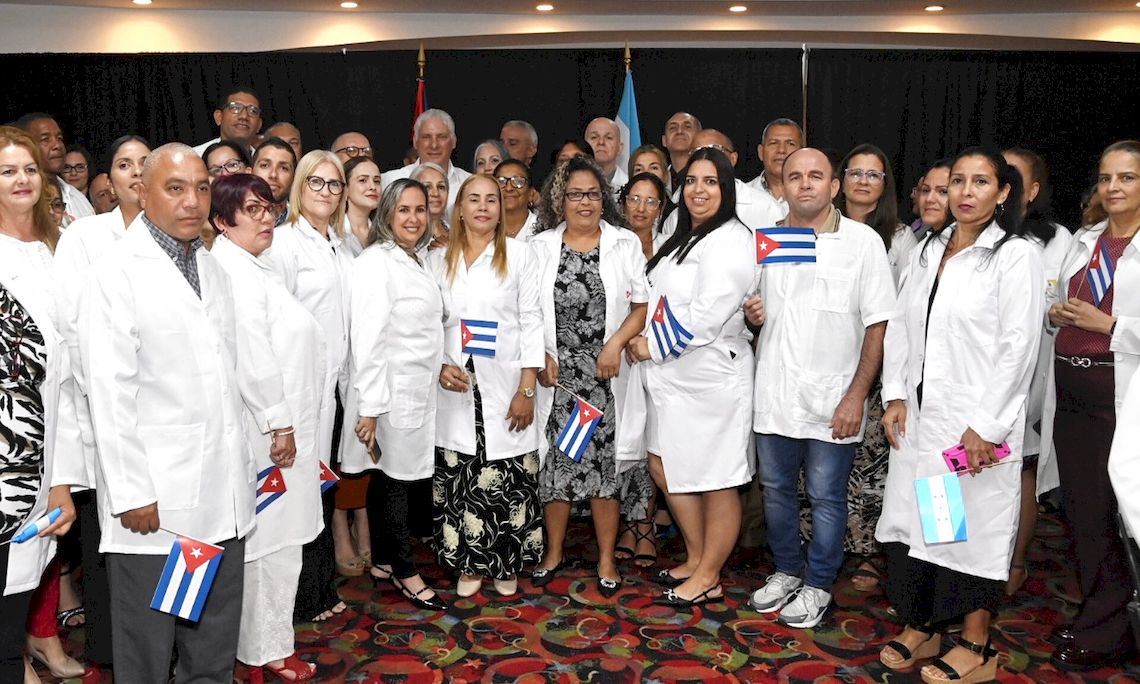
In total, there are 128 Cuban health professionals who will have to leave Honduran territory after the decision of Nasry Asfura’s government not to renew the agreement that kept them in the country.
The measure is part of the US Government’s strategy of reducing sources of foreign currency to Havana, whose main income comes precisely from the export of professional services.
The contract that allowed the presence of Cuban medical brigades in Honduras will expire this week, and the new conservative government announced that it will not be renewed. “The departure of the Cuban doctors is a foreign policy decision,” declared the Secretary of Communications, José Augusto Argueta.
For his part, the Vice Minister of Health, Eduardo Midence, assured that the services will be replaced by local or accredited foreign personnel. “We are going to work to hire Honduran or foreign doctors duly accredited by the Medical College,” said the official. quoted by the French press agency AFP.
Cuban doctors in Honduras
The Cuban medical brigade in Honduras is made up of 128 specialists, although some sources cite higher figures. The island’s professionals worked in rural areas and in programs such as the Miracle Mission, which until October 2025 carried out some 44,000 ophthalmological consultations and nearly 7,000 surgeries, according to official figures.
The Cuban doctors hope to be transferred to the island on a charter flight at the beginning of March. Meanwhile, the Honduran government assures that the clinics will not be closed and that they will be attended by local professionals.
After Hurricane Mitch hit in 1998, Cuba deployed medical brigades to several Central American countries that had been devastated. The first contingent arrived in Honduras, Guatemala and Nicaragua, where the Comprehensive Health Program was established to serve the most affected communities with the least access to health services.
The collaboration ceased in 2009 following the coup d’état against then-president Manuel Zelaya and resumed in 2024. under the administration of President Xiomara Castro to mainly provide continuity in rural areas to the Milagro Mission.
Díaz-Canel travels to Honduras and meets with Xiomara Castro and Cuban collaborators
Accusations and investigations
Meanwhile, the vice president of the National Congress of Honduras, Johana Bermúdezannounced that an investigation will be opened to determine if all the members of the brigades were really health professionals or if some were part of intelligence structures sent by Havana.
“That political relationship between the previous government and Cuba brought a number of personnel that we never knew if they were doctors, nurses or intelligence agents,” said Bermúdez, quoted by the local press.
The parliamentarian added that the destination of the public funds spent to support the agreement will be reviewed, which according to complaints were channeled through institutions such as the National Institute of Retirements and Pensions of Public Employees (Injupemp).
The previous Government, led by Xiomara Castro, has defended the legality of the collaboration program with Cuba, as well as the relevance of the work carried out by the island’s professionals, a perspective shared by the Honduran population, particularly by those who were treated by Cuban doctors.
A regional boss under pressure from Washington
Honduras’ decision follows in the footsteps of countries such as Guatemala and Antigua and Barbuda, which also ended their agreements with Cuban medical brigades. In other cases, such as Guyana, it has been decided to modify payment conditions, directly remunerating professionals instead of transferring funds to the Cuban State.
Washington has intensified its diplomatic pressure for nations in the region to reduce or eliminate agreements with Cuba. Washington argues that the medical brigades constitute a form of “labor exploitation” and a source of foreign currency for the government of Miguel Díaz-Canel.
Countries that have given in to US pressure are Brazil in 2018, Bolivia in 2019, Ecuador in 2019, El Salvador in 2020, Guatemala in 2025, Antigua and Barbuda in 2025 and more recently Honduras in 2026.
In contrast, other nations in America and the Caribbean still maintain active agreements with Cuban medical brigades. Meanwhile, in Africa, countries such as Angola and South Africa continue to receive Cuban doctors, and in the Middle East Qatar has renewed agreements in recent years.
Marco Rubio and the CARICOM Summit
American pressure against Cuban medical collaboration could intensify in the Caribbean.
The Secretary of State, Marco Rubio, one of the main promoters of sanctions against Havana, will participate in the 50th Ordinary Meeting of the Conference of Heads of Government of the Caribbean Community (CARICOM) that will begin on Wednesday in Saint Kitts and Nevis.
Rubio will hold meetings with Caribbean leaders, mostly in solidarity with Cuba since the 1970s as they were the first to break hemispheric isolation—with the exception of Mexico and Canada—to discuss shared priorities such as regional security, migration, illicit trafficking, economic growth, health and energy security.
The visit of the head of US diplomacy raises concern in governments that depend on the island’s medical cooperation to sustain basic services in rural areas and vulnerable communities.
The departure of medical brigades represents a hard blow for Cuba, which obtained more than 6 billion dollars annually from the export of professional services. These incomes are vital to sustain the island’s economy, especially in a crisis scenario aggravated by the United States oil blockade, the collapse of tourism and the effects of natural disasters such as Hurricane Melissa.