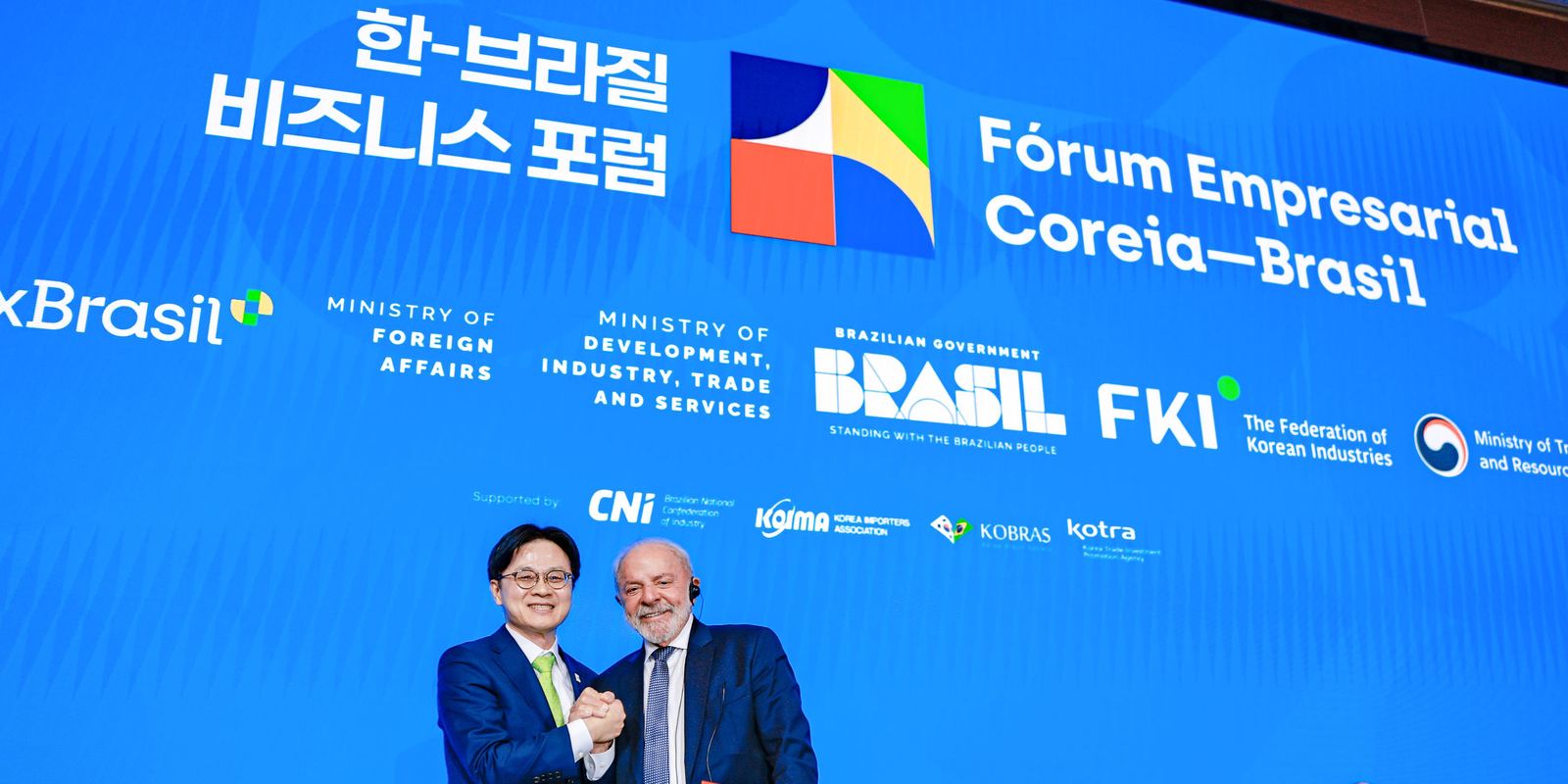
President Luiz Inácio Lula da Silva stated, this Monday (23), that collaboration with South Korean companies in “knowledge-intensive” sectors is a priority for Brazil. He is traveling to Seoul, the capital of South Korea, and participated in the closing of a business forum that brought together 230 companies from both countries.
In a speech, Lula spoke, for example, about the possibility of partnerships in the exploration of critical minerals.
“Korea is the world’s second largest producer of semiconductors and holds a significant share of the battery market. Brazil has critical minerals that are essential inputs for the electronics and electric vehicle production chains and is a reliable partner in a scenario in which arbitrariness is becoming the rule,” he said.
“The role of mere exporters of raw materials does not match our potential. We seek partnerships that allow us to add value and produce cutting-edge technology on Brazilian soil”, highlighted the president.
Furthermore, Lula cited “mutually advantageous” cooperation opportunities in the aerospace, health, cosmetics and cultural areas. He remembered the operations of start-up Korean Innospace at the Alcântara Launch Center, in Maranhão, and stated that dialogue between space agencies is “crucial” to deepen this collaboration, including sharing satellite data and lunar exploration projects.
Regarding health actions, the Brazilian president spoke about the expectation of joint manufacturing of new vaccines, drugs and medical supplies, as South Korea expands its research and development in the area and as Brazil advances in construction of the Órion biosafety laboratorythe only one in the world connected to a particle accelerator, Sirius.
“This will allow us to seek solutions for diseases, develop diagnostic methods and prevent epidemics. Public health institutions, such as Fiocruz and other Brazilian state foundations, are strengthening their cooperation with Korea,” he said.
In the cosmetics area, Lula recalled that, in 2025, the Brazilian beauty sector surpassed the US$ 1 billion mark in exports for the first time, at the same time that Korea’s cosmetics industry is already rivaling that of France in the global market.
“Brazil has the greatest biodiversity in the world. By combining Brazilian potential with Korean technology, we can multiply our reach in this sector”, he argued.
Finally, the Brazilian spoke about cultural initiatives and the possibilities of partnerships between the two countries. “In Korea, the creative economy surpasses exports from traditional sectors such as household appliances. In Brazil, the sector already accounts for more than 3% of GDP – above the automobile industry – and has an average job creation rate higher than the national rate”, he said.
“From Brazilian funk to K-Pop, from Parasita to Agente Secreto, from soap operas to K-Dramas, our music and our audiovisual production are conquering the four corners of the world”, he said.
Trade and integration
The trade flow between Brazil and Korea is around US$11 billion, below the record of almost US$15 billion registered in 2011.
“It means that we were already better at business,” Lula told the businesspeople, highlighting that the Brazilian Export Promotion Agency (ApexBrasil) identified 280 opportunities for Brazilian products in Korea, from food and beverages to chemical products.
Earlier, Lula was received by the country’s president, Lee Jae-myungon a state visit, when the two countries signed 10 acts of cooperation. THE The main one, according to the president, is a commercial cooperation and productive integration agreement, with a focus on strengthening industrial, technological and agricultural cooperation.
“The agreement will also strengthen resilient and secure supply chains and innovate in strategic minerals, sustainable industries, and audiovisual. Our ministries will meet regularly to discuss how to strengthen economic relations,” he explained.
The president spoke about the country’s socioeconomic indicators and the “advantageous conditions” for investments. He also cited the public policies implemented during his administration that encourage the arrival of foreign companies: the Growth Acceleration Program (PAC), the New Industry Brazil Program (NIB), the Green Mobility and Innovation Program (MOVER) and the Ecological Transformation Plan.
Furthermore, Lula recalled that Brazil has been working for 15 years to gain access to the Korean beef market and stated that, to this end, Brazilian companies and institutions are ready to advance the necessary sanitary procedures.
The Brazilian took the opportunity to “advertise Brazilian agribusiness” and said that the role of the country’s political leader is to “open the gate” for businesspeople to do business. “When the people of Korea want to have access to protein, don’t worry, Brazil will be ready to meet Korea’s demand,” he stated.
Development of work
Lula also reaffirmed his defense of multilateralism and criticized trade wars in the world. “The best response to the attempt to use trade as a weapon is to show that it is possible to reach mutually beneficial understandings through dialogue and negotiation,” he said.
For Brazilians, protectionism hinders economic and social growth.
“What we need is to make economies grow, generate job opportunities to improve the quality of life of the people we represent […]. We need to be aware that only the development of work can allow us to solve the problem of hunger”, he stated.
President Lula also pointed out the similarities and contrasts in which the two countries developed trade and how Brazil can learn from the South Korean experience.
According to him, in the 1960s, GDP per capita Korean was equivalent to less than half of Brazilian and, today, it is three times greater than Brazilian. While, until the 1980s, Brazil’s industrial production was greater than that of Korea, today, Korea is one of the main technological hubs in the world.
“In the 1990s, while Brazil surrendered to neoliberal prescriptions, Korea continued to invest in the inducing role of the State in strategic sectors. No country that arrived late to the industrial race managed to climb the development ladder without robust public policies”, recalled Lula.
“The Korean experience proves that increasing the population’s education level is a valuable investment. It also demonstrates that sustained growth depends on a varied and sophisticated economy, capable of absorbing highly qualified labor”, added the president.