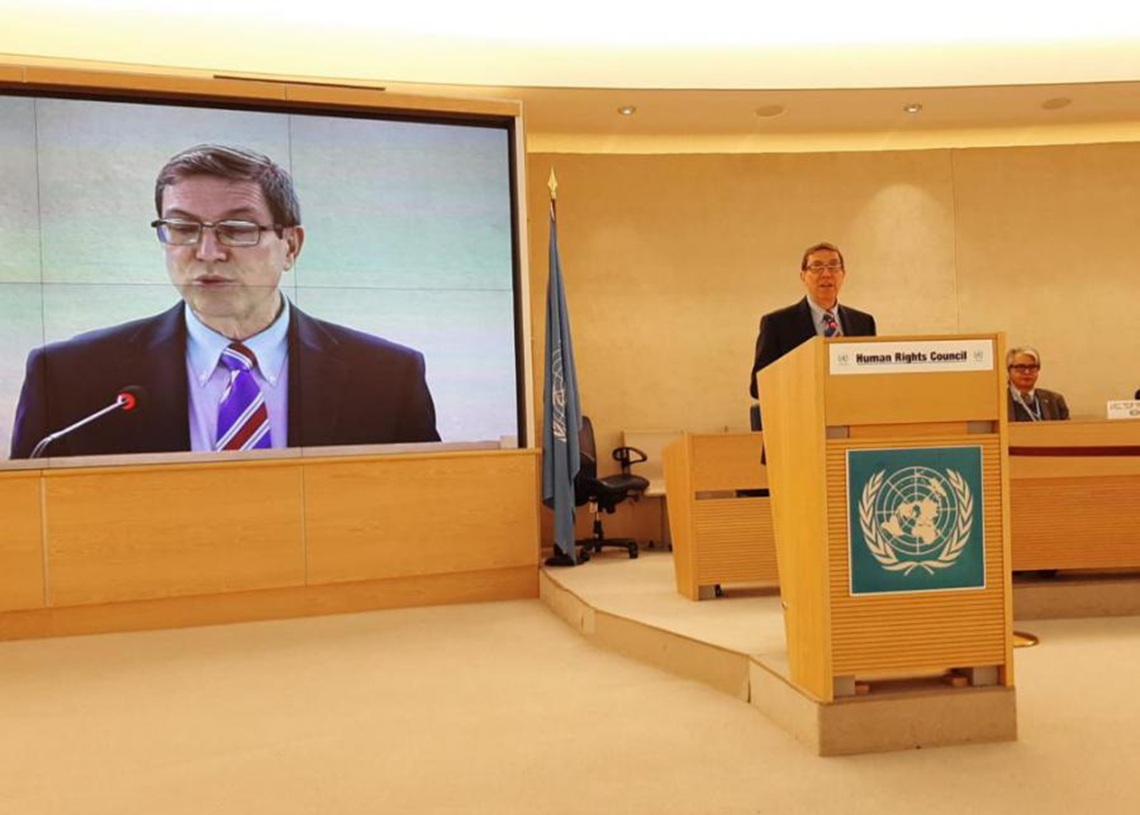
The Cuban Government will take its diplomatic efforts to the UN Human Rights Council this Monday to gather international support against the oil siege of the US, culminating a tour by its Foreign Minister, Bruno Rodríguez, through Vietnam, China, Spain, Russia and France.
Washington’s decision to cut off the flow of oil from Venezuela to the island and to threaten with tariffs on those who supply it with crude oil has led the entire country to a total emergency situation and put its government on the brink.
Faced with this situation, the Cuban Government launched a tough contingency plan to try to survive without oil from abroad and sent Rodríguez on an extensive tour as a “special envoy” of the Cuban Communist Party (PCC) and the Government.”
At the moment the fruits of this tour are not known – beyond an announcement of humanitarian aid by Spain yet to be finalized – in which Rodríguez has met, among others, with the Russian president, Vladimir Putin, and the foreign ministers of Spain and France, José Manuel Albares and Jean-Noël Barrot.
Foreign Ministers of France and Cuba address “complicated and tense context” for the island
Vietnam and China
Vietnam, a traditional ally of the island, was Rodríguez’s first stop, where held meetings with the general secretary of the Communist Party, To Lam, the president of the country, Luong Cuong; and Prime Minister Pham Minh Chinh, among others.
Rodríguez praised To’s “involvement and strategic direction” in bilateral relations on social networks, who for his part reiterated his country’s willingness to support Cuba “within its capabilities.”
Vietnam It is currently Cuba’s second trading partner and its main investor in Asia-Pacific. In recent months he has donated thousands of tons of rice and raised a popular donation of 23.3 million dollars.
In his next stage, in Beijing, Rodríguez met with the member of the Standing Committee of the Political Bureau of the Communist Party of China, Wang Huning, and the director of the China International Cooperation Agency (CIDCA), Chen Xiaodong, among others.
“I reiterated the high priority that Cuba attaches to the full and comprehensive development of our historical and strategic ties and cooperation in all spheres with this sister socialist nation,” said Rodríguez.
At the end of January, Chinese President Xi Jinping approved a emerging aid to Cuba which includes financial assistance of 80 million dollars and a donation of 60 thousand tons of rice.
China promises to continue supporting Cuba “within its capabilities” in the face of the US embargo
Spain and Russia
The chancellor then traveled to Spain, which, although not an ally, does maintain economic and political ties for historical reasons. Rodríguez conveyed to Albares his interest in “strengthening political, economic-commercial dialogue and cooperation for the benefit of both countries, in the current complicated international context.”
He then traveled to Moscow, a close political ally and commercial partner that maintains a “strategic partnership” with Cuba. Rodríguez was received by his Russian counterpart, Sergei Lavrov, and by Putin himself, who considered that Washington’s new sanctions are “unacceptable”.
“Now is a special moment, with new sanctions. You know what our position is on this matter. We do not accept anything like that,” said the Russian president.
The Kremlin confirmed that the parties discussed the concrete help that Moscow can provide to Havana. The Russian Government has indicated that it will soon send oil to the island as “humanitarian aid,” but has avoided giving details.
Lavrov, for his part, stressed that cooperation between his country and Cuba does not represent a threat to Washington and urged the US to show “common sense.”
In his last stop before the UN Human Rights Council, Rodríguez met with his French counterpart, to whom he reiterated the “escalation of US threats.” with the subsequent “impact on the fundamental rights of the Cuban people.”
Rodríguez was accompanied on part of this tour by the vice prime minister and head of Foreign Trade and Foreign Investment, Oscar Pérez-Oliva, and by the vice minister of the Revolutionary Armed Forces and chief of the General Staff, Roberto Legrá, among other officials.
Raquel Martori / EFE