Perkins Rocha, legal coordinator of the Vente Venezuela party, was released on February 8 after spending more than a year and a half imprisoned in El Helicoide. Despite this, the authorities imposed precautionary measures.
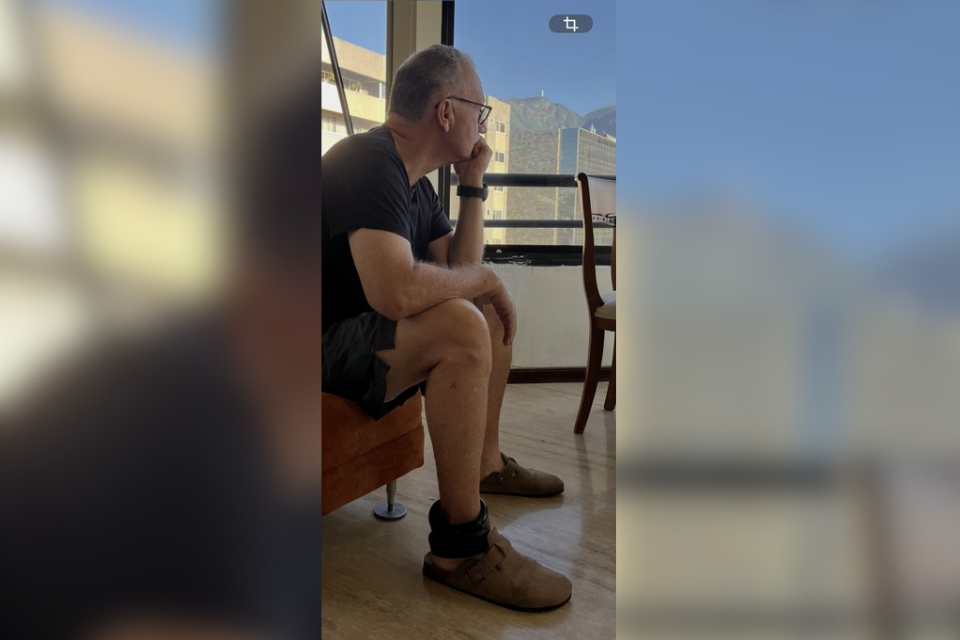
The lawyer and opposition leader Perkins Rocha, who is under house arrest with an electronic shackle, was recently photographed at his residence, in a gesture that his family uses to make visible that, despite having been released, he still does not enjoy full freedom within the framework of the controversial Amnesty Law for Democratic Coexistence approved by the National Assembly.
The image was spread by his wife, María Constanza Cipriani, on the social network “The amnesty has not yet reached our home… But while the shackle is being carried, the mind and spirit are also being burdened with the desire for Freedom,” Cipriani wrote from his account.
The #Amnesty It hasn’t arrived at our home yet…
But while the shackle is loaded, the mind and spirit are also loaded with a desire for Freedom!!!@PerkinsRocha #MayTheyBeEveryone #FreedomForAllPoliticalPrisoners #WithIntactFaith pic.twitter.com/6l3GWVhEnG— Looking for Citizens (@MaCostanzaCR) February 22, 2026
Rocha, legal coordinator of the Vente Venezuela party, was released on February 8 after spending more than a year and a half imprisoned in El Helicoide, a detention center of the Bolivarian National Intelligence Service (Sebin). Despite this, the authorities imposed precautionary measures on him that included house arrest, a ban on public expression, and the placement of a tracking device on his right leg.
The lawyer’s family has insisted that the Amnesty Law, recently passed by Parliament under government control, should be applied without restrictive conditions and allow him full freedom, without shackles or limitations. This lawsuit joins the claims of other sectors that have questioned both the scope and speed of implementation of the law.
The regulations were presented by the acting president Delcy Rodríguez as an instrument to free those who have been detained for political motivations and move towards a reconciliation process in the country; However, its implementation has generated controversies, criticism and discrepancies between official figures and those verified by human rights organizations.
*Read also: Sairam Rivas returns to Venezuela after six months in exile
The law is not automatic and its application requires courts to evaluate on a case-by-case basis, which has led to numerous requests for amnesty. According to the authorities, more than 1,500 people have requested to benefit from the measure, and hundreds have already been assisted, although organizations such as Foro Penal have pointed out that the exclusions and conditions of the legislation limit its real scope.
In the last few hours, former deputy Juan Pablo Guanipa – who was also under house arrest with shackles after his release – saw the electronic device removed, generating expectations in Rocha’s family that the same thing could happen in his case in the coming days.
Meanwhile, the lawyer remains under strict home custody, and his case has become a living example of the tensions between the expectations generated by the Amnesty Law and the reality of the conditions under which some released prisoners continue to live in Venezuela.
*Journalism in Venezuela is carried out in a hostile environment for the press with dozens of legal instruments in place to punish the word, especially the laws “against hate”, “against fascism” and “against the blockade.” This content was written taking into consideration the threats and limits that, consequently, have been imposed on the dissemination of information from within the country.
Post Views: 59