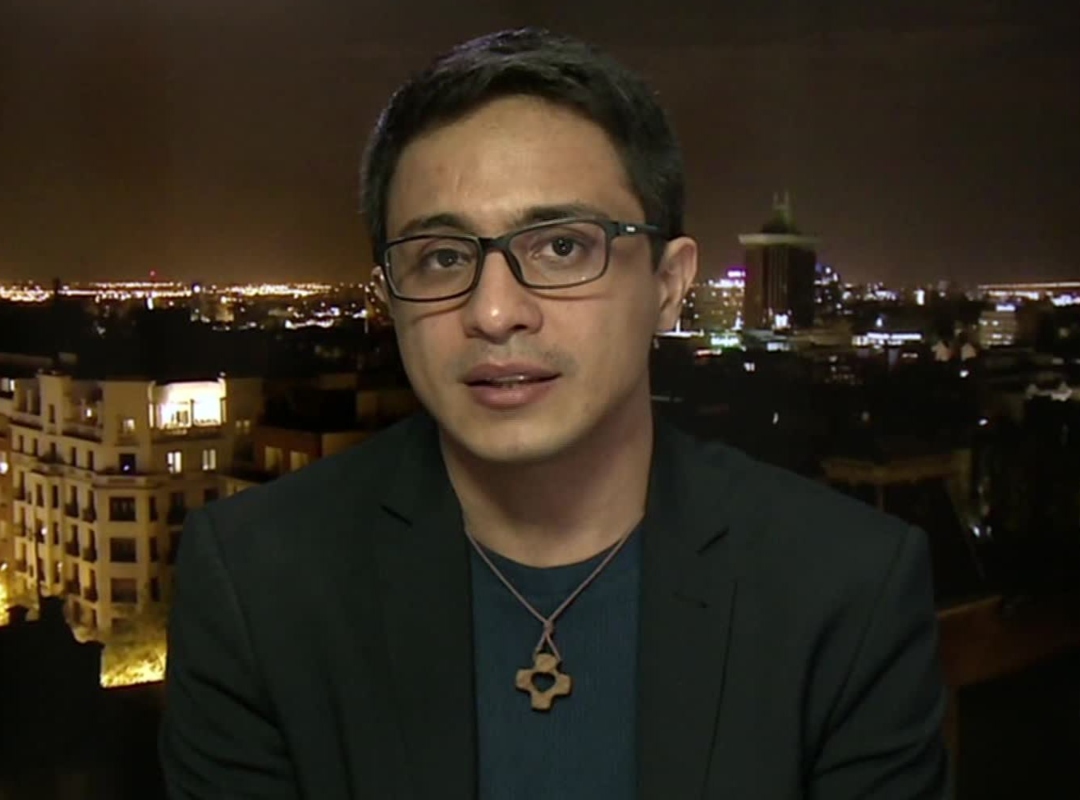
In Strasbourg, the Institute for Political Studies (Sciences Po) commemorated its 80th anniversary by becoming the epicenter of a crucial debate on ethics and democracy. The protagonist of this day was the Sakharov Prize, Lorent Saleh, who contributed his vision to Nuit de l’Europe 2026 in front of an audience of researchers, artists and students.
Your participation in the infringement workshop to international law and the role of civil society generated massive interest among young French academics. The former political prisoner shared the platform with experts such as Nicolas Boeglin and Gaudiose Vallière Luhahe, addressing citizen mobilization and the necessary reparation after large-scale humanitarian crises.
The human rights defender focused much of his speech on the situation in Venezuela, using it as a mirror for other contexts of repression. Saleh stated that “the recognition of the victims is not a symbolic gesture, “It is a structural duty of the State and the international community.”
For the speaker, the reconstruction of nations in crisis does not depend only on political agreements, but of a non-negotiable commitment with historical and judicial truth. In this sense, he stressed that those responsible for crimes against humanity must face courts so that there is a real and deep institutional recovery in Venezuela.
Pillars of a true transition
For Saleh, the democratic transition was analyzed as a process that requires cleaning up the justice system and removing those They used power for systematic persecution. “Without truth there is no reparation; without justice there is no sustainable transition,” warning about the dangers of impunity.
During his presentation, the Venezuelan activist questioned the effectiveness of global legal frameworks when they collide head-on with the inaction of governments. “International law does not fail for lack of norms, but because of the distance between the norm and the political will.”
The dynamic allowed students to work on hypothetical scenarios of international politics, seeking legal solutions to real conflicts that shake the world today. Saleh guided these working groups, analyzing universal jurisdiction and how civil society can act as a corrective mechanism in the face of the silence of state institutions.
The event concluded with a call to action for the European academic community, urging it not to be a passive spectator in the face of violations of human dignity. Saleh’s presence at Sciences Po Strasbourg reaffirmed the importance of memory as a living political tool to prevent the repetition of atrocities in the future.