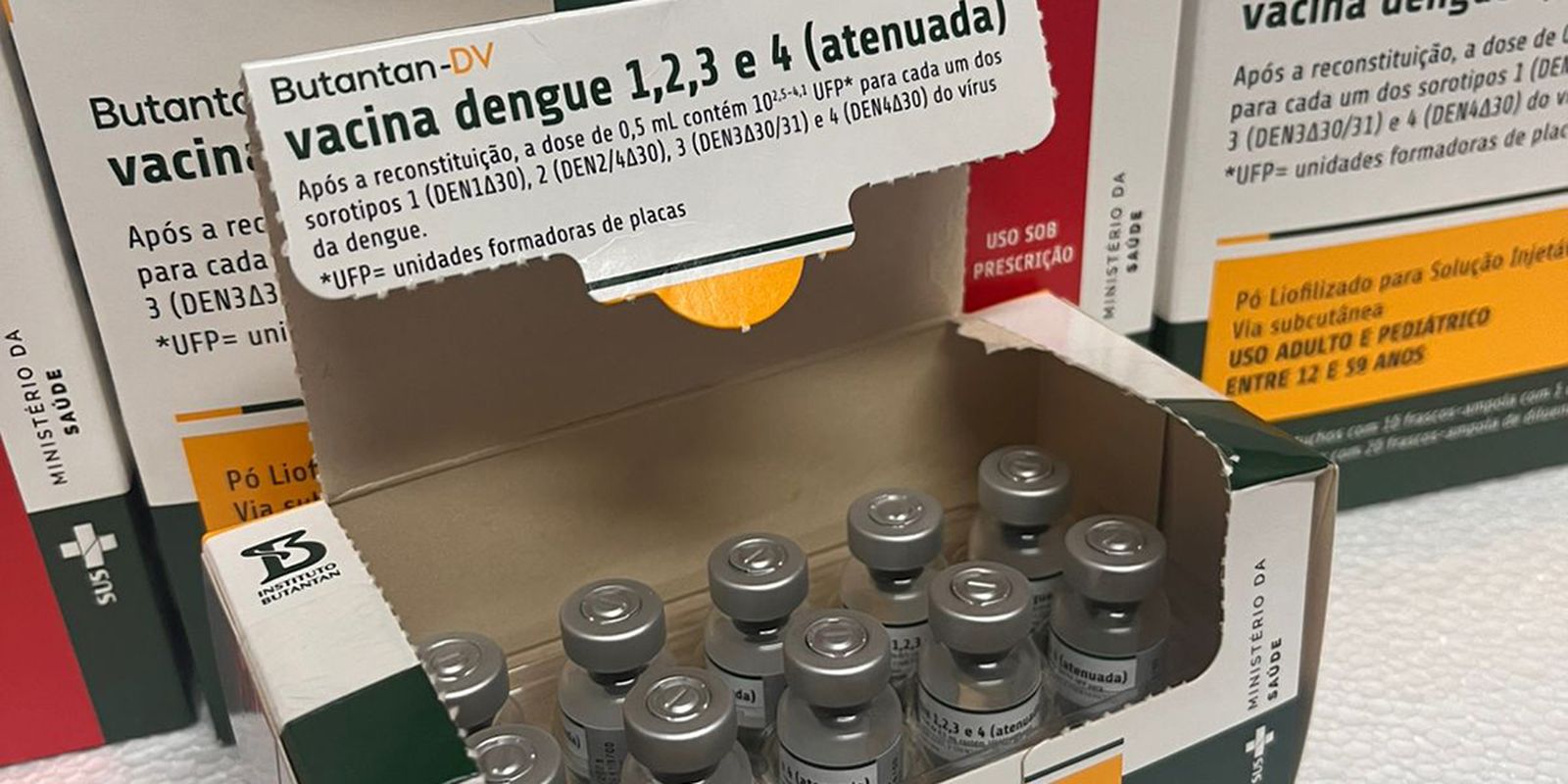
The 92 municipalities in Rio de Janeiro will begin receiving, this Monday (23), the new vaccine against dengue, produced by the Butantan Institute. Distribution will be carried out by the State Department of Health of Rio de Janeiro (SES-RJ). In total, the state received 33,364 doses, of which 12,500 went to the capital of Rio de Janeiro.
As determined by the Ministry of Health, the first doses of the vaccine are intended for professionals in Primary Health Care of the Unified Health System (APS/SUS). Administrative and support workers who work in the units are also included.
At this first stage, professionals who work directly in the units will be included, including doctors, nurses, nursing technicians and assistants, dentists, members of multidisciplinary teams (such as nutritionists, psychologists, physiotherapists, physical educators, social workers and pharmacists), as well as community health agents (ACS) and agents to combat endemic diseases (ACE). The expansion to other audiences will occur later, informed SES-RJ.
The Secretariat’s Immunization Manager, Keli Magno, explained that the Butantan Institute’s dengue vaccine was licensed for use in the age group of 12 to 59 years. “Considering that the vaccine from the Takeda laboratory is recommended for the population aged 10 to 14 years, it is recommended that the vaccine from the Butantan Institute be administered to the age group of 15 to 59 years of age”.
“The strategy will be staggered and gradual, starting with the group of Primary Health Care professionals, and progressively advancing, depending on the availability of doses by the manufacturer, to other groups, until we cover all adolescents aged 15 who have not been vaccinated with the vaccine from the Takeda laboratory”, he added.
Vaccination
The deployment of vaccination will take into account the availability of doses and the epidemiological situation of the municipalities. The vaccine has a single dose and protects against the four serotypes of the disease. In the state of Rio de Janeiro, serotypes 1 and 2 have appeared more frequently.
However, the possibility of cases of type 3 dengue emerging worries SES-RJ, as it has not been circulating in the state since 2007, which could lead to a scenario of vulnerability for people who have not had contact with this serotype, explained the Secretariat. This variant of dengue circulates in neighboring states, but has not spread in Rio de Janeiro until now.
Prevention
Although dengue indicators remain at low levels, the State Department of Health warns of the importance of actions to prevent the disease after Carnival. He highlighted that the intense rains that occurred days before the start of the festivities, associated with excessive summer heat, can lead to mosquito reproduction Aedes aegyptitransmitter of dengue fever and also chikungunya and zika. Furthermore, there is a lot of movement of tourists during this period, in the state, who may come from places where the virus is circulating.
Probable cases
Data from the SES-RJ Health Intelligence Center show that this year, until the 20th, the state recorded 1,198 probable cases and 56 hospitalizations for dengue, with no confirmed deaths. To date, there are 41 probable cases of chikungunya, with 5 hospitalizations. There are, however, no confirmed cases of Zika in Rio de Janeiro.
Monitoring of dengue, the most circulating arbovirus, is carried out with a composite indicator that analyzes visits to UPAs, bed requests and positivity rate, SES-RJ reported. The data can be viewed in real time on MonitoraRJ (monitorar.saude.rj.gov.br). The state’s 92 municipalities are in a routine situation.
As the Aedes aegypti mosquito has a high reproduction capacity, the recommendation is that each person dedicate ten minutes a week to sweeping their homes, checking the sealing of the water tank, cleaning gutters, placing sand in plant dishes and disposing of water from refrigerator trays.
The secretariat also points out that, in summer, a season that alternates between rain and heat, the mosquito reproduction cycle has ideal conditions. The eggs of Aedes aegypti They are deposited in accumulations of water and hatch when exposed to sunlight and heat.
Other actions
In 2023, the Ministry of Health began supplying the Japanese-made Qdenga vaccine. More than 758,000 doses of the vaccine were administered across the state. Of the target audience aged 10 to 14, more than 360,000 children and adolescents received the first dose and 244,000 completed the regimen with the second dose.
Video classes and training are also used by the Secretariat, aiming to qualify the health network. The state was a pioneer in creating a digital tool that standardizes the management of dengue cases in health units. The application was also made available to other Brazilian states.
Furthermore, the Noel Nutels Central Laboratory (Lacen-RJ) was equipped to carry out up to 40 thousand tests per month, ensuring rapid detection of dengue fever and also Zika, chikungunya and the recently introduced Oropouche fever, which is an arbovirus not transmitted by Aedes aegypti, but by Ceratopogonidae, better known as Maruim, informed SES-RJ, through its press office.