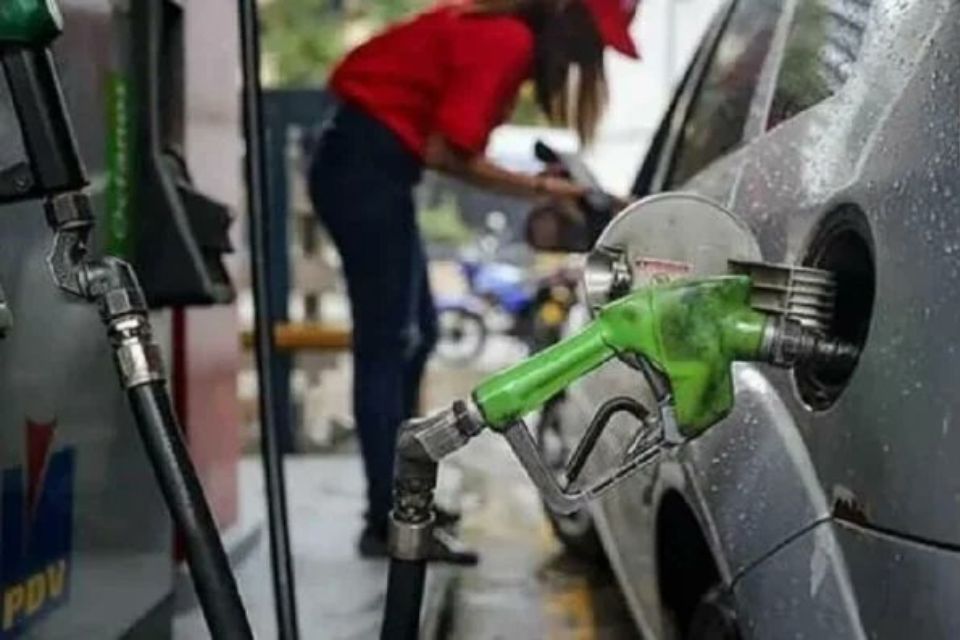
PDVSA’s pilot plan for the distribution of 97 octane gasoline fell by surprise at the selected service stations, says a manager who preferred to omit his identity. This sale serves a specific sector with greater payment capacity in a country that needs to stop subsidizing fuel, says Oswaldo Felizzola, coordinator of the National Center for Energy and Environment of Venezuela. For the economist Asdrúbal Oliveros, this is one of the meters for a possible price increase
The days off for carnivals were not wasted by Petróleos de Venezuela (Pdvsa). The state company launched a pilot plan for the sale of higher octane gasoline at six service stations east of Caracas.
This new gasoline, 97 octane, has a cost of one dollar per liter, double what is regularly sold at service stations and is available in El Hatillo, Terrazas del Club Hífico, Tamanaco, Blandín, La Floresta and Altamira. For some experts, this plan responds to the needs of a specific niche and, in turn, could be used as a gauge of a possible increase in fuel prices.
97 octane or premium gasoline, as it has been marketed, is designed for the requirements of high-end or modern vehicles whose engine has a turbo mechanismthat is, smaller in size due to carbon dioxide emission issues (CO₂) but with high performance.
Oswaldo Felizzola, coordinator of the National Center for Energy and Environment of Venezuela, points out that so far this sale is only a pilot project. “The idea is to see how feasible this 97 octane gasoline is within the supply networks in Venezuela. Not all vehicles need this type of gasoline, it is created for a specific market of vehicles that do not exceed 60 thousand (units). To give an idea, the Venezuelan automobile fleet exceeds four and a half million vehicles.”
The manager of a service station, who asked to remain anonymous, says that they were selected without prior notification from the state company. “We were informed that we had to sell gasoline for a dollar per liter. We don’t know what the distribution scheme will be like, everything is very new and I suppose they will give us more information as more days pass.”
Carlos, who works as a dispatcher at the La Floresta service station, comments that on Wednesday the 18th they started the sale. “Any car can use that gasoline because it is cleaner, more treated. The variety is that this gasoline is now being charged in foreign currency, it is not paid in bolivars for now.”
He explains that although there are new vehicle models that must necessarily use this type of fuel, any model of car or motorcycle can be supplied. As in other stations, it is unknown what PDVSA’s distribution plan will be like for this octane.
For Felizzola, it is likely that this plan will expand to other cities, “but always under the scheme of few gas stations.” He rules out that it is directly a “way to increase the price of gasoline, it seems to be to solve a problem for that specific niche that has purchasing power, because if you are buying a new or high-end car it should not be difficult to put it in, although we are talking about a significant cost.”
Adjustment in gasoline prices
Economist Asdrúbal Oliveros considers that the introduction of this type of gasoline, although it is presented as an additional option in the market, is the anticipation of a price increase.
“It is part of these changes in the issue of licenses… It is proof that a fuel adjustment is being considered. It is probable, but these are my estimates, that we will end up with gasoline at 0.50 and subsidized gasoline,” said in interview with Union Radiowhile mentioning that this would help fiscal balance.
Oliveros mentions that the Venezuelan government has applied a “silent adjustment” in the fuel market, due to changes in subsidized sales. It details that around 70% of the stations were selling gasoline at $0.50 per liter by September 2025, while only 30% maintained the subsidized scheme.
Since 2022, a pricing scheme for gasoline has been established in the country: subsidized at 0.10 bolivars per liter and international at 0.50 dollars per liter or its equivalent in bolivars. At least 1,430 service stations remained operational by June 2025.
For his part, Felizzola highlights that “it is not viable” for PDVSA to continue the production of subsidized gasoline. “Sooner or later we will all have to migrate to 0.50 cents per liter gasoline.”
The IESA professor maintains that, certainly, an adjustment must be made to the price of gasoline to reach 0.75 cents on the dollar. “Partly because the national market represents almost 40% of all our refining capacity, that is, those who pay for the refining process are Venezuelans. It is no longer like before when it was less than 15%. We cannot continue subsidizing the price of gasoline, we must pay a price that makes it profitable and be able to carry out the necessary repairs in the refineries.”
What users require
Rubén Pérez, a mechanic with more than 10 years of experience, explains that any vehicle can work with gasoline that is produced and sold in Venezuela. “At some specific gas stations you buy the additive to improve the octane rating and put it directly into the vehicle’s tank. Now PDVSA does it directly, but it will always be better to buy lower octane gasoline in terms of savings.”
“The problem is that the quality of the gasoline is not consistent, sometimes it has many impurities and that affects the performance of the car. Filters and injectors become clogged and, in the long run, it can cause damage to the gasoline pump,” says Pérez.
Due to this, it recommends rigorous maintenance of the vehicle or motorcycles: oil changes, inspection of gasoline filters and the engine. “If they are carbureted cars, check the injectors, that is, traditional maintenance.”
*Journalism in Venezuela is carried out in a hostile environment for the press with dozens of legal instruments in place to punish the word, especially the laws “against hate”, “against fascism” and “against the blockade.” This content was written taking into consideration the threats and limits that, consequently, have been imposed on the dissemination of information from within the country.
Post Views: 138