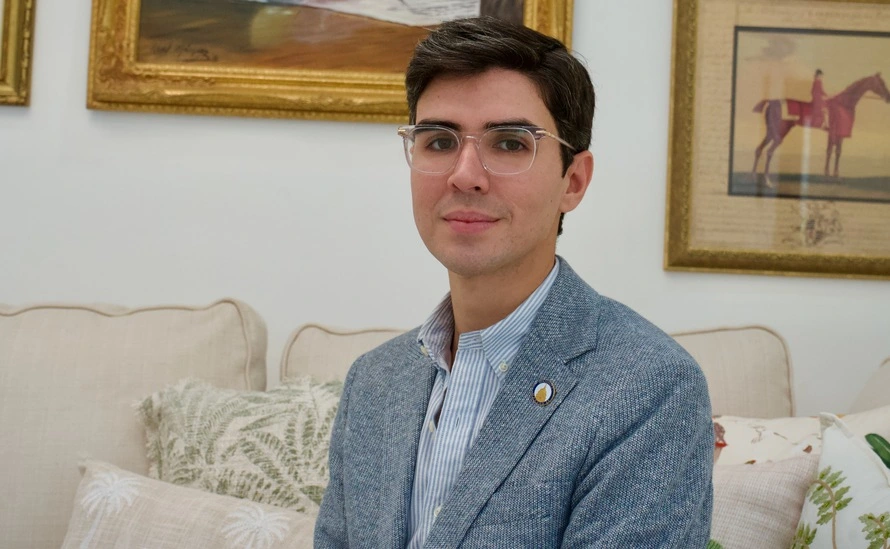
MIAMI.-With a solid career in politics, despite his youth, and an identity deeply marked by Cuban exile, Rey Anthony has just taken over as Chief of Staff of the congressman Carlos Gimenez. The appointment consolidates the rise of this political consultant from Miami, who has held key positions in both Congress and the Senate, and who recently served as senior advisor to Senator Ashley Moody, in addition to having been Director of Public Affairs for the Florida Attorney General’s Office and Director of Communications for the congresswoman Maria Elvira Salazar.
But beyond the positions and titles, Anthony defines himself from a much more intimate place. “I say it with great honor: I am from Pinar del Río. I was born in Miami, but I am from Pinar del Río,” he says, claiming peasant roots that place his origins in Pinar del Río and in a family of guajiros and teachers marked by exile. Grandson of four Cuban exiles—one of them a political prisoner—he grew up hearing stories of a lost Cuba that, as he recalls, “was a daily topic, sometimes without them realizing it.”
That family memory, woven between the Cuban countryside, repression and the impossibility of return, is what explains why Anthony speaks about Cuba not as a distant matter, but as a personal cause.
—Where do you come from and how do you define your roots?
—I say it with great honor: I am from Pinar del Río. I was born in Miami, but I am from Pinar del Río. I come from a family of guajiros, peasants and teachers. All the women in my family—my mother, my sister, my grandmothers—were teachers; The men worked the land, grew fruits and vegetables. I grew up with that legacy very present.
—What did your family teach you about Cuba?
-Lot. I am King Anthony, born and raised in Miamiand I feel deeply proud to be the grandson of four Cuban exiles. I had the privilege of growing up with my four grandparents, who instilled in me gratitude for the United States, but also the essence of who we are: Cubans. That has marked my entire life.
—What memories of your grandparents marked you the most?
—It is impossible to think about my family without thinking about Cuba. Cuba was a daily topic, sometimes without them realizing it. Everything was better in Cuba: the fruits, the mameyes, the guavas, life in the countryside of Pinar del Río. My grandparents were Guajiros and those anecdotes were always present.
—Did they tell you about their departure from Cuba?
-Yeah. As a child I was very curious and preferred to talk to my grandparents rather than other children. They told me things that not even my parents knew, like that one of my grandparents was political prisoner. Over time I learned about these very hard stories, and that had a profound impact on me.
—How do you remember Cuba before 1959 through them?
—My grandmother was born in a sugar plantation; He describes a beautiful, diverse childhood, with workers, winemakers, vendors, peasants. She was in Havana on January 1, 1959 and saw the euphoria of the people. I always remembered a phrase: “The good thing about this is how bad it is getting.” That initial hope that was later betrayed.
—What was your childhood like in Miami?
—Very happy. I grew up surrounded by my grandparents, parents, uncles and cousins. In my family we were always taught that failure is not an option. There was affection, discipline and healthy ambition. We traveled a lot and had a farm in the Redlands, where my mother organized peasant parties. There I connected deeply with Cuban music and culture.
—When did you decide to enter politics?
—I was always restless and dissatisfied. Since I was a child I wanted to understand and participate in decisions. As I grew older, I began to question government decisions and understood that, instead of complaining, I should get involved. If you are not at the table, others decide for you. And in my case, the issue of Cuba was decisive.

—Did you think about another profession?
-Never. Politics has always fascinated me, precisely because of the stories of my grandparents, because of what they experienced and because of the injustice that people I admire have been banished from their country.
—What motivates you today regarding Cuba, Anthony?
—See the young people inside the island raising their voices with courage. It pains me to see young people like me, who could have the same opportunities, living under a cruel dictatorship that humiliates the people. That deeply angers me.
—What would you say to someone who defends the regime?
—That we could never return. While other Latin Americans traveled to their country every summer, we did not have that option. That wound marks. Just 30 minutes from here there are people like us, but without basic freedoms. That cannot be justified.
—How do you see the role of exile in South Florida politics?
—It is inseparable. You cannot ask an exile to forget. Cuban exiles have shaped this policy since the 1980s, when many became citizens to vote, especially motivated by figures like Ronald Reagan.
—Today you work in Congress. What does that mean to you?
—It is an immense honor to be chief of staff of a federal congressman like Carlos Gimenez. We represent the community, help solve everyday problems and work on key issues such as national security, the border and the threat of communism, especially China’s role in Cuba.
—How do you handle stress?
—I sleep little, but I do what I love. It doesn’t feel like work. I would do it for free. The hardest thing is to see that, after 67 years, Cuba is still not free. That frustrates, but I don’t give up. I am an incorrigible optimist.
—Where do you draw your red line in politics?
—The freedom of Cuba. That is not negotiated. Human rights, principles, democracy are not currency. Everything else can be debated.
—What is your biggest personal dream?
—Go to Cuba with my grandparents. Close that circle. Walk through the places they knew. It would be a moment of absolute realization.
—To finish: many feel that you speak like someone born in Cuba. Because?
—Because Miami is Cuba. It is the seventh province. I grew up with the customs, the music, the language, the exile radio, Martí, the dominoes. Being Cuban makes me a better American, and being American will make me a better Cuban when the day comes to rebuild our island.