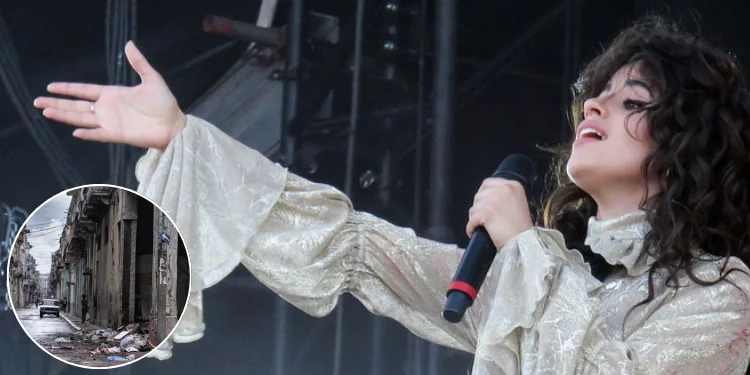
MIAMI, United States. – Cuban-Mexican and American singer Camila Cabello He denounced this Friday on his social networks the “deep humanitarian crisis” in Cuba after “67 years of a failed dictatorship and an oppressive regime.” Furthermore, the singer born on the Island assured that the Cuban people “are suffering in an echo chamber where no one can hear them because speaking is risking their lives.”
In the message, Cabello noted that he feels “a personal responsibility to speak about what is happening in Cuba,” and explained that he still maintains direct ties with the country. “I still have family on the Island that we talk to and to whom we send medicine, food and clothing,” he wrote.
The interpreter described a scenario marked by the shortage of basic products and medicines. “Many people are starving, searching for food in piles of garbage, and the only way to survive is to have relatives send you boxes of medicine because not even hospitals have medicine,” he said.
He also referred to prolonged blackouts and their consequences: “The electricity goes out for so long that food spoils and water becomes scarce.”
Cabello also denounced the repression against those who demonstrate peacefully. “When people have protested peacefully, they have disappeared or been imprisoned, some as young as 13,” he said. In that context, he added: “This is a reality in which an online publication costs you your life.”
The singer stated that Cubans have lived “without dignity and without hope for too long” and linked that situation to irregular emigration. “No wonder so many Cubans have jumped into shark-infested waters, making boats out of tires and sticks and risking their lives for freedom,” he wrote.
At the beginning of the text, Cabello also alluded to the situation of the immigrant community in the United States. “There is so much happening here at home and so much that I could say about the heartbreaking things that the immigrant community is experiencing here in the United States,” he indicated, before referring to the Cuban reality.
Finally, the artist called to support the work of Caritas Cuba. “Now they are in the middle of a deep humanitarian crisis. (…) If you can donate, any contribution makes a difference,” he wrote.
The publication was accompanied by several images, including photographs of his childhood in Cuba and scenes that show material precariousness and repression.
Camila Cabello (Karla Camila Cabello Estrabao) was born on March 3, 1997 in Mexico Cityalthough she herself has assured which was in Cojímar, Havana. Daughter of a Cuban mother and Mexican father, she spent part of her childhood between the Island and Mexico. At the age of six he moved with his family to Miami, United States. The migratory experience and his Cuban roots have been recurring themes in his public statements and in part of his artistic work. Camila identifies as Cuban-Mexican and Cuban-American.
He achieved international notoriety in 2012 after participating in the television program The X Factor in the United States. Although she initially auditioned as a soloist, she was integrated into the female group Fifth Harmony, which became one of the most successful pop groups of the decade, with multiple platinum albums and international tours. Cabello remained in the group until December 2016, when he announced his departure to pursue a solo career.
As a soloist, he debuted with the album Camilla in 2018. The album included the single Havanawhich reached number one in several countries and became one of the biggest commercial successes of that year. The song, with clear references to his Cuban roots, consolidated his artistic identity and global projection. He later released the albums Romance (2019) and Family (2022).
Throughout his career he has received multiple awards and nominations, including Latin Grammy, American Music Awards and Billboard Music Awards. In addition to his musical career, he has participated in film projects, such as his leading role in the film Cinderella (2021).
Cabello has also intervened publicly in social and political issues, especially related to the immigrant community in the United States and the situation in Cuba.